
Applied physics/Electronics/Physics BS Physics 1 Semester/Term University Of Sargodha (UOS) 2023

Discussion
Ask a question about this paper, or help someone else with theirs. Answers are emailed to whoever asked.
No questions yet — be the first to ask.
More Applied physics papers
See all Applied physics BSSE/CS/IT 1 Semester/Term University Of Sargodha (UOS) 2018
Uploaded 1 year ago
Download ↓
Applied physics BSSE/CS/IT 1 Semester/Term University Of Sargodha (UOS) 2018
Uploaded 1 year ago
Download ↓
 Applied physics BSCS 1 Semester/Term University Of Sargodha (UOS) 2021
Uploaded 1 year ago
Download ↓
Applied physics BSCS 1 Semester/Term University Of Sargodha (UOS) 2021
Uploaded 1 year ago
Download ↓
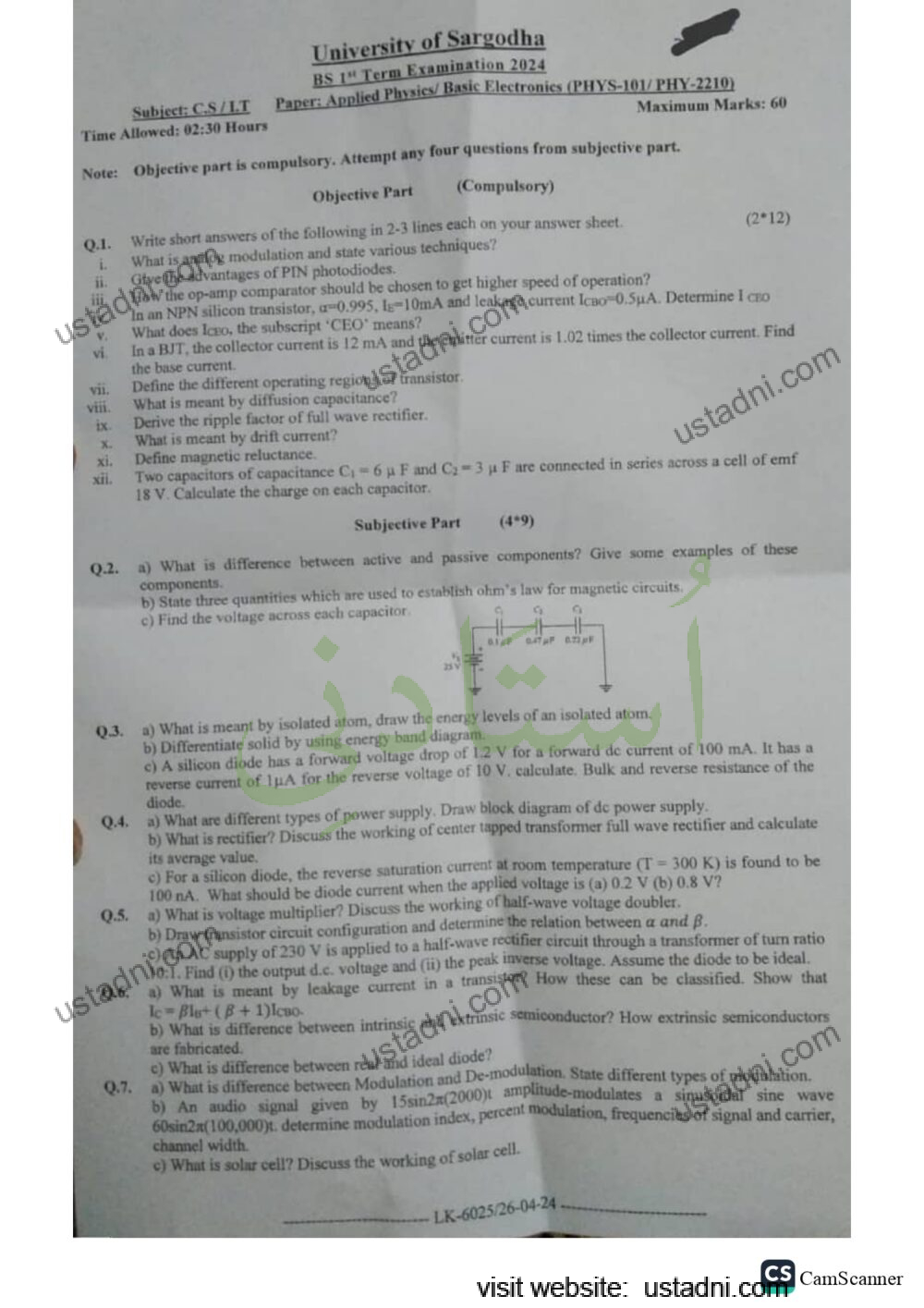 Applied physics/Basic Electronics/Electronics BS Physics 1 Semester/Term University Of Sargodha (UOS) 2024
Uploaded 1 year ago
Download ↓
Applied physics/Basic Electronics/Electronics BS Physics 1 Semester/Term University Of Sargodha (UOS) 2024
Uploaded 1 year ago
Download ↓
 Applied physics AD/BS University Of Sargodha (UOS) 2015
Uploaded 1 year ago
Download ↓
Applied physics AD/BS University Of Sargodha (UOS) 2015
Uploaded 1 year ago
Download ↓
 Applied physics/Basic Electronics/Electronics BS Physics 1 Semester/Term University Of Sargodha (UOS) 2022
Uploaded 1 year ago
Download ↓
Applied physics/Basic Electronics/Electronics BS Physics 1 Semester/Term University Of Sargodha (UOS) 2022
Uploaded 1 year ago
Download ↓
Paper text
University of Sargodha
BS 1" Term Examination 2023
Paper: Applied Physics/Rasic Electronics (PHYS-101/PHY-2210)
Subject: CS/IT
Time Allowed: 02:30 Hours
Maximum Marks: 60
Note: Objective part is compulsory, Attempt any four questions from subjective part.
Objective Part
(Compulsory)
Q.1. Write short answers of the following in 2-3 lines each on your answer sheet.
-
i.
(2*12)
What is chalog modulation and state various techniques?
r
i.
Give the advantages of PIN photodiodes.
How the op-amp comparator should be chosen to get higher speed of operation?
In an PN silicon transistor, u=0.995, le=10mA and leakage current IcRo=0.54A. Determine 1 cEO "
What does Iceo, the subscript 'CEO' means?
Avi.
In a BJT, the collector current is 12 meland the emiter current is 1.02 times the collector current. Find yo my
,
vii.
will.
ix.
• X.
Ai.
exii.
Define the different operating regions of transistor.
What is meant by diffusion capacitance?
Derive the ripple factor of full wave rectifier. :
ustadni.
What is meant by drift current?
Define magnetic reluctance.
Two capacitors of capacitance C, = 6 u F and C = 3 je Fare connected in series across a cell of emf 18 V.
Calculate the charge on each capacitor.
Q.2.
Subjective Part
a) What is difference between active and passive components? Give some examples of these components.
b) State three quantities which are used to establish Ohm's law for magnetic circuits.
c) Find the voltage across each capacitor.
C,
0.1 48
0L.47 pF
022 pl
Q.3.
a) What is meant by isolated alom, draw the energy levels of an isolated atom.
b) Differentiate solid by using energy band diagram.
c) A silicon diode has a forward voltage drop of 1.2 V for a forward do current of 100 mA. It has a reverse
current of luA for the reverse voltage of 10 V. calculate. Bulk and reverse resistance of the diode.
0.4.
a) What are different types of power supply. Draw block diagram of de power supply.
b) What is rectifier? Discuss the working of center tapped transformer full wave rectifier and calculate its
average value.
c) For a silicon diode, the reverse saturation current at room temperature (T = 300 K) is found to be
100 nA. What should be diode current when the applied voltage is
(a) 0.2 V
(b) 0.8 V?
a) What is voltage multiplier? Discuss the working of half-wave voltage doubler.
b) Draw transistor circuit configuration and determine the relation between a and B.
c) An AC supply of 230 V is applied to a half-wave rectifier circuit through a transformer of tum ratio 10:1.
Find
(i) the putput d.c. voltage and
(ii) the peak inverse voltage. Assume the diode to be ideal.
Q.6.
a) Whathis meant by leakage current in a transistor? How these can be classified.
ustadr
phew that Ic = Slat (8 +
1) Ico.
'b) What is difference between intrinsic and extrinsic afpiconductor? How extrinsic semiconductors are
fabricated.
c) What is difference between real and ideal diode?
Q.7.
a) What is difference between Modulationtand De-modulation? State different types of modulation.
b) An audio signal given by 15sin2 amplitude-modulates a sinussidal sine wave wave M
determine modulation index, percent modulation, frequencies of signal and carrier, chamel with
c) What is solar cell? Discuss the working of solar cell.
usta
- LK-602S/02-06-23
Scanned with CamScanner
Scapned with CamScanner
visit website: ustadni.com