
Design and Analysis Algorithm BS 4 Semester/Term University Of Sargodha (UOS) 2023
Discussion
Ask a question about this paper, or help someone else with theirs. Answers are emailed to whoever asked.
No questions yet — be the first to ask.
More Design and Analysis Algorithm papers
See all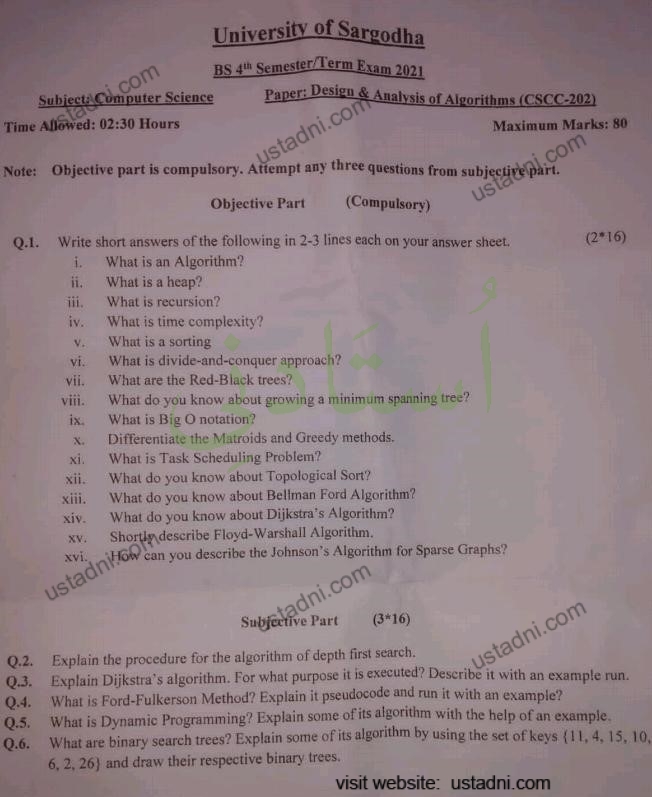 Design and Analysis Algorithm BS/MS Computer Science/MSc Computer Science 4 Semester/Term University Of Sargodha (UOS) 2021
Uploaded 3 years ago
Download ↓
Design and Analysis Algorithm BS/MS Computer Science/MSc Computer Science 4 Semester/Term University Of Sargodha (UOS) 2021
Uploaded 3 years ago
Download ↓
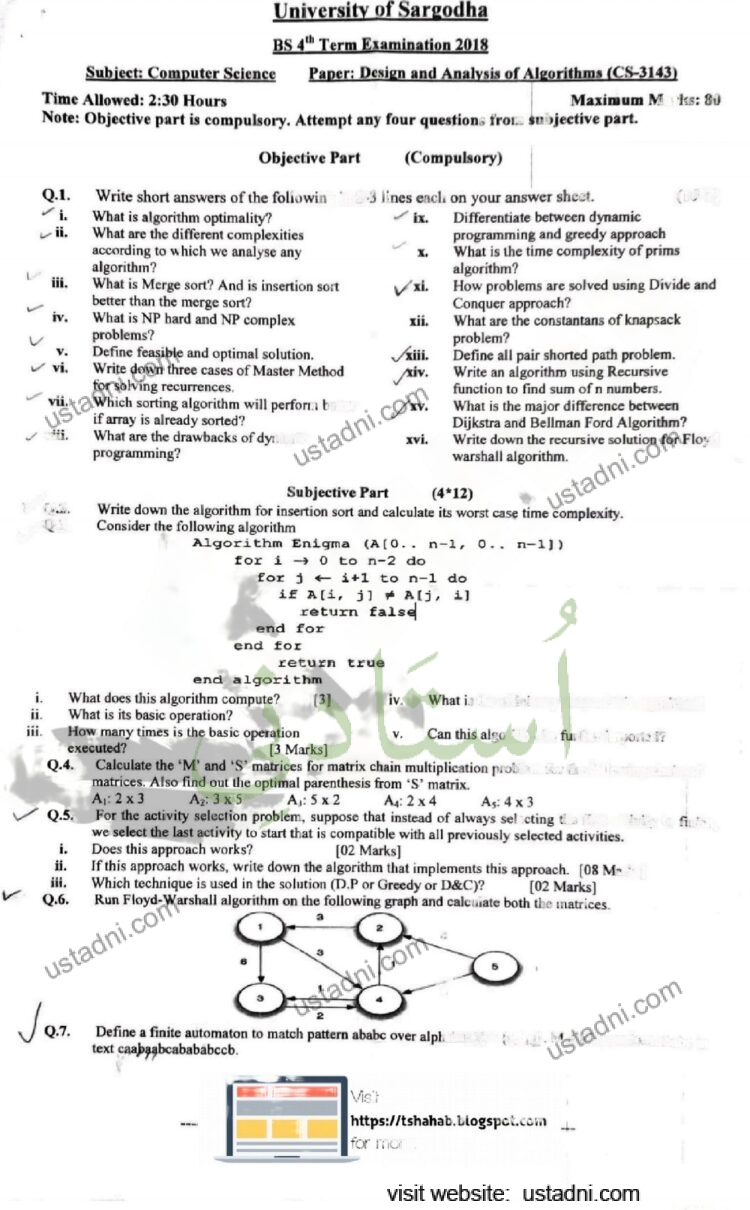 Design and Analysis Algorithm BS/MPhil Computer Science/MS Computer Science 4 Semester/Term University Of Sargodha (UOS) 2018
Uploaded 3 years ago
Download ↓
Design and Analysis Algorithm BS/MPhil Computer Science/MS Computer Science 4 Semester/Term University Of Sargodha (UOS) 2018
Uploaded 3 years ago
Download ↓
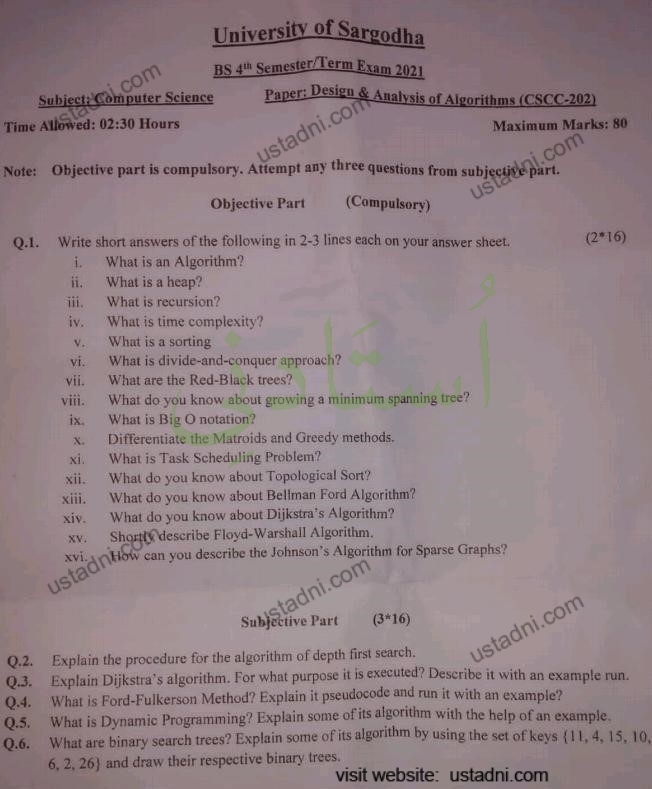 Design and Analysis Algorithm BSCS 2021 UOS
Uploaded 3 years ago
Download ↓
Design and Analysis Algorithm BSCS 2021 UOS
Uploaded 3 years ago
Download ↓
 Design and Analysis Algorithm BSCS 2015 UOS
Uploaded 3 years ago
Download ↓
Design and Analysis Algorithm BSCS 2015 UOS
Uploaded 3 years ago
Download ↓
 Design and Analysis of Algorithm BSCS 2014 Mid Term UOS
Uploaded 3 years ago
Download ↓
Design and Analysis of Algorithm BSCS 2014 Mid Term UOS
Uploaded 3 years ago
Download ↓
 Design and Analysis of Algorithm MSC IT 2015 UOS
Uploaded 3 years ago
Download ↓
Design and Analysis of Algorithm MSC IT 2015 UOS
Uploaded 3 years ago
Download ↓
Paper text
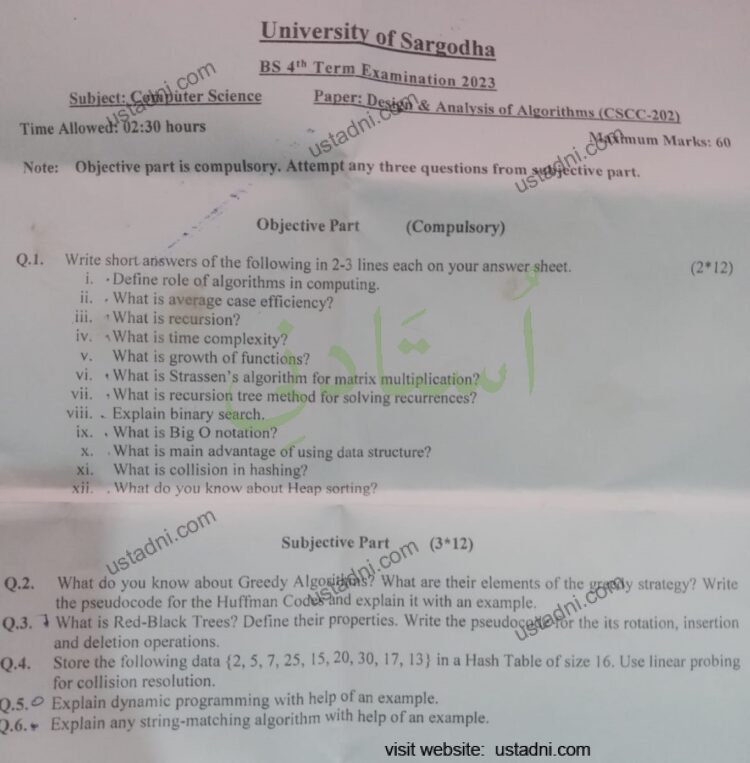
University of Sargodha
Subject:
com
emputer Science
Time Allowed: 02:30 hours
BS 4** Term Examination 2023
Paper: Design & Analysis of Algorithms (CSCC-202)
ustadni.
Joimum Marks: 60
Note: Objective part is compulsory. Attempt any three questions from
wastetive part.
Objective Part
(Compulsory)
Q.1.
Write short answers of the following in 2-3 lines each on your answer sheet.
(2*12)
i. - Define role of algorithms in computing.
ii. What is average case efficiency?
iii. + What is recursion?
iv. What is time complexity?
V. What is growth of functions?
vi. « What is Strassen's algorithm for matrix multiplication?
Vil. + What is recursion tree method for solving recurrences?
vili. - Explain binary search.
ix. . What is Big O notation?
x. What is main advantage of using data structure?
XI.
What is collision in hashing?
xii.
• What do you know about Heap sorting?
ustadni.com
Subjective Part
0.2.
the pseudocode for the Huffiman Codes ind explain it with an example.
0.3. 7 What is Red-Black Trees? Define their properties. Write the pseudoggte for the its rotation, insertion
and deletion operations.
Q.4.
Store the following data (2, 5, 7, 25, 15, 20, 30, 17,
13) in a Hash Table of size
16. Use linear probing
for collision resolution.
Q.5.O Explain dynamic programming with help of an example.
2.6.+ Explain any string-matching algorithm with help of an example.
visit website: ustadni.com