
Design and Analysis of Algorithm BS University Of Sargodha (UOS) 2023
Discussion
Ask a question about this paper, or help someone else with theirs. Answers are emailed to whoever asked.
No questions yet — be the first to ask.
More Design and Analysis of Algorithm papers
See all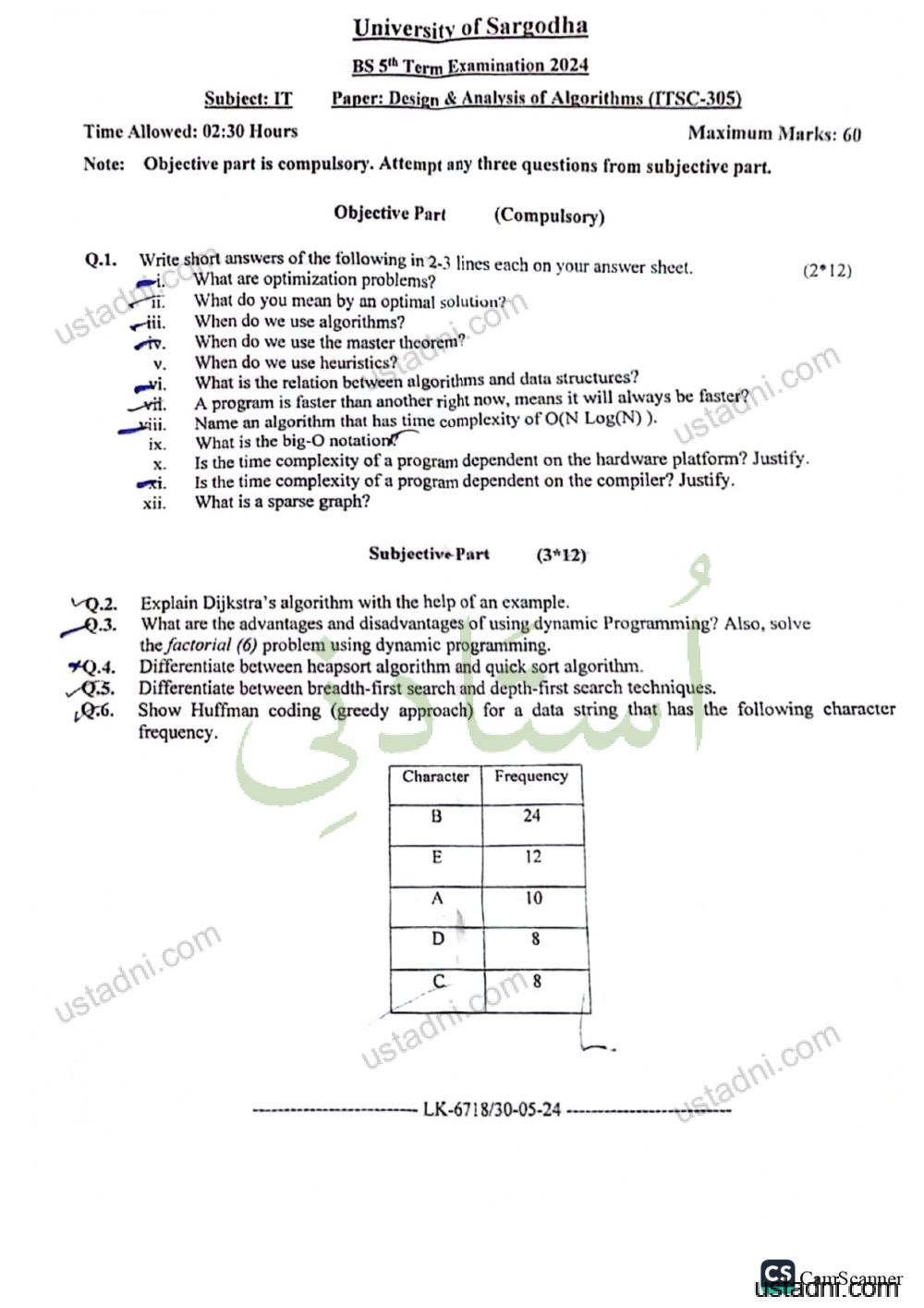 Design and Analysis of Algorithm BS 5 Semester/Term University Of Sargodha (UOS) 2024
Uploaded 1 year ago
Download ↓
Design and Analysis of Algorithm BS 5 Semester/Term University Of Sargodha (UOS) 2024
Uploaded 1 year ago
Download ↓
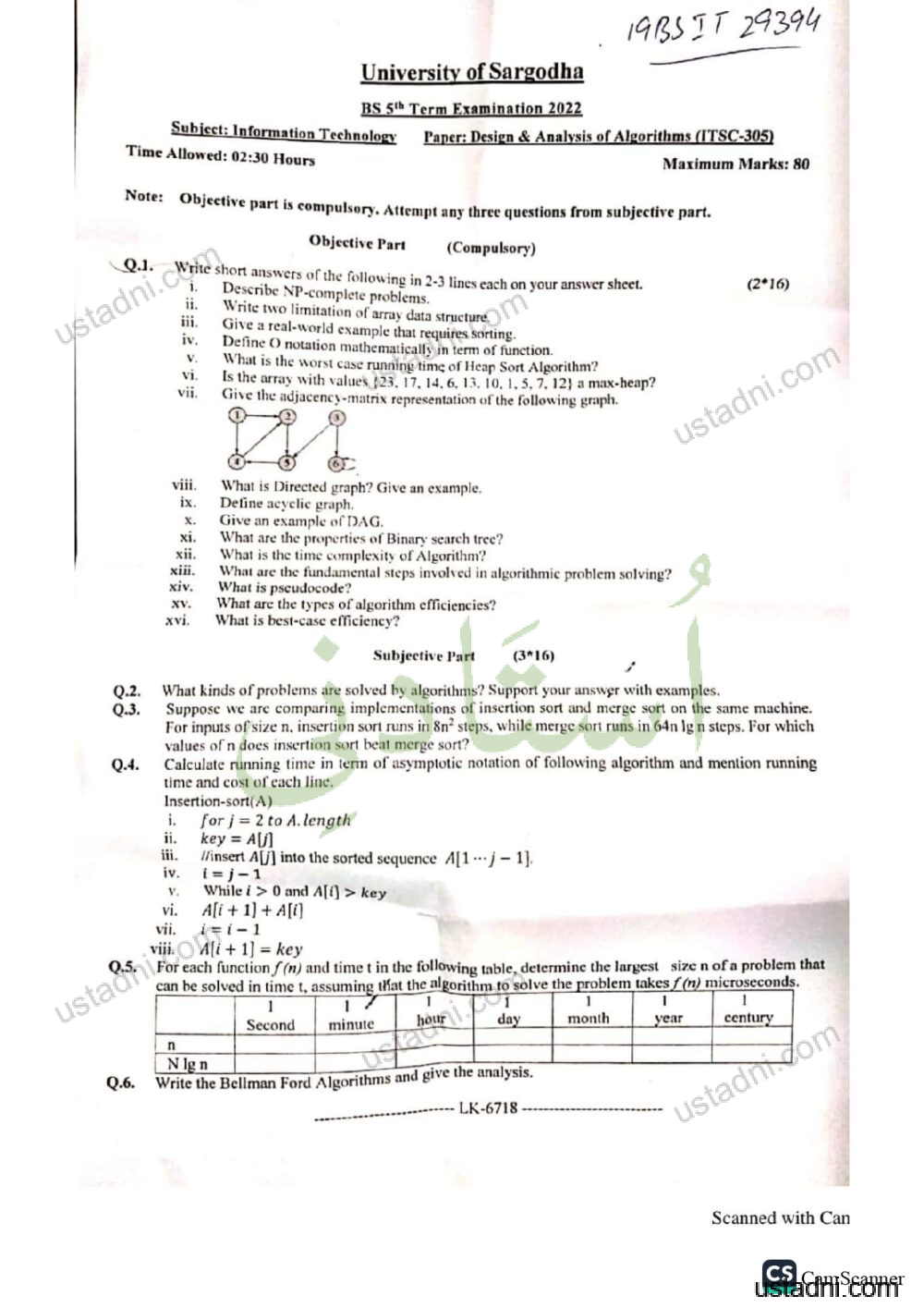 Design and Analysis of Algorithm BS/MPhil Information Technology/MS Information Technology 5 Semester/Term University Of Sargodha (UOS) 2022
Uploaded 1 year ago
Download ↓
Design and Analysis of Algorithm BS/MPhil Information Technology/MS Information Technology 5 Semester/Term University Of Sargodha (UOS) 2022
Uploaded 1 year ago
Download ↓
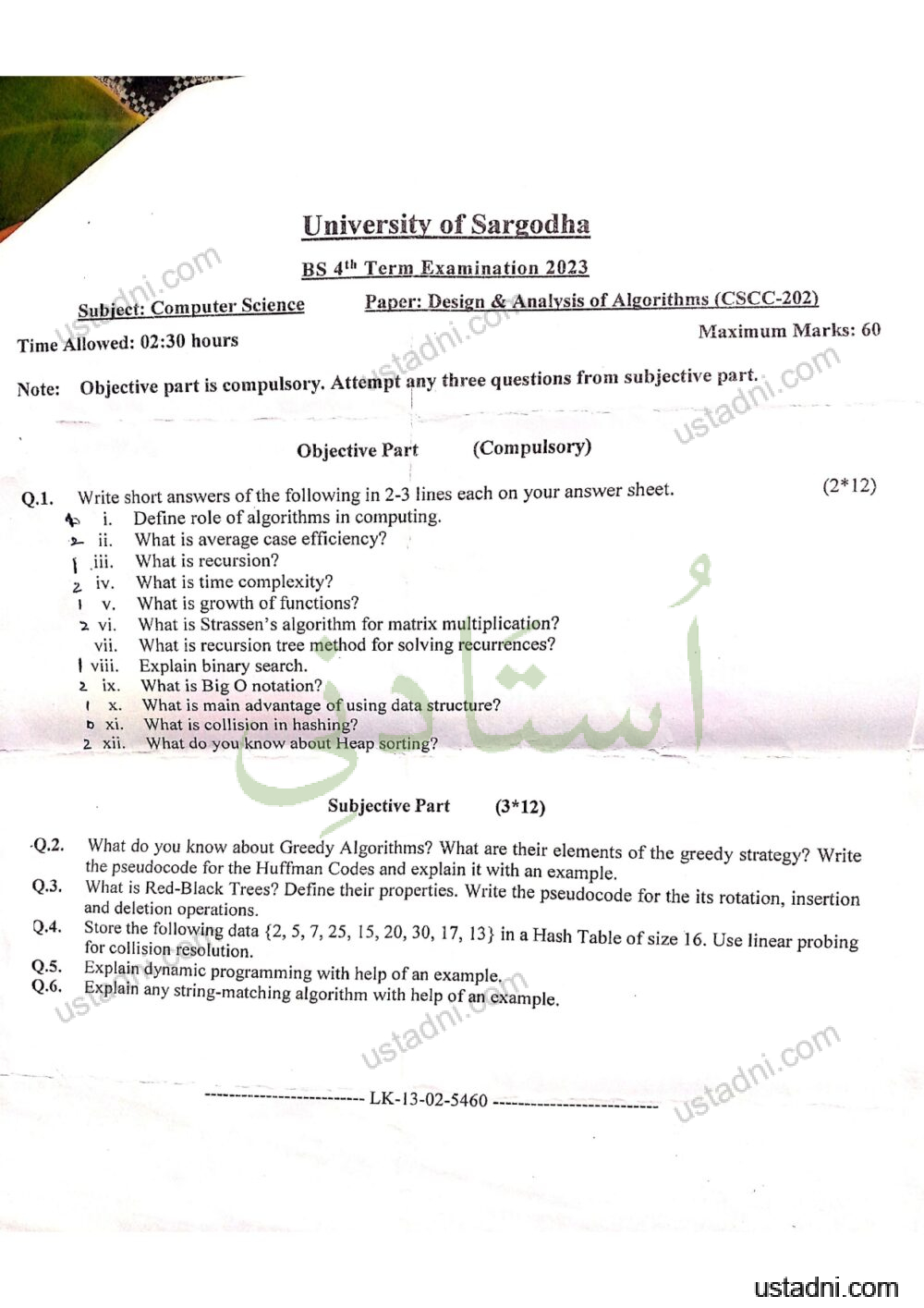 Design and Analysis of Algorithm BS/MPhil Computer Science/MS Computer Science 4 Semester/Term University Of Sargodha (UOS) 2023
Uploaded 1 year ago
Download ↓
Design and Analysis of Algorithm BS/MPhil Computer Science/MS Computer Science 4 Semester/Term University Of Sargodha (UOS) 2023
Uploaded 1 year ago
Download ↓
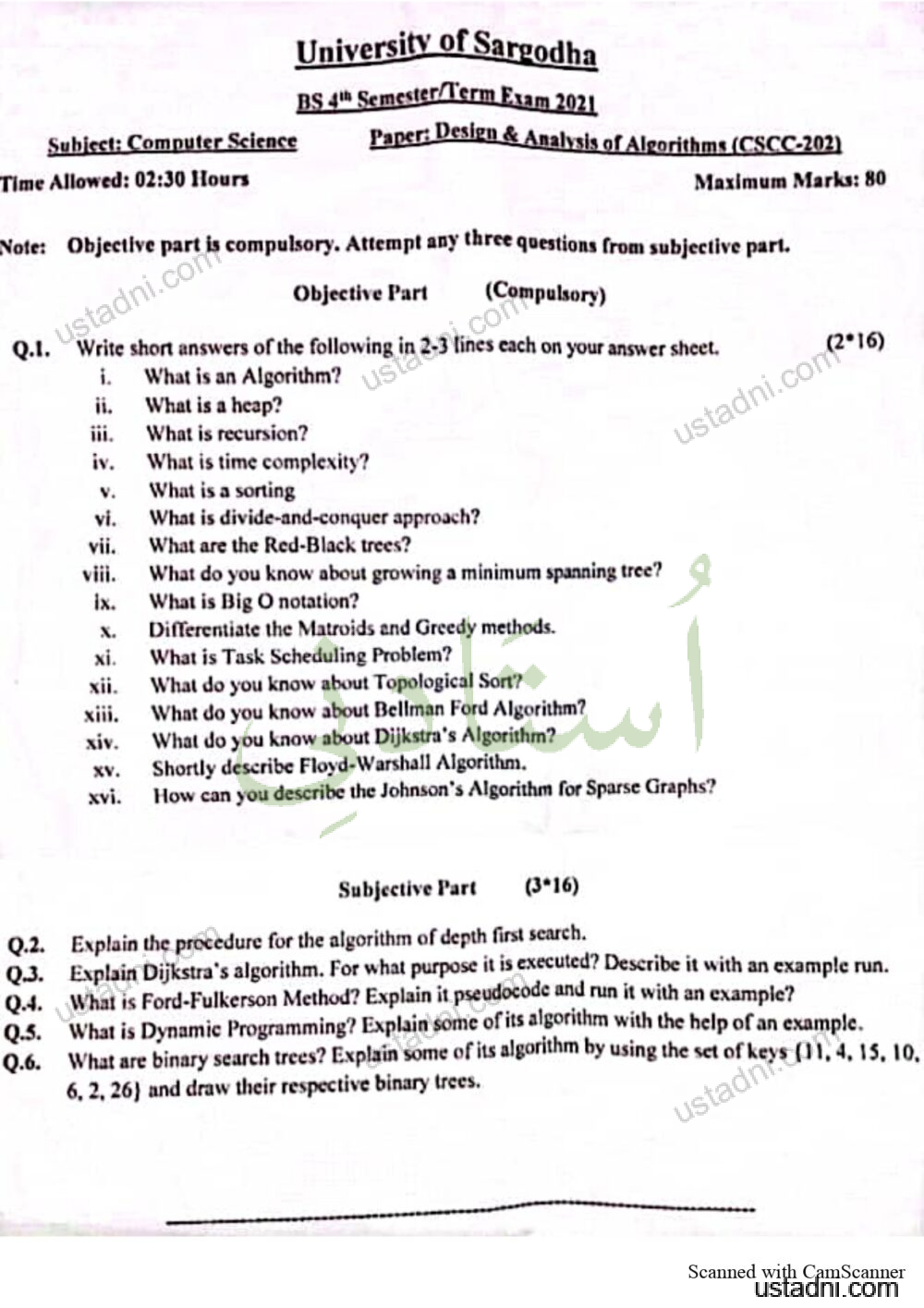 Design and Analysis of Algorithm BS/MPhil Computer Science/MS Computer Science 4 Semester/Term University Of Sargodha (UOS) 2021
Uploaded 1 year ago
Download ↓
Design and Analysis of Algorithm BS/MPhil Computer Science/MS Computer Science 4 Semester/Term University Of Sargodha (UOS) 2021
Uploaded 1 year ago
Download ↓
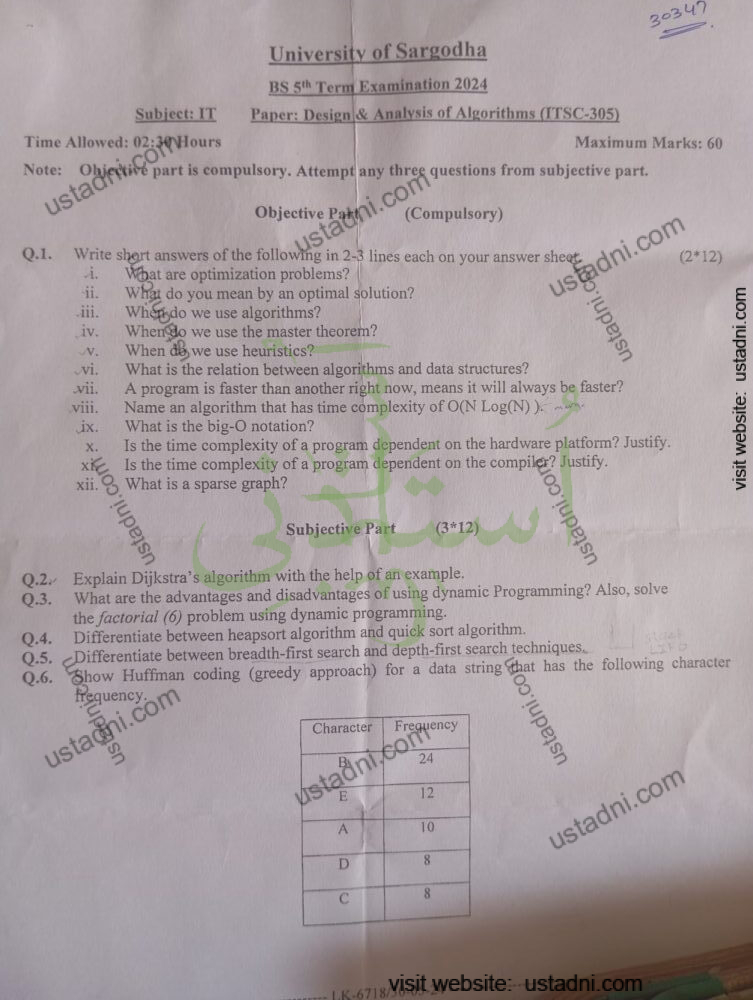 Design and Analysis of Algorithm BS 5 Semester/Term University Of Sargodha (UOS) 2024
Uploaded 2 years ago
Download ↓
Design and Analysis of Algorithm BS 5 Semester/Term University Of Sargodha (UOS) 2024
Uploaded 2 years ago
Download ↓
Paper text
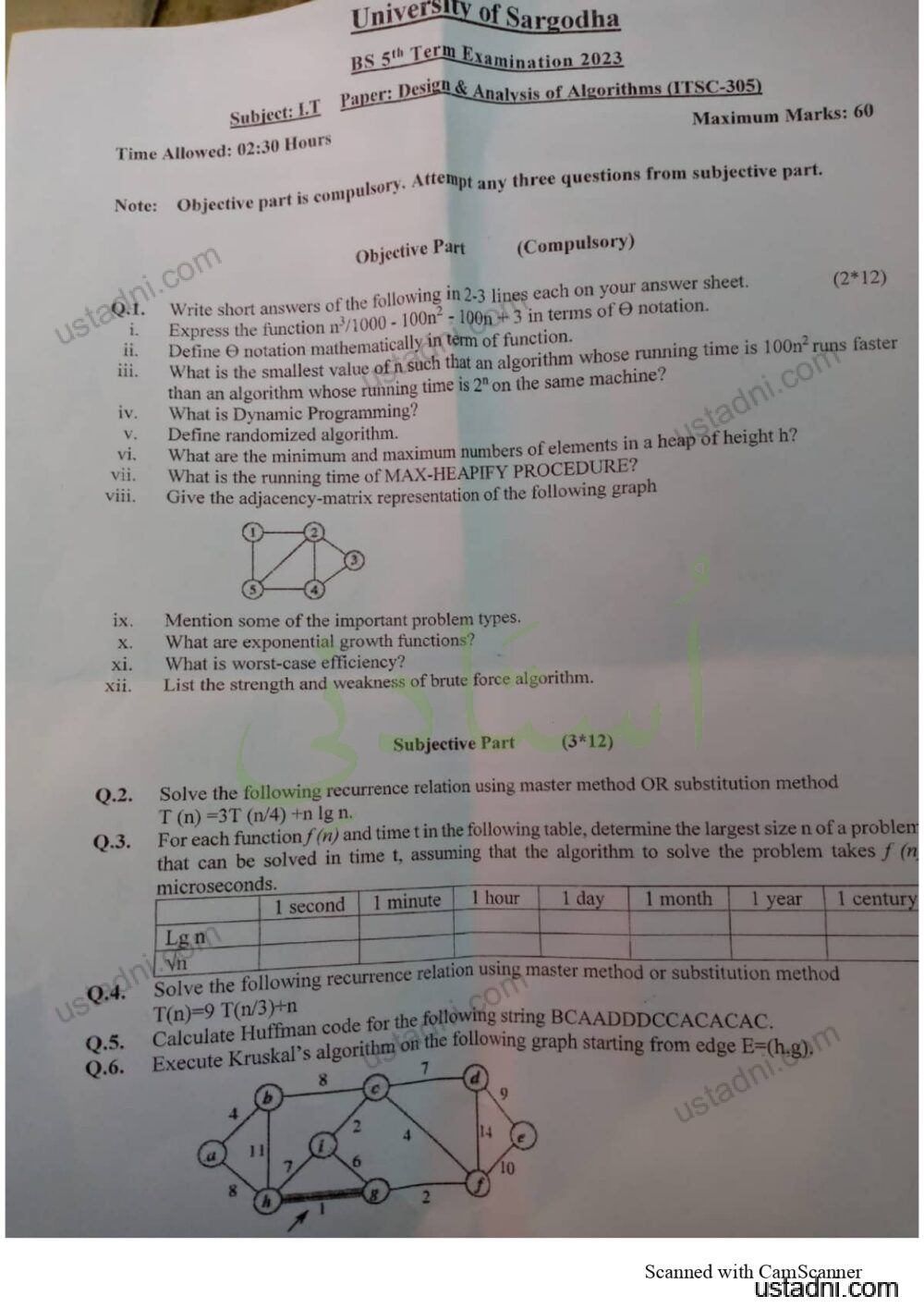
University of Sargodha
BS Sill Term Examination 2023
Subject: LT
Paper: Design & Analysis of Algorithms (ITSC-305)
Maximum Marks: 60
Time Allowed: 02:30 Hours
Note:
Objective part is compulsory. Affempt any three questions from subjective part.
usta@ni.com
Objective Part
(Compulsory)
Write short answers of the following in 2-3 lines each on your answer sheet.
(2*12)
Express the function n/1000 - 100n' - 100n+ 3 in terms of e notation.
H.
Define O notation mathematically in term of function.
ili.
What is the smallest value of n such that an algorithm whose running time is 100n? runs faster
than an algorithm whose running time is 2ª on the same machine?
iv.
V.
vi.
vii.
viii.
What is Dynamic Programming?
Define randomized algorithm.
istadni.com
What are the minimum and maximum numbers of elements in a heap of height h?
What is the running time of MAX-HEAPIFY PROCEDURE?
Give the adjacency-matrix representation of the following graph
ix.
X.
xi.
xii.
Q.2.
Q.3.
Q.5.
Q.6.
Mention some of the important problem types.
What are exponential growth functions?
What is worst-case efficiency?
List the strength and weakness of brute force algorithm.
Subjective Part
(3*12)
Solve the following recurrence relation using master method OR substitution method
T (n) =3T (n/4) +n Ig n.
For each function f (n) and time t in the following table, determine the largest size n of a problem
that can be solved in time t, assuming that the algorithm to solve the problem takes f (n
microseconds.
1 second
1 minute
1 hour
1 day
1 month
1 year
1 century
Lg n
Vn
Solve the following recurrence relation using master method or substitution method
T(n)=9 T(n/3)+n
Calculate Huffman code for the following string BCAADDDCCACACAC.
Execute Kruskal's algorithm on the following graph starting from edge B=(h.g),
00)
9
ustadni!
11
10
Scanned with CamScanne
ustadni con