
Differential Equation BS 3 Semester/Term University Of Sargodha (UOS) 2022
Discussion
Ask a question about this paper, or help someone else with theirs. Answers are emailed to whoever asked.
No questions yet — be the first to ask.
More Differential Equation papers
See all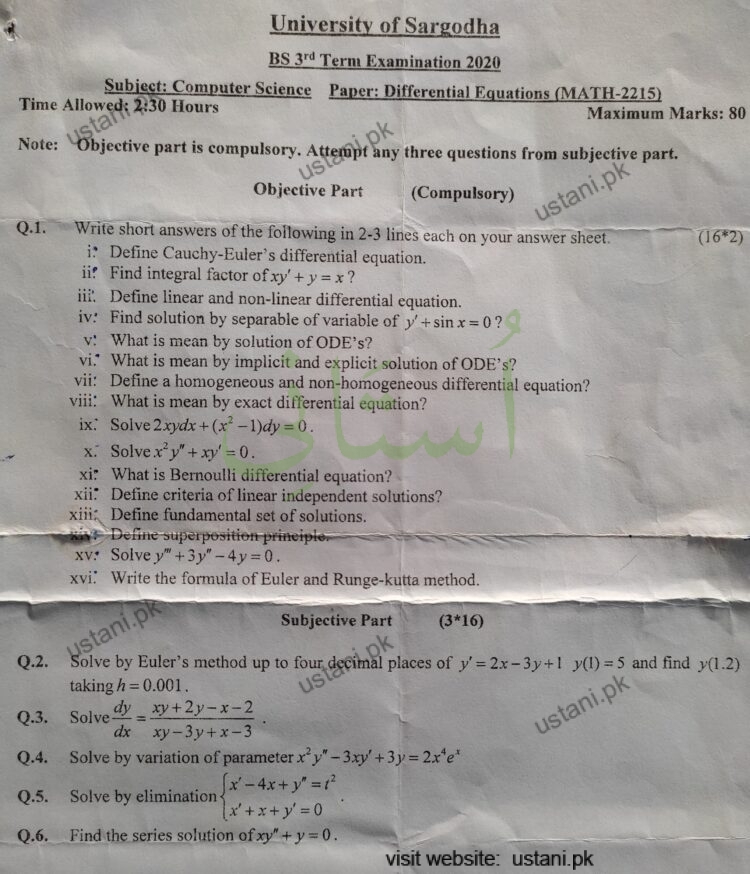 Differential Equation BS/MPhil Computer Science/MS Computer Science 3 Semester/Term University Of Sargodha (UOS) 2020
Uploaded 3 years ago
Download ↓
Differential Equation BS/MPhil Computer Science/MS Computer Science 3 Semester/Term University Of Sargodha (UOS) 2020
Uploaded 3 years ago
Download ↓
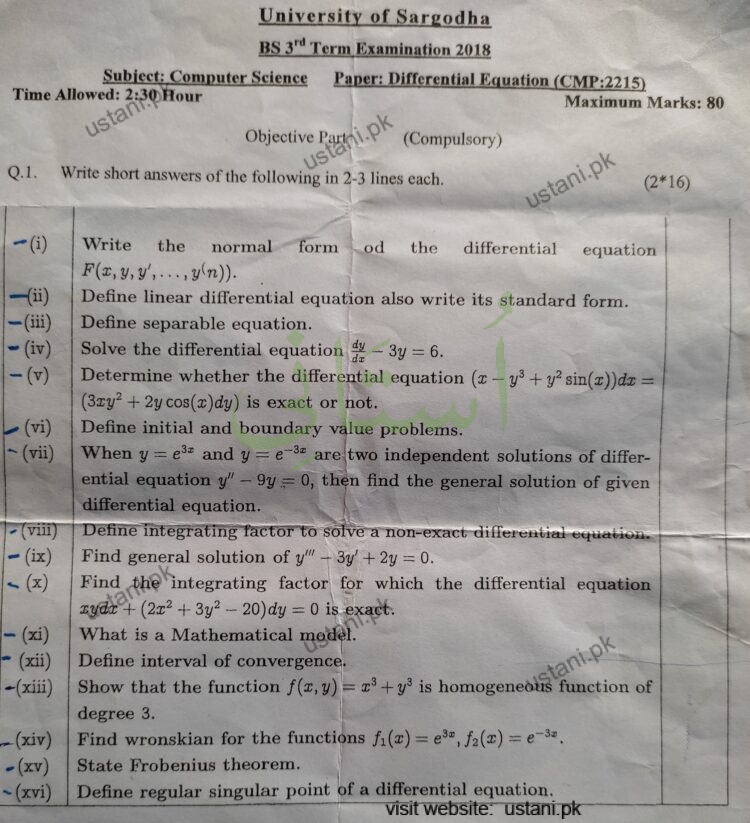 Differential Equation BS 3 Semester/Term UOS — University of Sargodha 2018
Uploaded 3 years ago
Download ↓
Differential Equation BS 3 Semester/Term UOS — University of Sargodha 2018
Uploaded 3 years ago
Download ↓
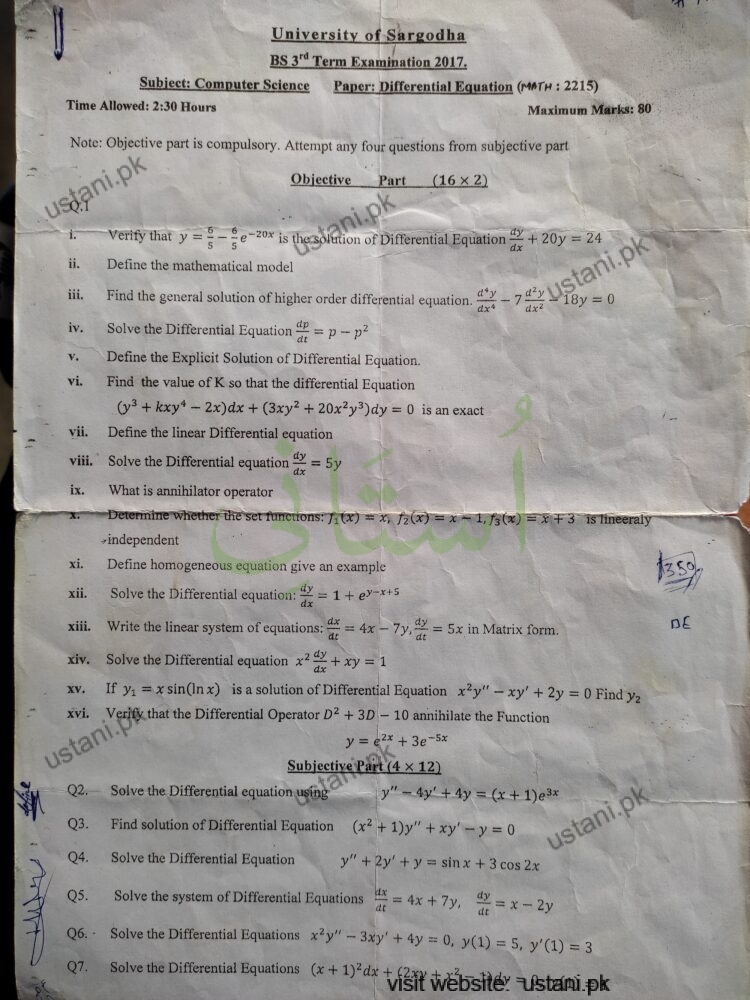 Differential Equation BS 3 Semester/Term UOS — University of Sargodha 2017
Uploaded 3 years ago
Download ↓
Differential Equation BS 3 Semester/Term UOS — University of Sargodha 2017
Uploaded 3 years ago
Download ↓
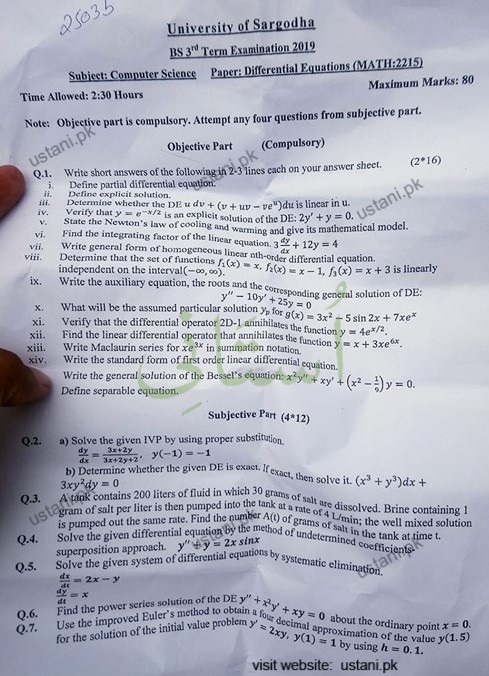 Differential Equation BSCS 2019 UOS
Uploaded 3 years ago
Download ↓
Differential Equation BSCS 2019 UOS
Uploaded 3 years ago
Download ↓
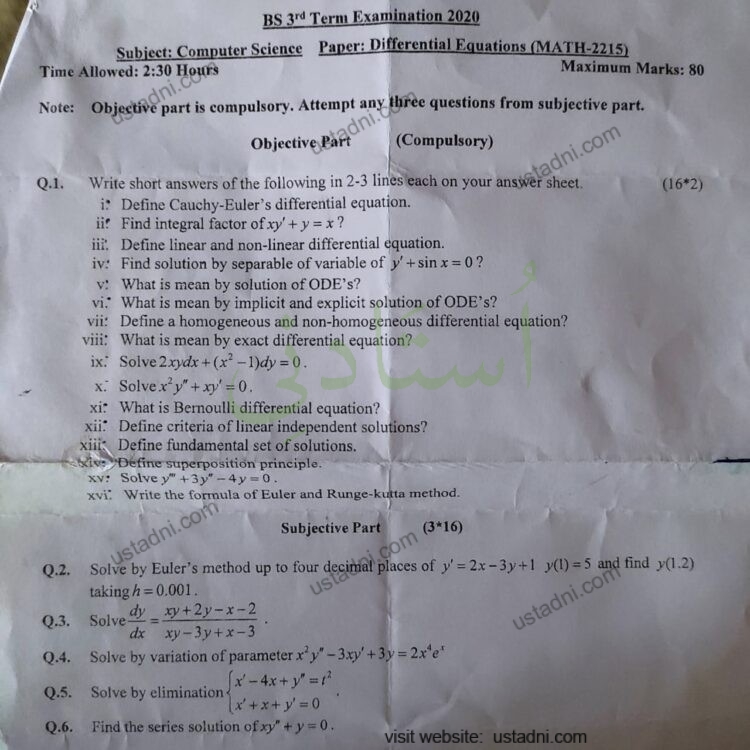 BS 3'd Term Examination 2020 Subject: Computer Science Paper: Differential Equations (MATH-2215) Time Allowed: 2:30 Hours Maximum Marks: 80
Uploaded 3 years ago
Download ↓
BS 3'd Term Examination 2020 Subject: Computer Science Paper: Differential Equations (MATH-2215) Time Allowed: 2:30 Hours Maximum Marks: 80
Uploaded 3 years ago
Download ↓
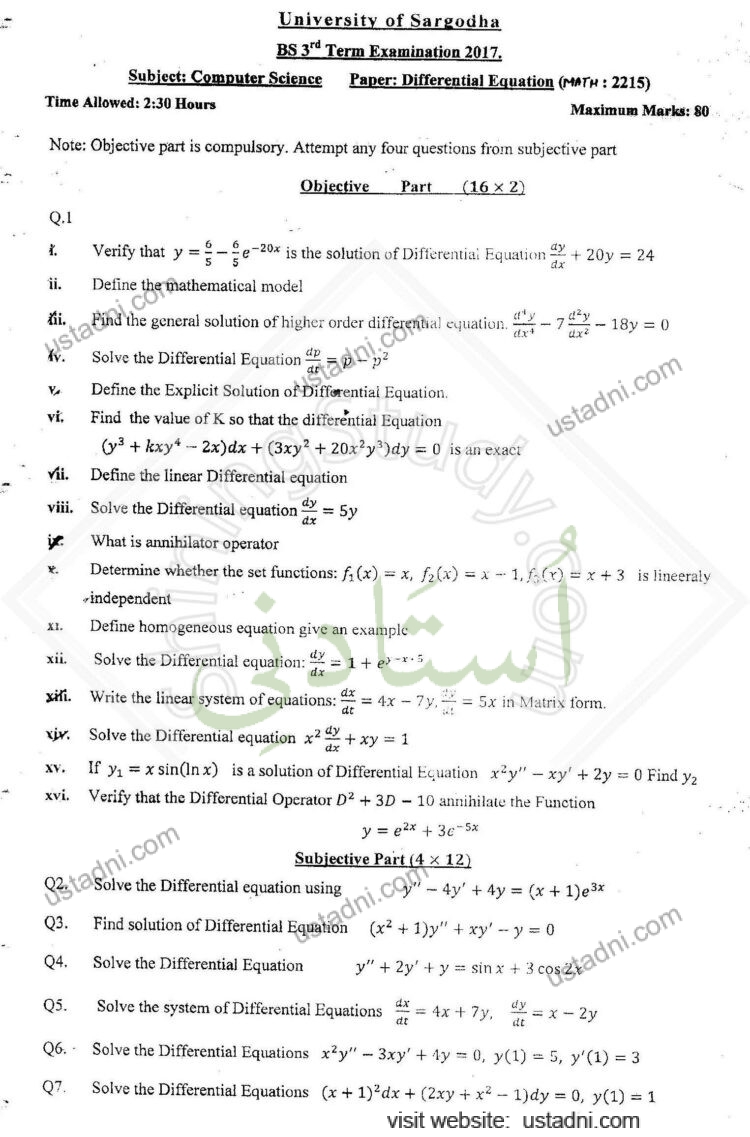 University of Sargodha BS 3*° Term Examination 2017. Subject: Computer Science Paper: Differential Equation (MATH: 2215) Time Allowed: 2:30 Hours
Uploaded 3 years ago
Download ↓
University of Sargodha BS 3*° Term Examination 2017. Subject: Computer Science Paper: Differential Equation (MATH: 2215) Time Allowed: 2:30 Hours
Uploaded 3 years ago
Download ↓
Paper text
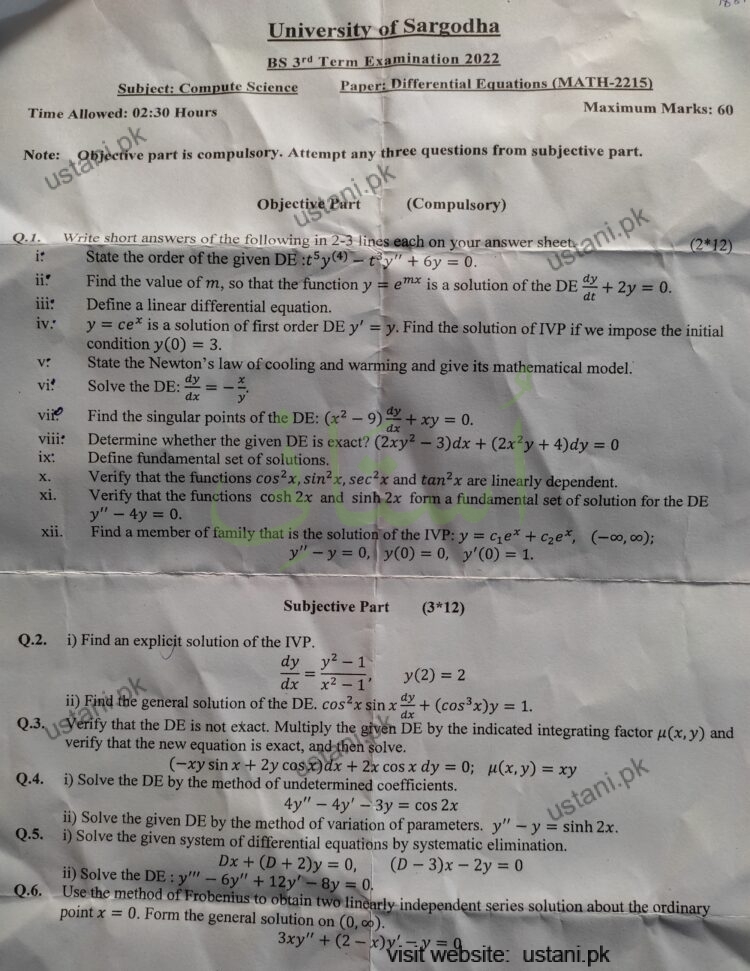
Subject: Compute Science
Time Allowed: 02:30 Hours
University of Sargodha
BS 3rd Term Examination 2022
Paper: Differential Equations (MATH-2215)
Maximum Marks: 60
USt Jective part is compulsory. Attempt any three questions from subjective part.
Objective Birt
(Compulsory)
Write short answers of the following in 2-3 lines each on your answer sheet ani ok
(2*12)
it
ii"
iii:
iv:
State the order of the given DE:ty (4) - ty" + 6y =
0.
Find the value of m, so that the function y = emx is a solution of the DE ay + 2y =
0.
Define a linear differential equation.
y = ce* is a solution of first order DE y' = y. Find the solution of IVP if we impose the initial
condition y (0) =
3.
V:
vi!
vil?
viii:
ix:
X.
Xi.
State the Newton's law of cooling and warming and give its mathematical model.
Solve the DE: dy = _*
Find the singular points of the DE: (x? - 9)dy + xy =
0.
Determine whether the given DE is exact? (2xy? - 3)dx + (2x'y + 4)dy = 0
Define fundamental set of solutions.
Verify that the functions cos'x, sin?x, sec? and tan? x are linearly dependent.
Verify that the functions cosh 2x and sinh 2x form a fundamental set of solution for the DE
y" - 4y =
0.
xii.
Find a member of family that is the solution of the IVP: y = ge* + cze*, (-00,00);
y" - y = 0, y(0) = 0, y'(O) =
1.
Subjective Part
(3*12)
Q.2.
i) Find an explicit solution of the IVP.
y2-1
=
dx
x2 - 1'
y (2) = 2
il) Find the general solution of the DE. cos x sin x"y+ (cos?)y =
1.
0.3. Verify that the DE is not exact. Multiply the giyén DE by the indicated integrating factor u(x, y) and
verify that the new equation is exact, and then solve.
Q.4.
(-xy sin x + 2y cost)dx + 2x cos x dy = 0; u(x, y) = xy
i) Solve the DE by the method of undetermined coefficients.
4y" - 4y' - 3y = cos 2x
ustani.pk
i Solve the given DE by the method of variation of parameters. y" - y = sinh 2x.
Q.5. i Solve the given system of differential equations by systematic elimination.
Dx + (D + 2)y = 0,
0.6.
il) Solve the DE: y'" - 6y" + 12y - 8y =
0.
(D - 3)x - 2y = 0
Use the method of Frobenius to obtain two linearly independent series solution about the ordinary
point x =
0. Form the general solution on (0, co).
3xy" + (2 - x)y.
Visit website: ustani.pk