
Discrete Structures University Of Sargodha (UOS) 2025
Discussion
Ask a question about this paper, or help someone else with theirs. Answers are emailed to whoever asked.
No questions yet — be the first to ask.
More Discrete Structures papers
See all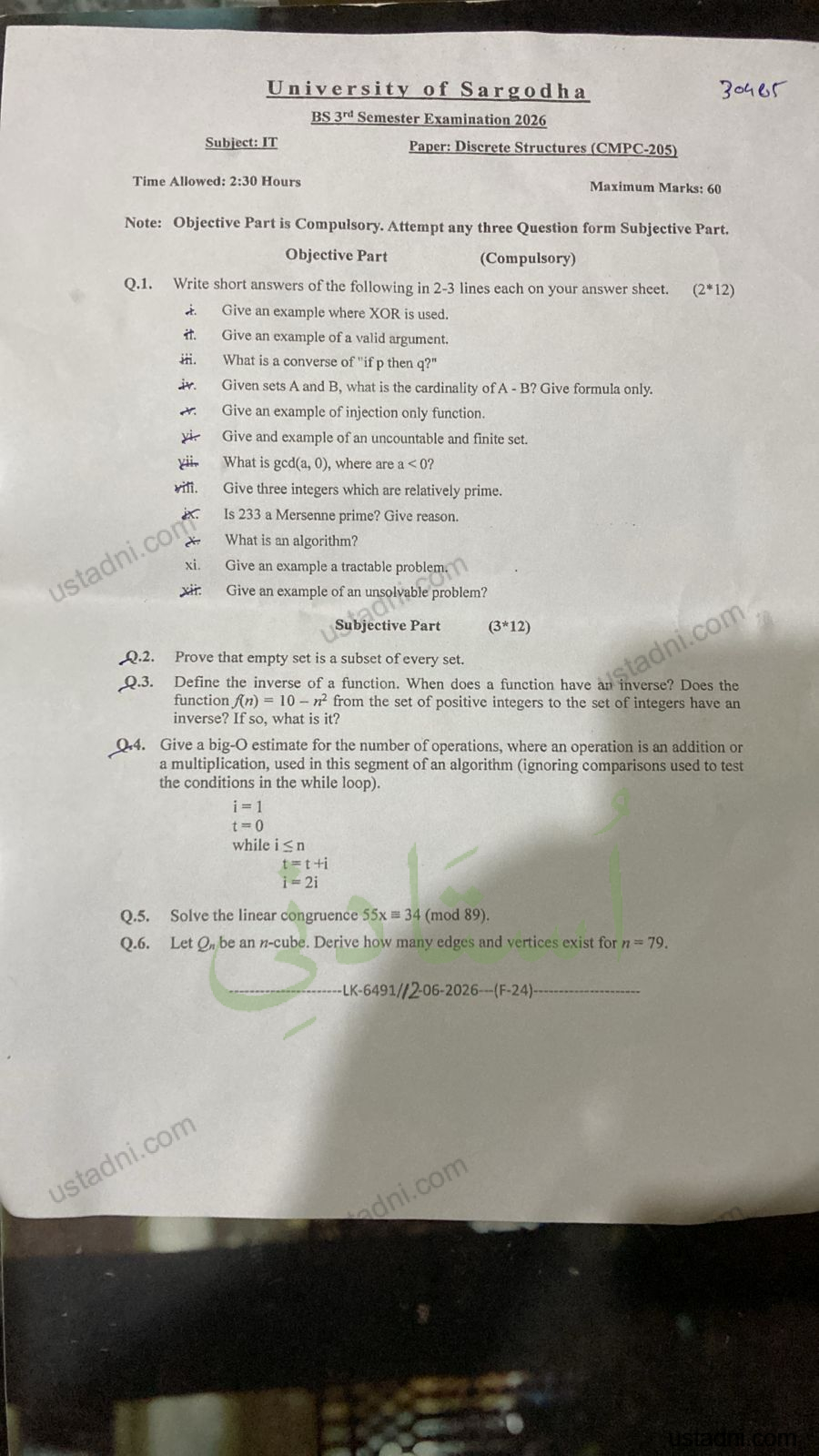 Discrete Structures BS 3 Semester/Term University Of Sargodha (UOS) 2026
Uploaded 3 months ago
Download ↓
Discrete Structures BS 3 Semester/Term University Of Sargodha (UOS) 2026
Uploaded 3 months ago
Download ↓
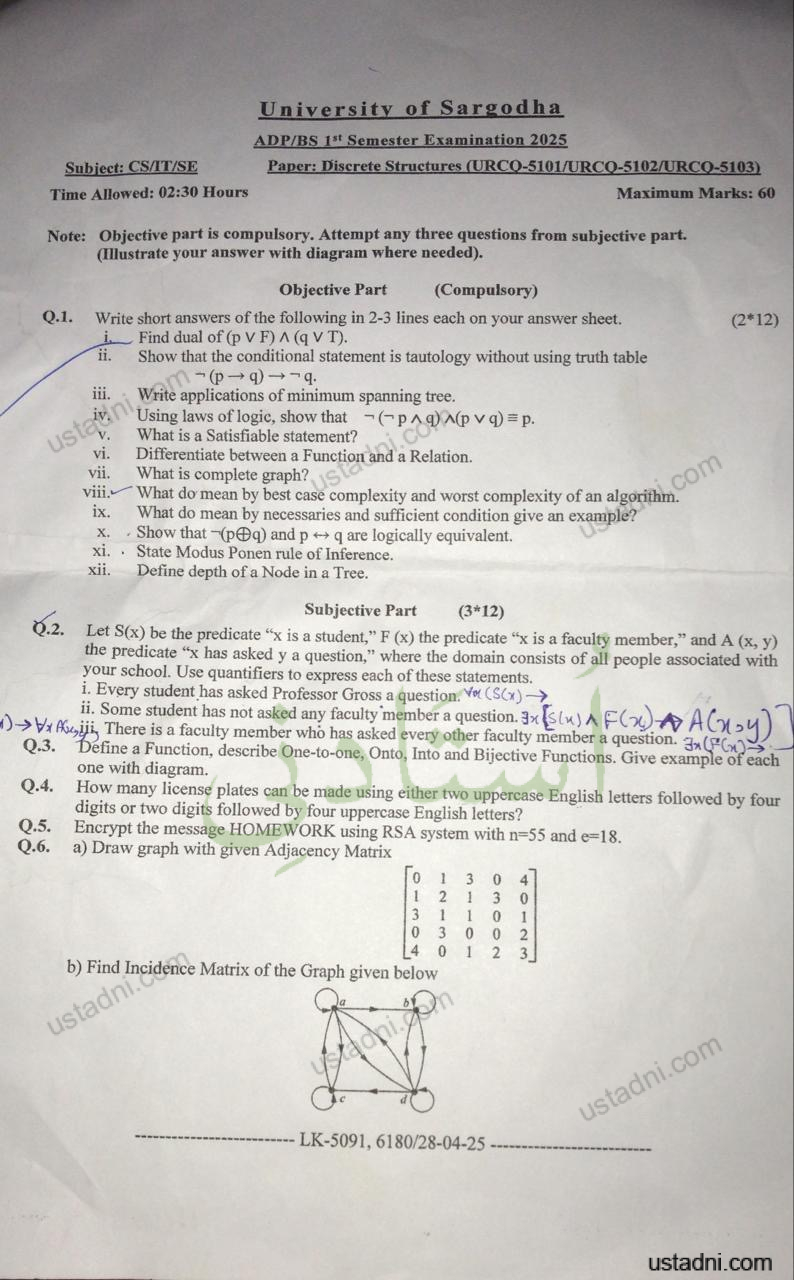 Discrete Structures (URCO-5101/URCO-5102/URCO-5103)- Subject: CS/IT/SE UOS - ADP/BS 1st Semester Examination 2025
Uploaded 9 months ago
Download ↓
Discrete Structures (URCO-5101/URCO-5102/URCO-5103)- Subject: CS/IT/SE UOS - ADP/BS 1st Semester Examination 2025
Uploaded 9 months ago
Download ↓
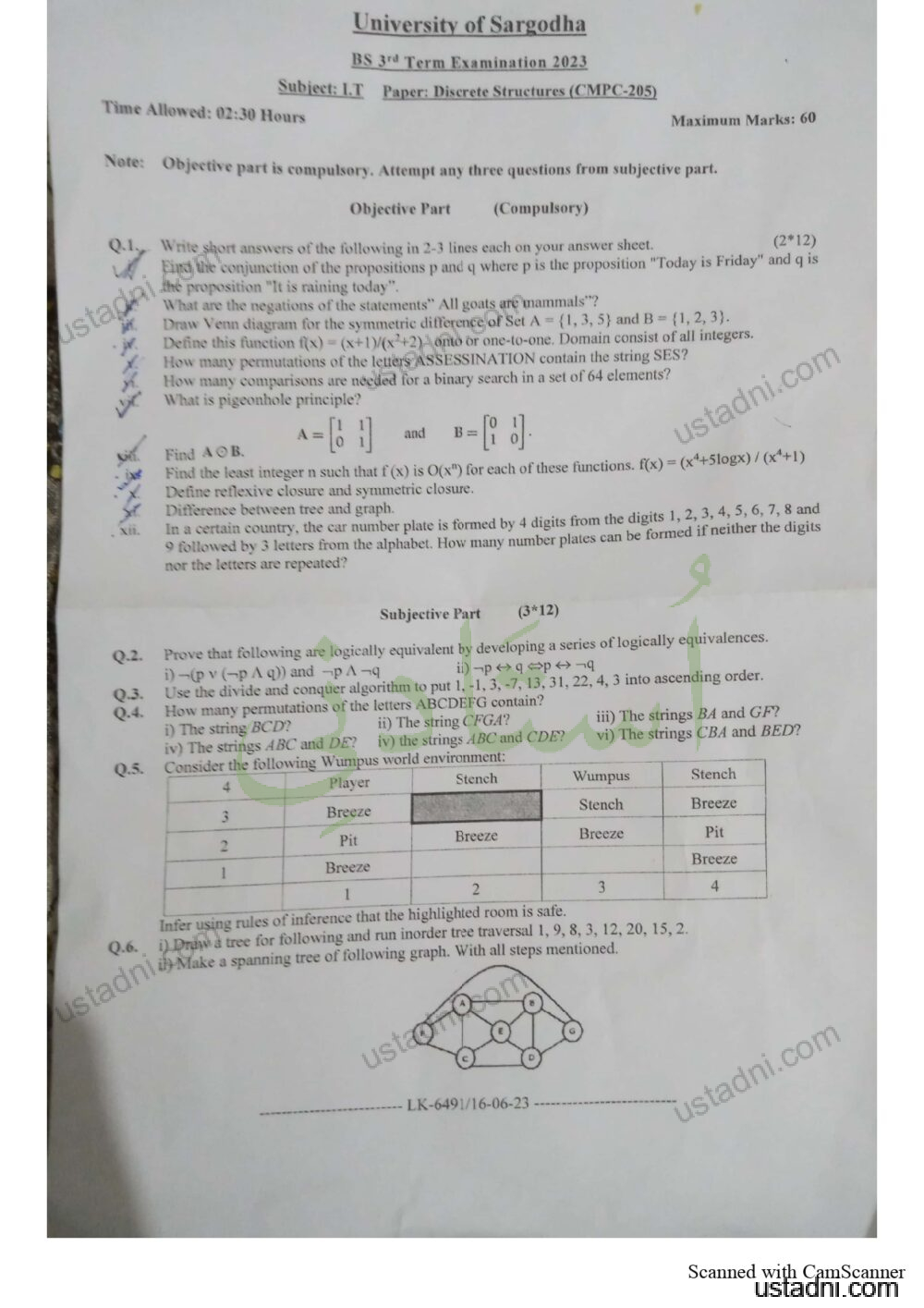 Discrete Structures B.ED/BS 3 Semester/Term University Of Sargodha (UOS) 2023
Uploaded 1 year ago
Download ↓
Discrete Structures B.ED/BS 3 Semester/Term University Of Sargodha (UOS) 2023
Uploaded 1 year ago
Download ↓
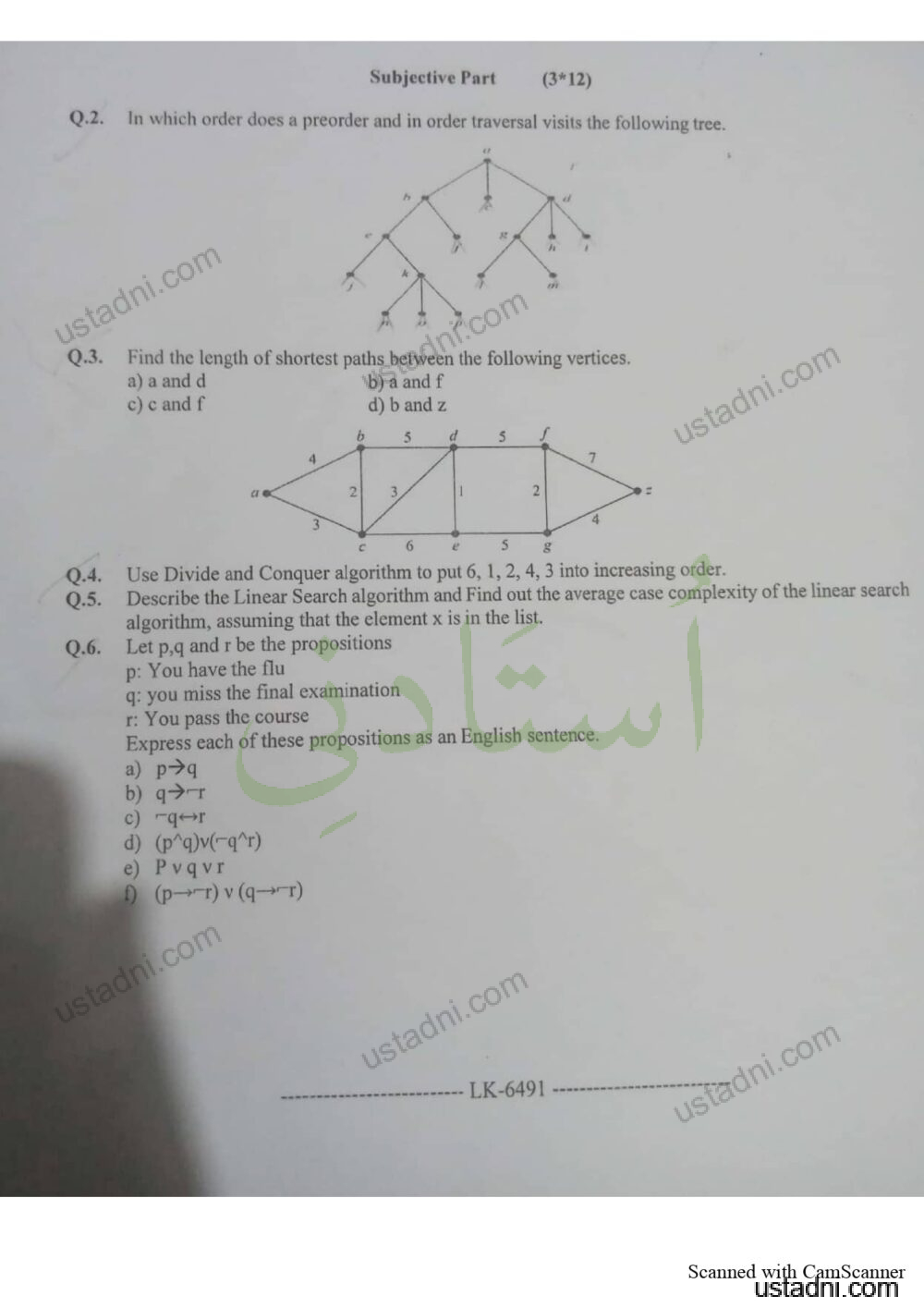 Discrete Structures BSIT University Of Sargodha (UOS) 2022
Uploaded 1 year ago
Download ↓
Discrete Structures BSIT University Of Sargodha (UOS) 2022
Uploaded 1 year ago
Download ↓
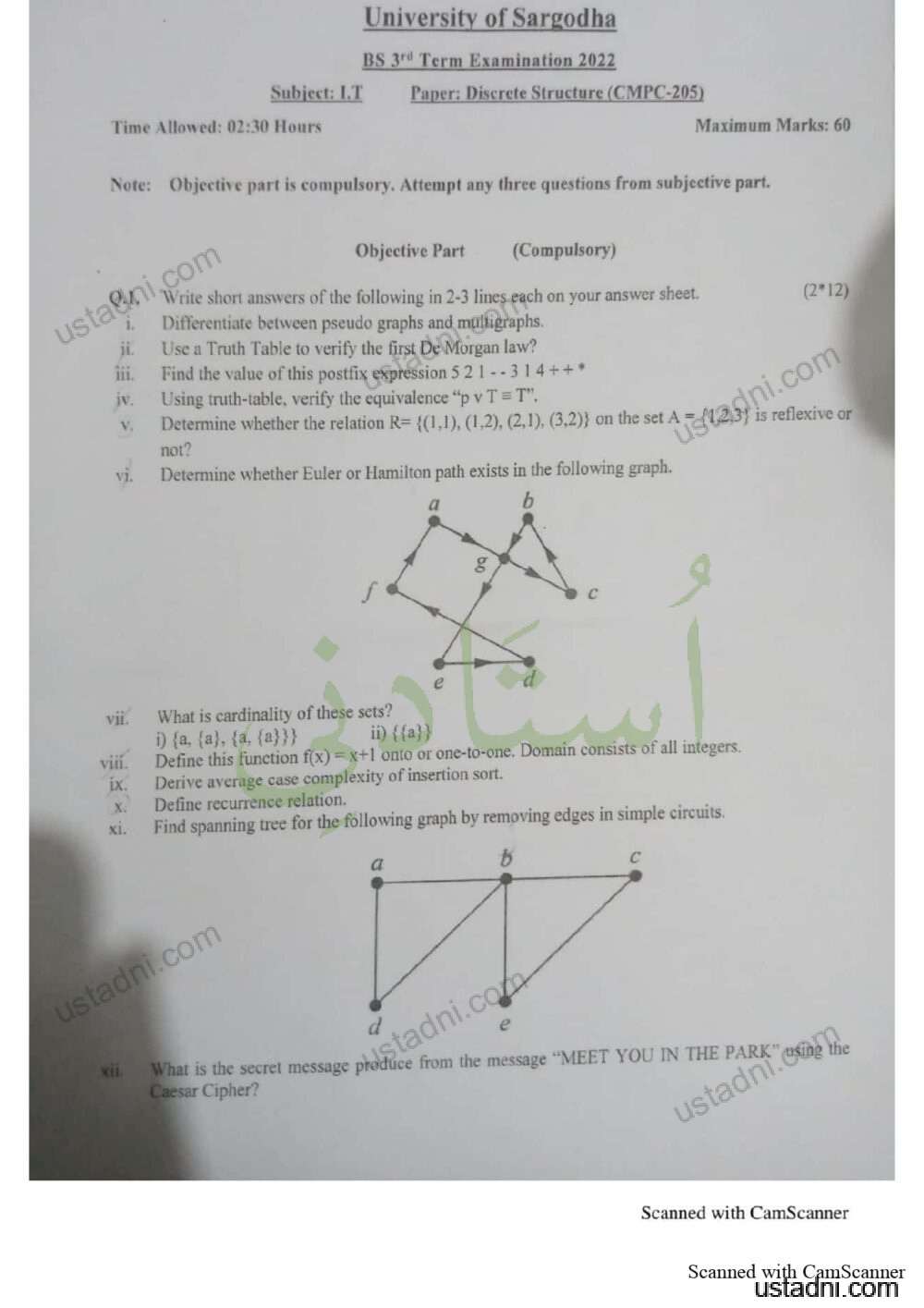 Discrete Structures BS 3 Semester/Term University Of Sargodha (UOS) 2022
Uploaded 1 year ago
Download ↓
Discrete Structures BS 3 Semester/Term University Of Sargodha (UOS) 2022
Uploaded 1 year ago
Download ↓
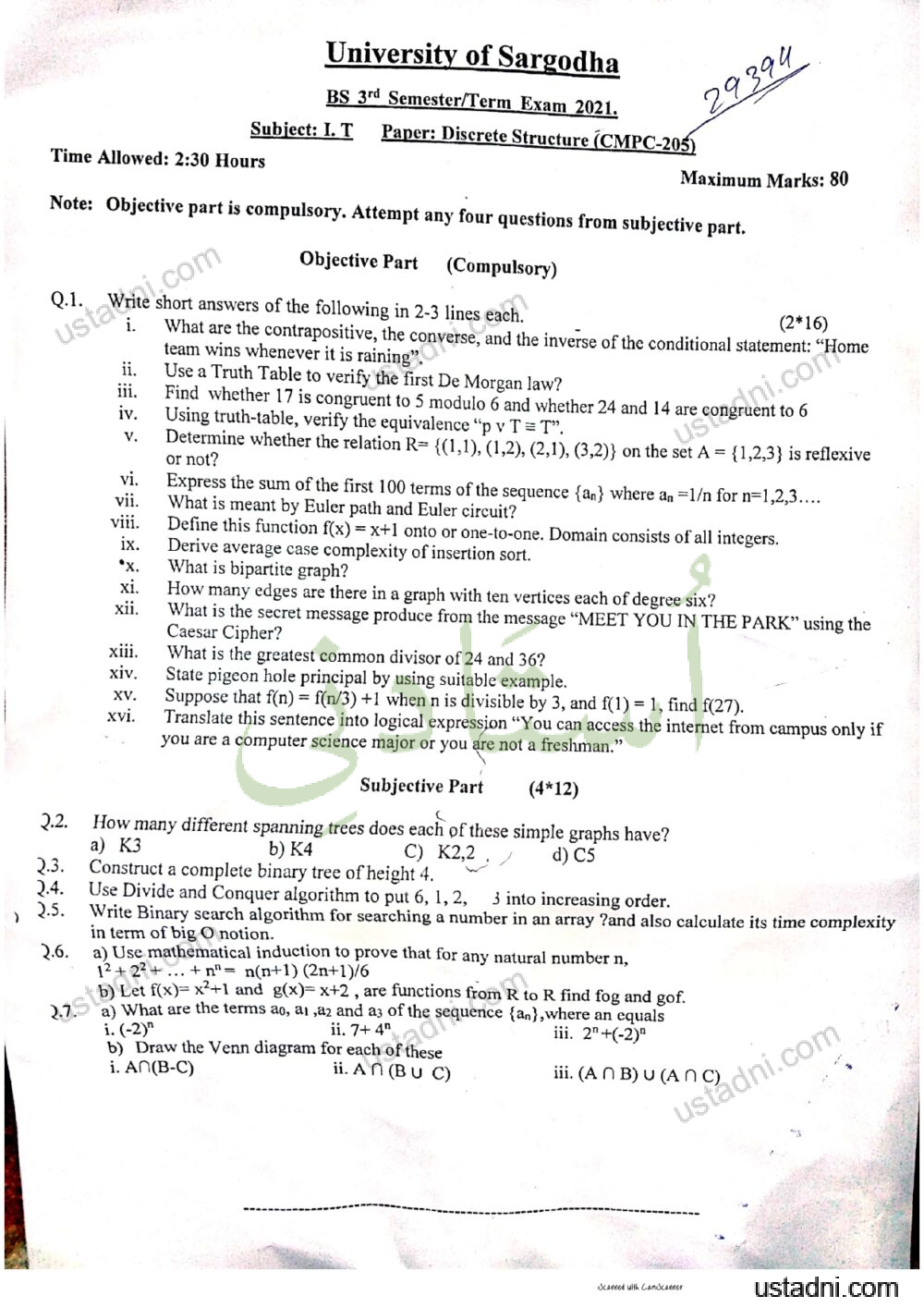 Discrete Structures BS 3 Semester/Term University Of Sargodha (UOS) 2021
Uploaded 1 year ago
Download ↓
Discrete Structures BS 3 Semester/Term University Of Sargodha (UOS) 2021
Uploaded 1 year ago
Download ↓
Paper text
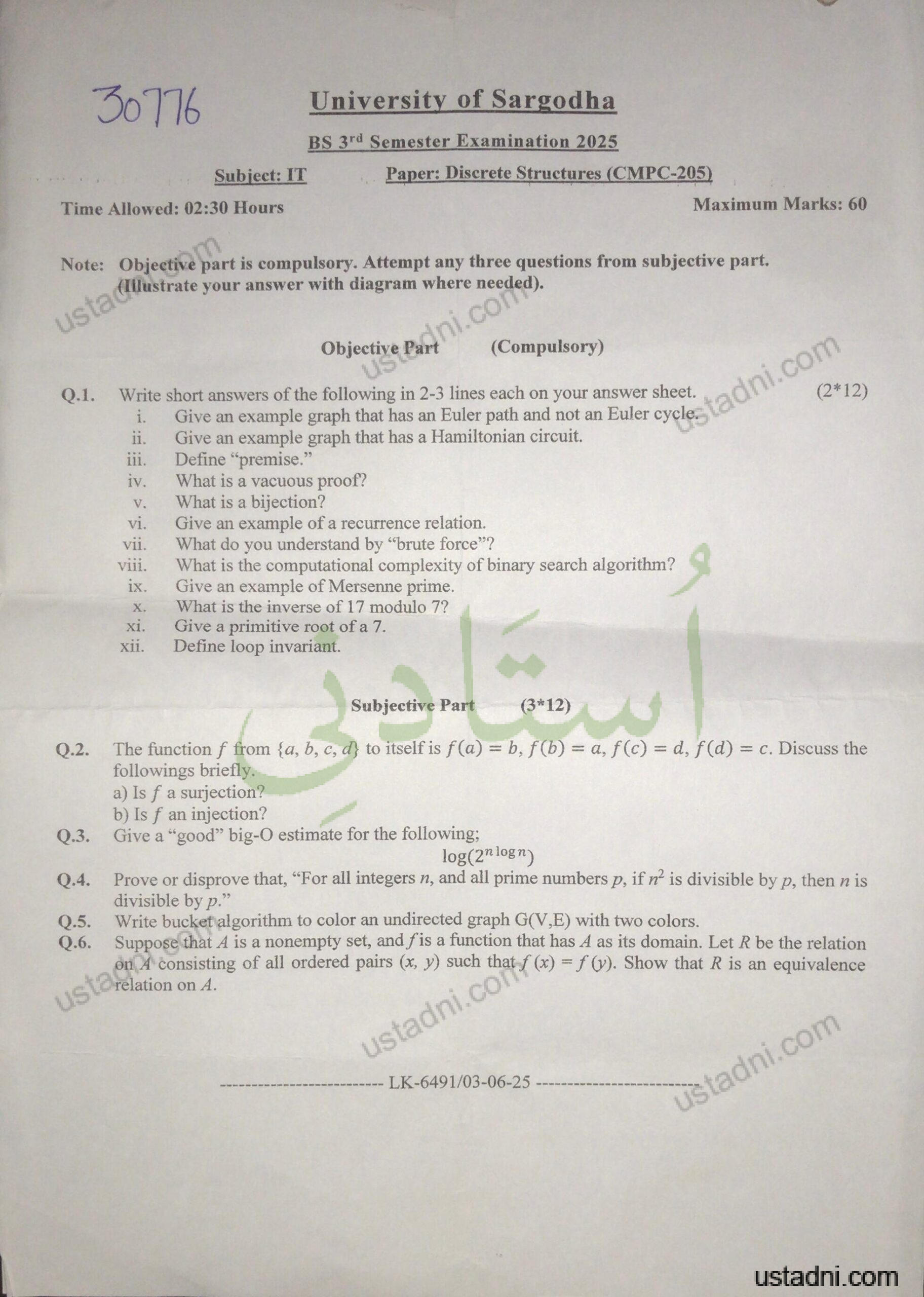
>, ie Te YE a { Cor A
Ci REY HR NEE RRA | ii
~~ Yaper: Discrete Structures (CVir€ -2u5) : ade
NES aS ERS STIR Ta Fo pod
ap BERL EE fa Maximum Marks: 60
SER, 5 Cai ger Evry % ; 3 Ba 8 : Hy,
Note: Objective part i ‘compulsory. Attempt any three questions from subjective part. ~~
$4 gy ustrate your answer with diagram where needed): S00 ia
fess NC
3 Objects par (Compulsory) ot
Q.1. Write short answers of the following in 2-3 lines each on your answer sheet. 20 (2%12)
4
i. Give an example graph that has an Euler path and not an Euler cycles, ;
ii. Give an example graph that has a Hamiltonian circuit.
iii. Define “premise.”
iv. What is a vacuous proof?
i v. What is a bijection?
¢
vi. Give an example of a recurrence relation.
vii. What do you understand by “brute force”?
d
viii. What is the computational complexity of binary search algorithm?
ER
ix. Give an example of Mersenne prime.
Q.2.
n| ulsory. Attempt any three questions from subjective part.
‘answer with diagram where needed).
A CP
Object art (Compulsory) o®
Write short answers of the following in 2-3 lines each on your answer sheet. RN (2%12)
i. Give an example graph that has an Euler path and not an Euler cycler
v. What is a bijection?
vi. Give an example of a recurrence relation.
viii. What is the computational complexity of binary search algorithm?
ix. Give an example of Mersenne prime.
X. What is the inverse of 17 modulo 77
xi. Give a primitive root of a
7. 1 -~
xii. Define loop invari
bd
' Subjective Part (3*12)
The function f from {a, b, c, d} to itself is f(a) = b, f(b) = a, f(c) = d, f(d) = c. Discuss the
followings briefly.
a) Is f a surjection?
b) Is f an injection?
Give a “good” big-O estimate for the following;
log(2n1ogm)
Prove or disprove that, “For all integers », and all prime numbers p, if »* is divisible by p, then n is
divisible by p.”
gorithm to color an undirected graph G(V,E) with two colors.
t A is a nonempty set, and fis a function that has 4 as its domain. Let R be the relation
consisting of all ordered pairs (x, y) such thak{ (x) = f(»). Show that R is an equivalence
ion on
4. rr
a
Rod
LK-6491/03-06-25