
Enterprise Application Development M.Sc. 3 Semester/Term UOS — University of Sargodha 2017
Discussion
Ask a question about this paper, or help someone else with theirs. Answers are emailed to whoever asked.
No questions yet — be the first to ask.
More Enterprise Application Development papers
See all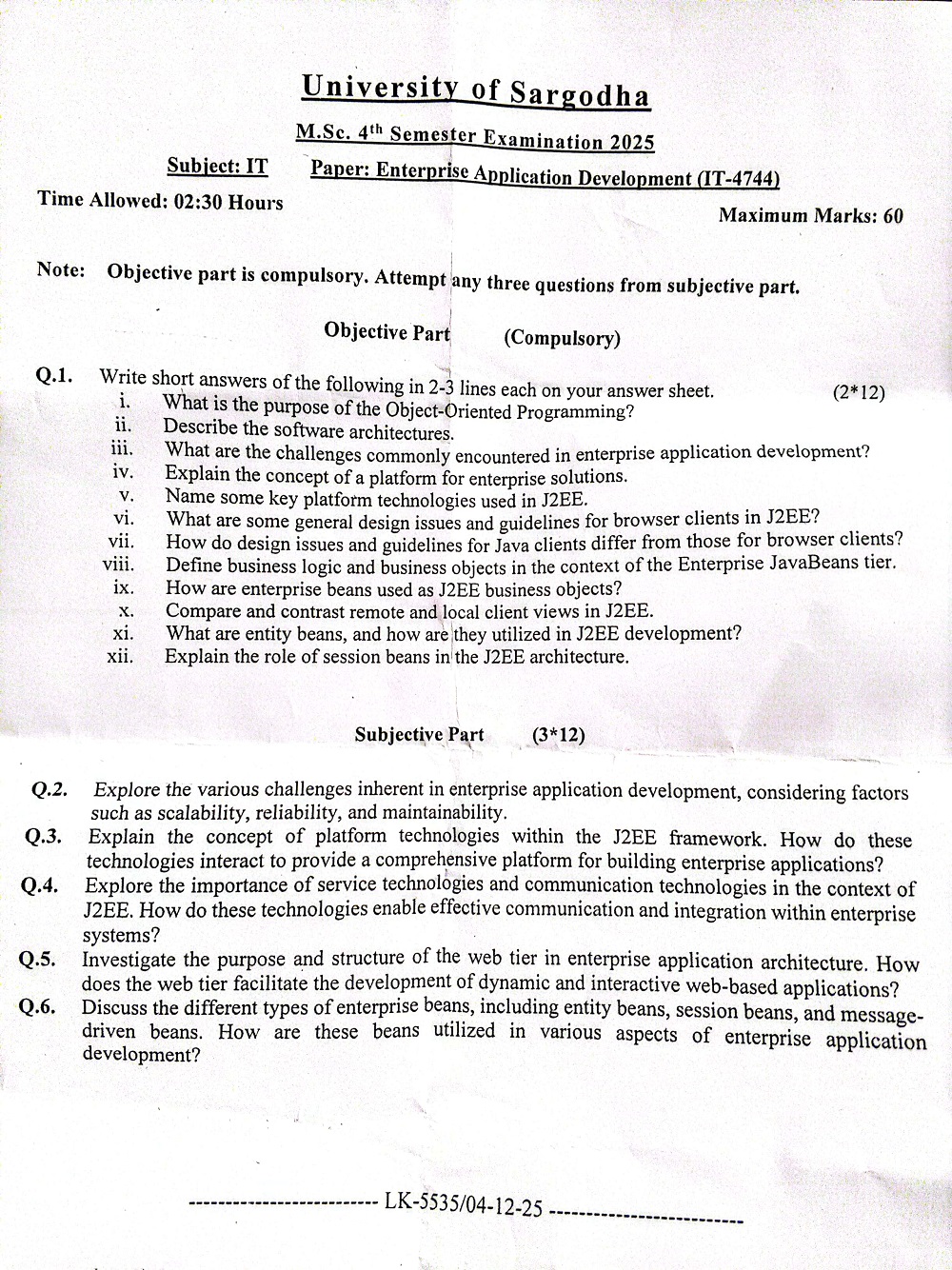 Enterprise Application Development Msc IT 4 Semester/Term University Of Sargodha (UOS) 2025
Uploaded 9 months ago
Download ↓
Enterprise Application Development Msc IT 4 Semester/Term University Of Sargodha (UOS) 2025
Uploaded 9 months ago
Download ↓
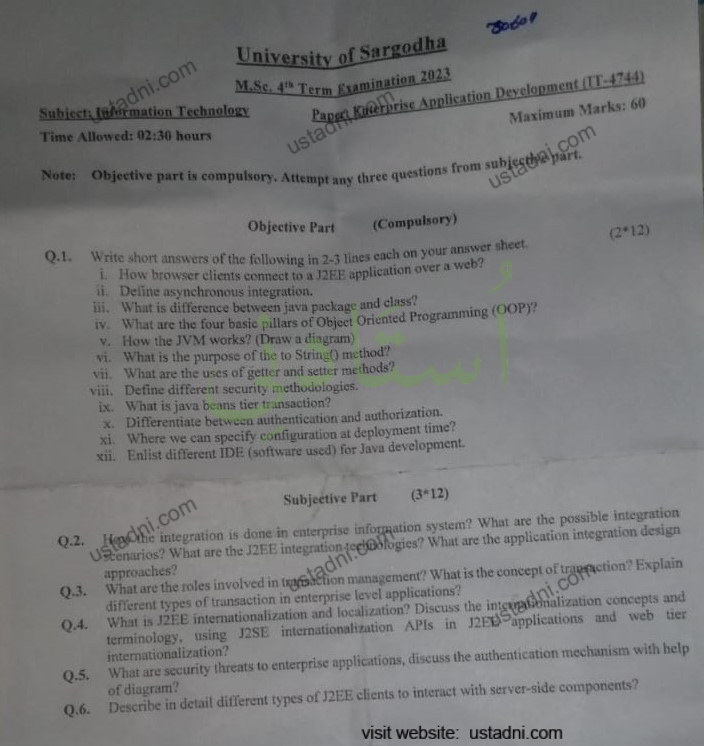 Enterprise Application Development Msc IT 4 Semester/Term University Of Sargodha (UOS) 2023
Uploaded 3 years ago
Download ↓
Enterprise Application Development Msc IT 4 Semester/Term University Of Sargodha (UOS) 2023
Uploaded 3 years ago
Download ↓
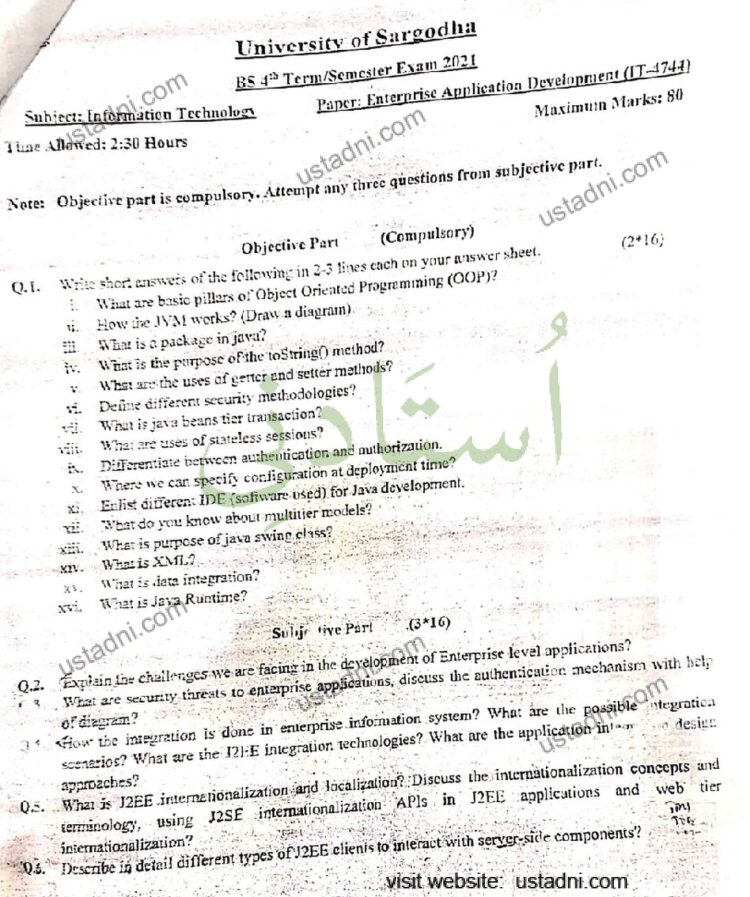 Enterprise Application Development BS 4 Semester/Term University Of Sargodha (UOS) 2021
Uploaded 3 years ago
Download ↓
Enterprise Application Development BS 4 Semester/Term University Of Sargodha (UOS) 2021
Uploaded 3 years ago
Download ↓
 Enterprise Application Development BS IT 2017 UOS
Uploaded 3 years ago
Download ↓
Enterprise Application Development BS IT 2017 UOS
Uploaded 3 years ago
Download ↓
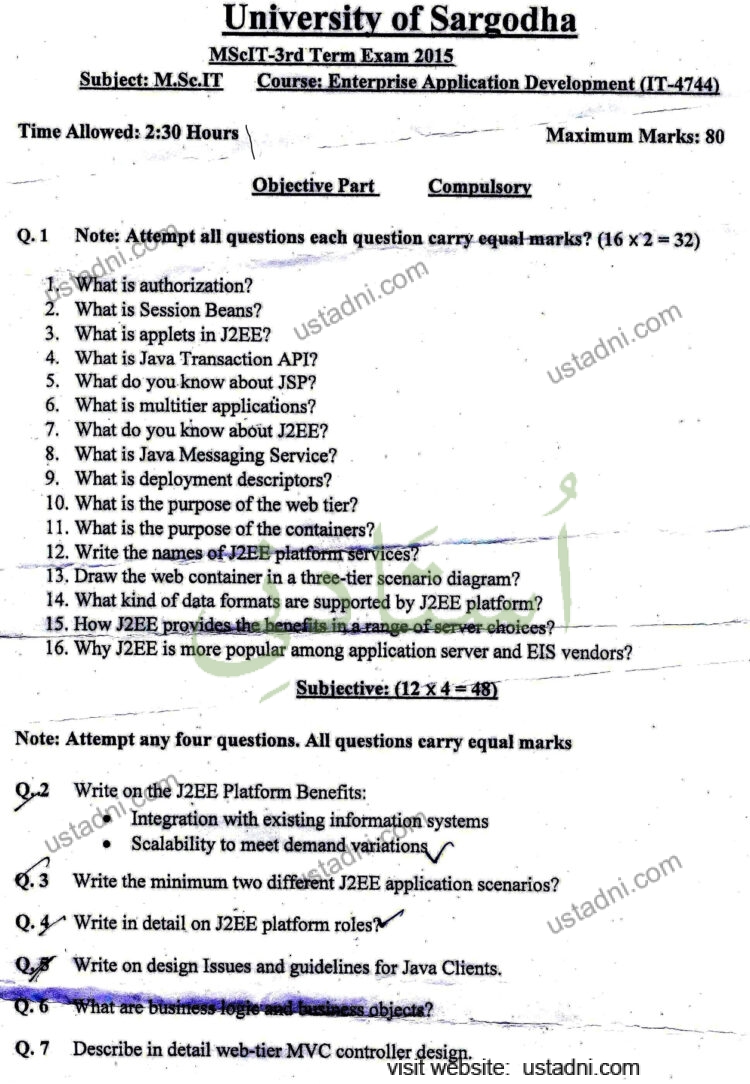 Enterprise Application Development MCS IT 2015 UOS
Uploaded 3 years ago
Download ↓
Enterprise Application Development MCS IT 2015 UOS
Uploaded 3 years ago
Download ↓
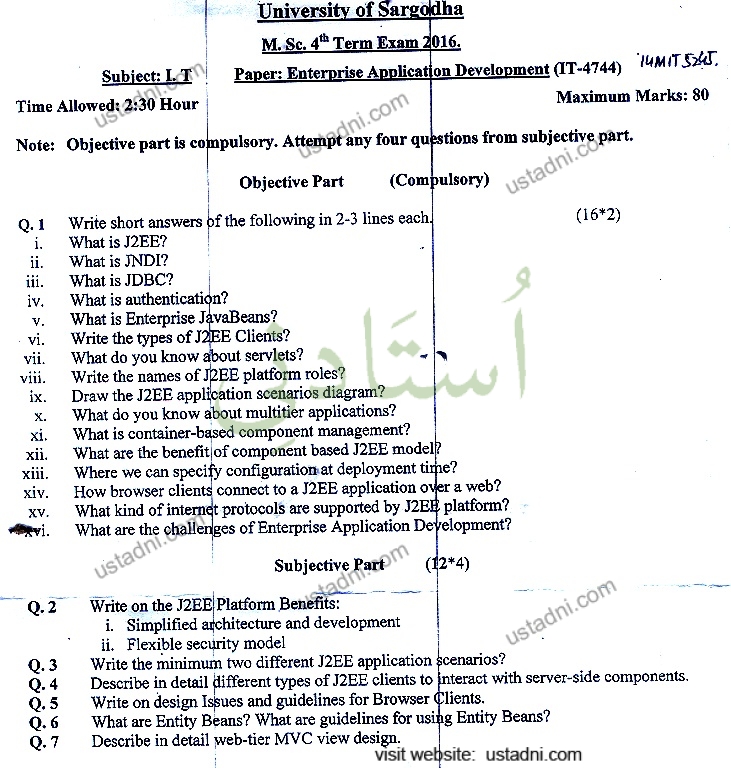 Enterprise Application Development MSC IT 2016 UOS
Uploaded 3 years ago
Download ↓
Enterprise Application Development MSC IT 2016 UOS
Uploaded 3 years ago
Download ↓
Paper text
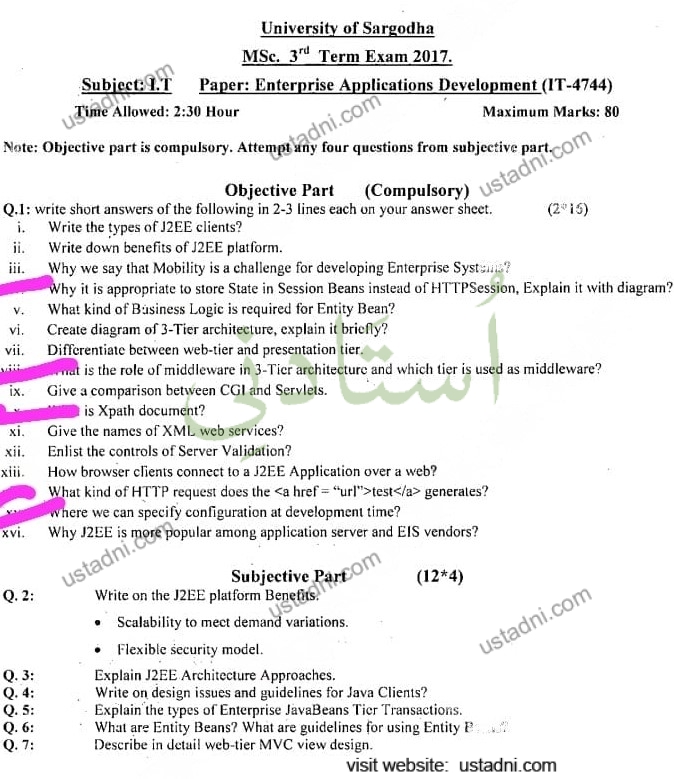
University of Sargodha
MSc. 3rd Term Exam 2017.
Subject: I.T Paper: Enterprise Applications Development (IT-4744)
Time Allowed: 2:30 Hour Maximum Marks: 80
Note: Objective part is compulsory. Attempt any four questions from subjective part.
Objective Part (Compulsory)
Q.1: write short answers of the following in 2-3 lines each on your answer sheet. (2*15)
i. Write the types of J2EE clients?
ii. Write down benefits of J2EE platform.
iii. Why we say that Mobility is a challenge for developing Enterprise Systems?
iv. Why it is appropriate to store State in Session Beans instead of HTTPSession, Explain it with diagram?
v. What kind of Business Logic is required for Entity Bean?
vi. Create diagram of 3-Tier architecture, explain it briefly?
vii. Differentiate between web-tier and presentation tier.
viii. What is the role of middleware in 3-Tier architecture and which tier is used as middleware?
ix. Give a comparison between CGI and Servlets.
x. What is Xpath document?
xi. Give the names of XML web services?
xii. Enlist the controls of Server Validation?
xiii. How browser clients connect to a J2EE Application over a web?
xiv. What kind of HTTP request does the test generates?
xv. Where we can specify configuration at development time?
xvi. Why J2EE is more popular among application server and EIS vendors?
Subjective Part (12*4)
Q. 2: Write on the J2EE platform Benefits.
• Scalability to meet demand variations.
• Flexible security model.
Q. 3: Explain J2EE Architecture Approaches.
Q. 4: Write on design issues and guidelines for Java Clients?
Q. 5: Explain the types of Enterprise JavaBeans Tier Transactions.
Q. 6: What are Entity Beans? What are guidelines for using Entity Beans?
Q. 7: Describe in detail web-tier MVC view design.