
Human Computer Interaction BSIT 5 Semester/Term UOS — University of Sargodha 2015
Discussion
Ask a question about this paper, or help someone else with theirs. Answers are emailed to whoever asked.
No questions yet — be the first to ask.
More Human Computer Interaction papers
See all 2024
Uploaded 26 days ago
Download ↓
2024
Uploaded 26 days ago
Download ↓
 Human Computer Interaction UOS — University of Sargodha 2015
Uploaded 3 years ago
Download ↓
Human Computer Interaction UOS — University of Sargodha 2015
Uploaded 3 years ago
Download ↓
 Human Computer Interaction BSCS 2015 Mid Term UOS
Uploaded 3 years ago
Download ↓
Human Computer Interaction BSCS 2015 Mid Term UOS
Uploaded 3 years ago
Download ↓
 Human Computer Interaction BSCS 2014 Mid Term UOS
Uploaded 3 years ago
Download ↓
Human Computer Interaction BSCS 2014 Mid Term UOS
Uploaded 3 years ago
Download ↓
 Human Computer Interaction MSC IT 2014 UOS
Uploaded 3 years ago
Download ↓
Human Computer Interaction MSC IT 2014 UOS
Uploaded 3 years ago
Download ↓
 Human Computer Interaction BS IT 2016 UOS
Uploaded 3 years ago
Download ↓
Human Computer Interaction BS IT 2016 UOS
Uploaded 3 years ago
Download ↓
Paper text
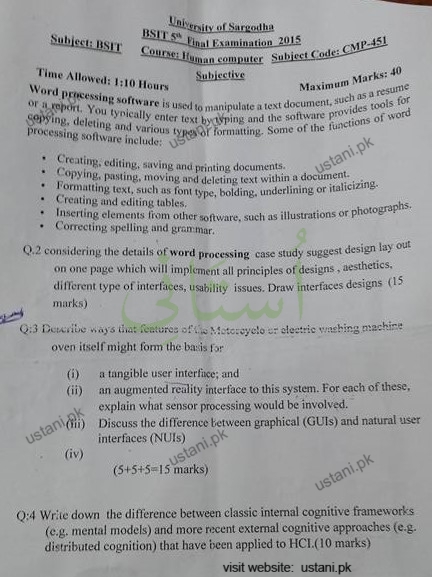
University of Sargodha
BSIT 5th Final Examination 2015
Course: Human computer Subject Code: CMP-451
Subjective
Time Allowed: 1:10 Hours Maximum Marks: 40
Word processing software is used to manipulate a text document, such as a resume
or a report. You typically enter text by typing and the software provides tools for
copying, deleting and various types of formatting. Some of the functions of word
processing software include:
• Creating, editing, saving and printing documents.
• Copying, pasting, moving and deleting text within a document.
• Formatting text, such as font type, bolding, underlining or italicizing.
• Creating and editing tables.
• Inserting elements from other software, such as illustrations or photographs.
• Correcting spelling and grammar.
Q.2 considering the details of word processing case study suggest design lay out
on one page which will implement all principles of designs, aesthetics,
different type of interfaces, usability issues. Draw interfaces designs (15
marks)
Q:3 Describe ways that features of the Motorcycle or electric washing machine
oven itself might form the basis for
(i) a tangible user interface; and
(ii) an augmented reality interface to this system. For each of these,
explain what sensor processing would be involved.
(iii) Discuss the difference between graphical (GUIs) and natural user
interfaces (NUIs)
(iv)
(5+5+5=15 marks)
Q:4 Write down the difference between classic internal cognitive frameworks
(e.g. mental models) and more recent external cognitive approaches (e.g.
distributed cognition) that have been applied to HCI.(10 marks)
visit website: ustani.pk