
Information Security BS 1/8 Semester/Term UOS — University of Sargodha 2025
Discussion
Ask a question about this paper, or help someone else with theirs. Answers are emailed to whoever asked.
No questions yet — be the first to ask.
More Information Security papers
See all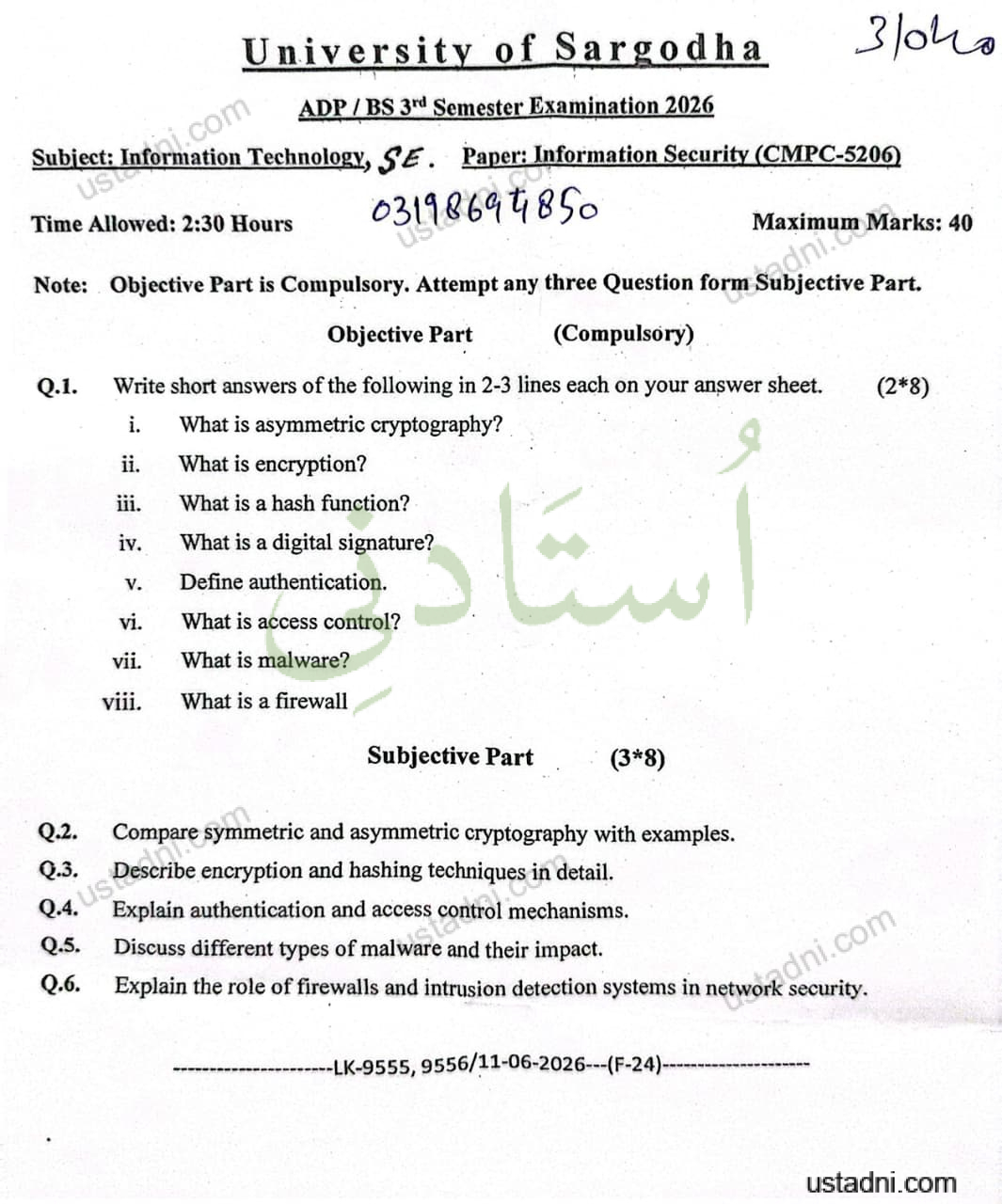 Information Security ADP/BS 3 Semester/Term University Of Sargodha (UOS) 2026
Uploaded 3 months ago
Download ↓
Information Security ADP/BS 3 Semester/Term University Of Sargodha (UOS) 2026
Uploaded 3 months ago
Download ↓
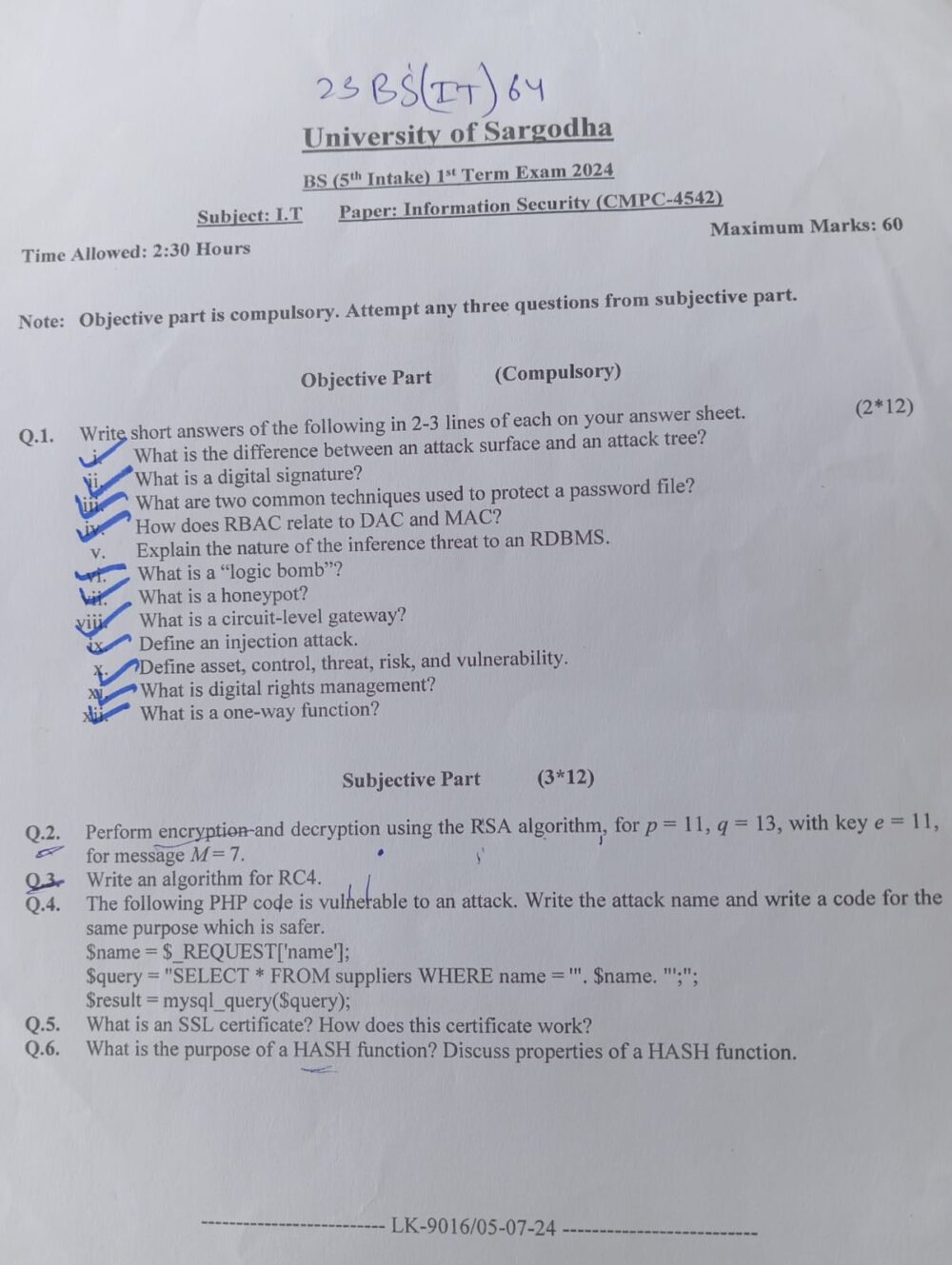 Information Security BS/MS Information Security 5/1 Semester/Term Islamia University Bhawalpur (IUB) 2024
Uploaded 1 year ago
Download ↓
Information Security BS/MS Information Security 5/1 Semester/Term Islamia University Bhawalpur (IUB) 2024
Uploaded 1 year ago
Download ↓
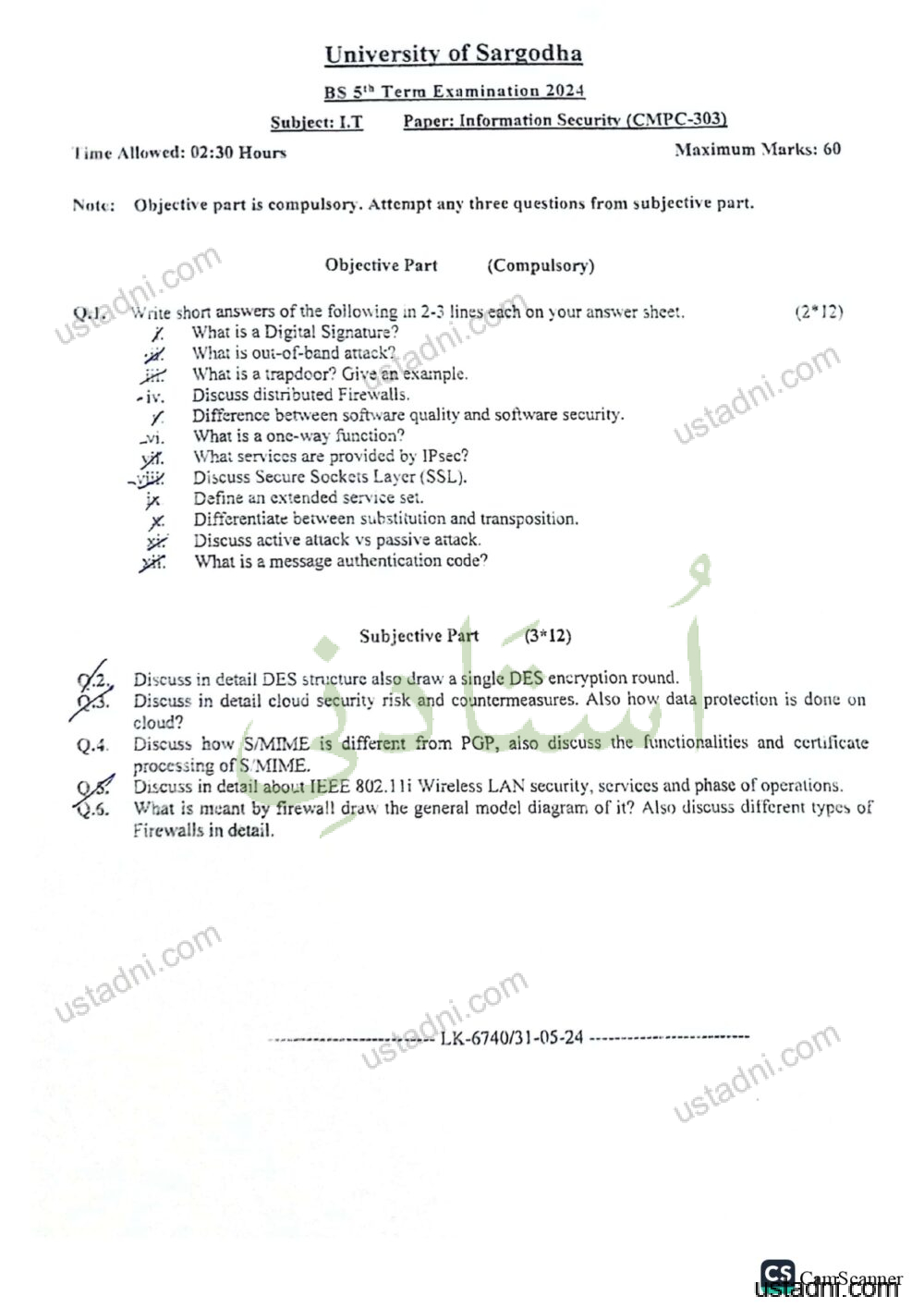 Information Security BS/MS Information Security 5 Semester/Term University Of Sargodha (UOS) 2024
Uploaded 1 year ago
Download ↓
Information Security BS/MS Information Security 5 Semester/Term University Of Sargodha (UOS) 2024
Uploaded 1 year ago
Download ↓
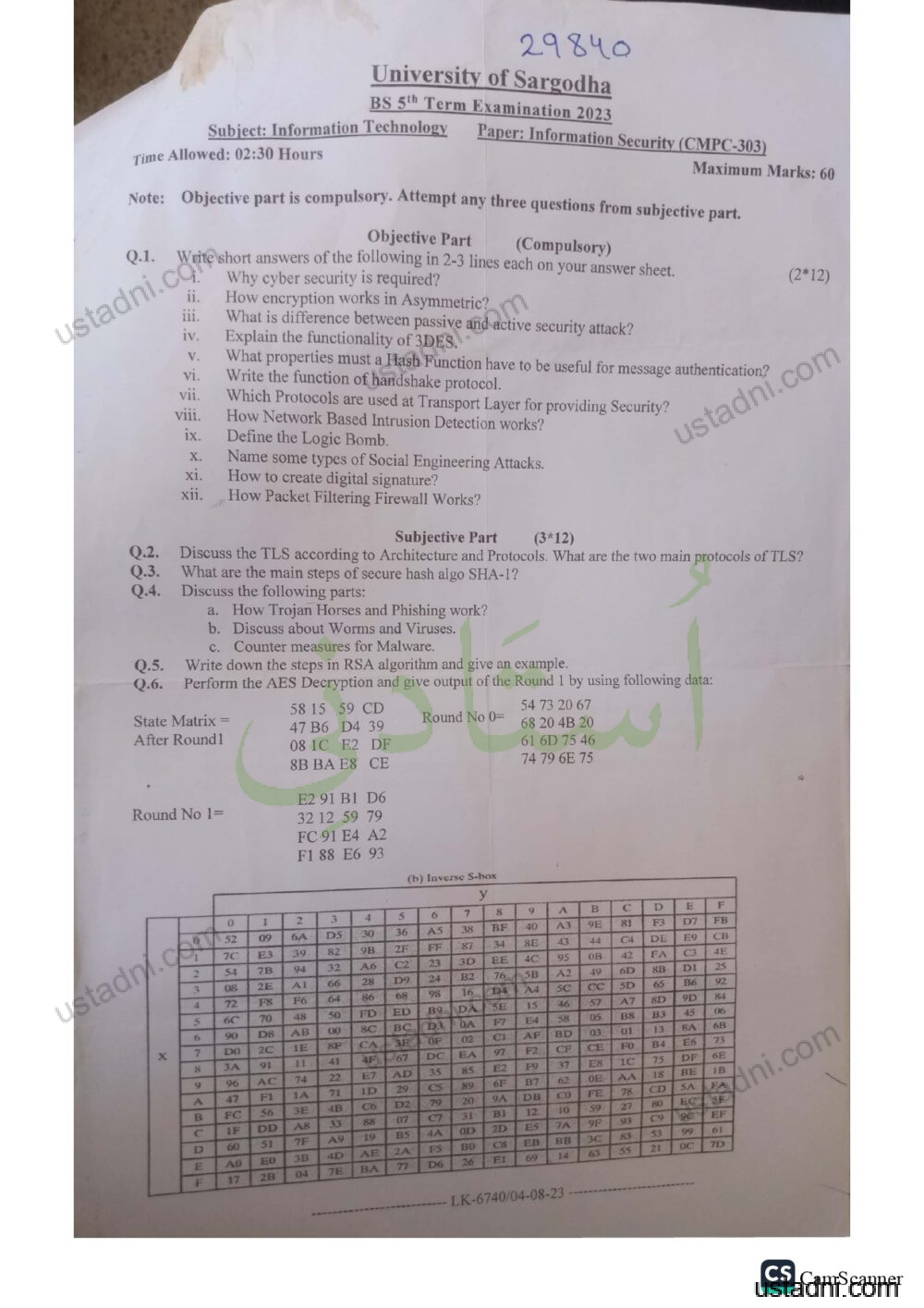 Information Security AD/BS/MPhil Information Technology 5 Semester/Term University Of Sargodha (UOS) 2023
Uploaded 1 year ago
Download ↓
Information Security AD/BS/MPhil Information Technology 5 Semester/Term University Of Sargodha (UOS) 2023
Uploaded 1 year ago
Download ↓
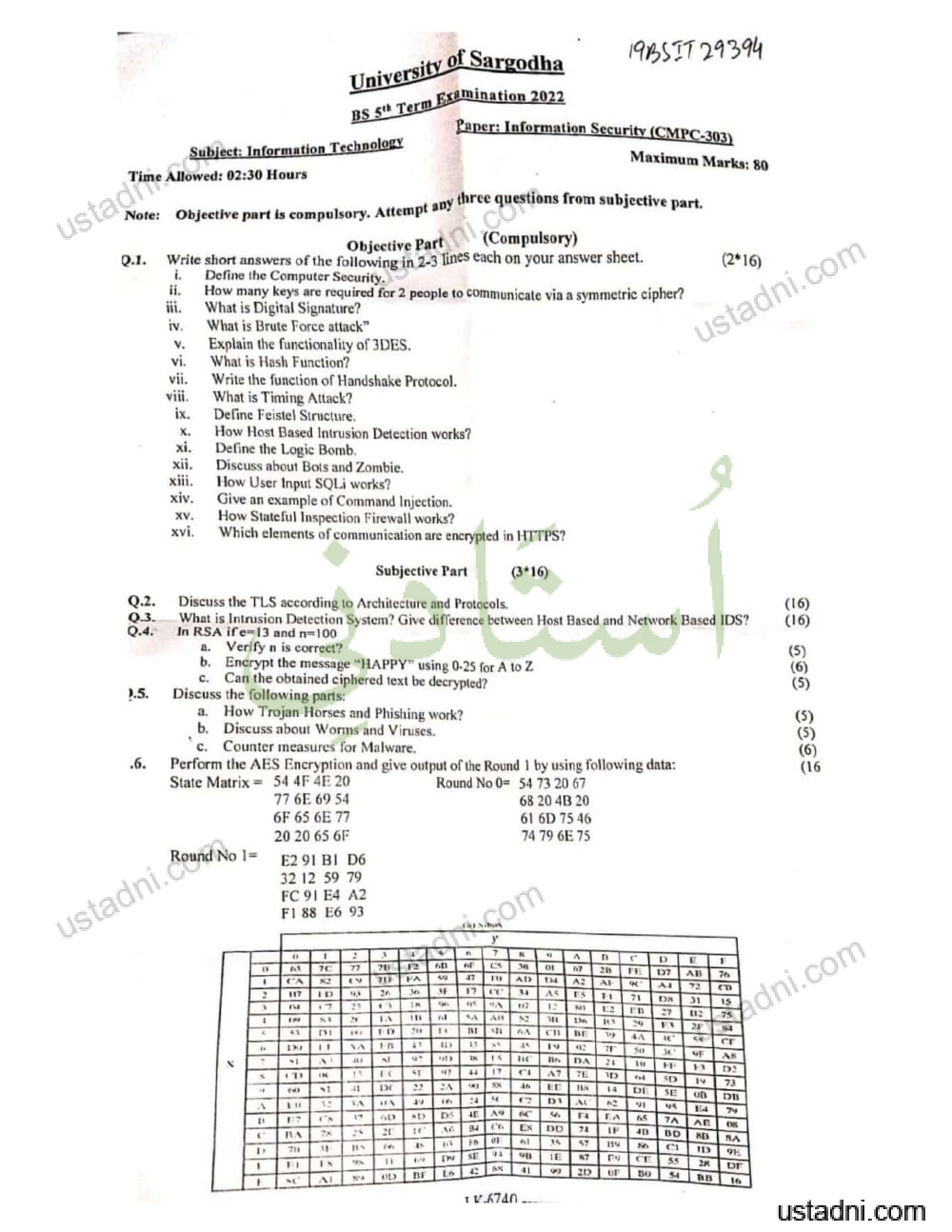 Information Security BS/MPhil Information Technology/MS Information Technology University Of Sargodha (UOS) 2022
Uploaded 1 year ago
Download ↓
Information Security BS/MPhil Information Technology/MS Information Technology University Of Sargodha (UOS) 2022
Uploaded 1 year ago
Download ↓
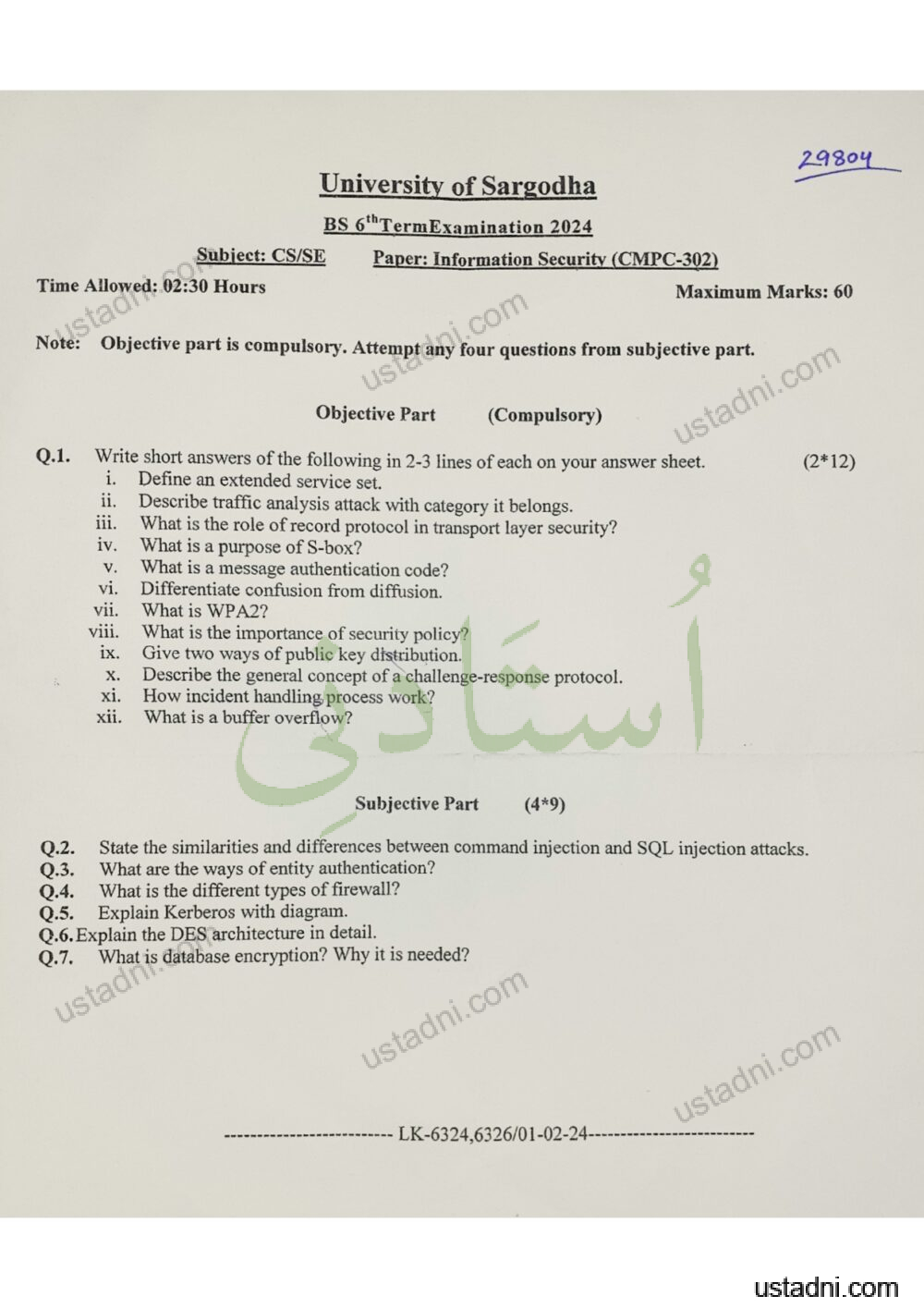 Information Security BS University Of Sargodha (UOS) 2024
Uploaded 1 year ago
Download ↓
Information Security BS University Of Sargodha (UOS) 2024
Uploaded 1 year ago
Download ↓
Paper text
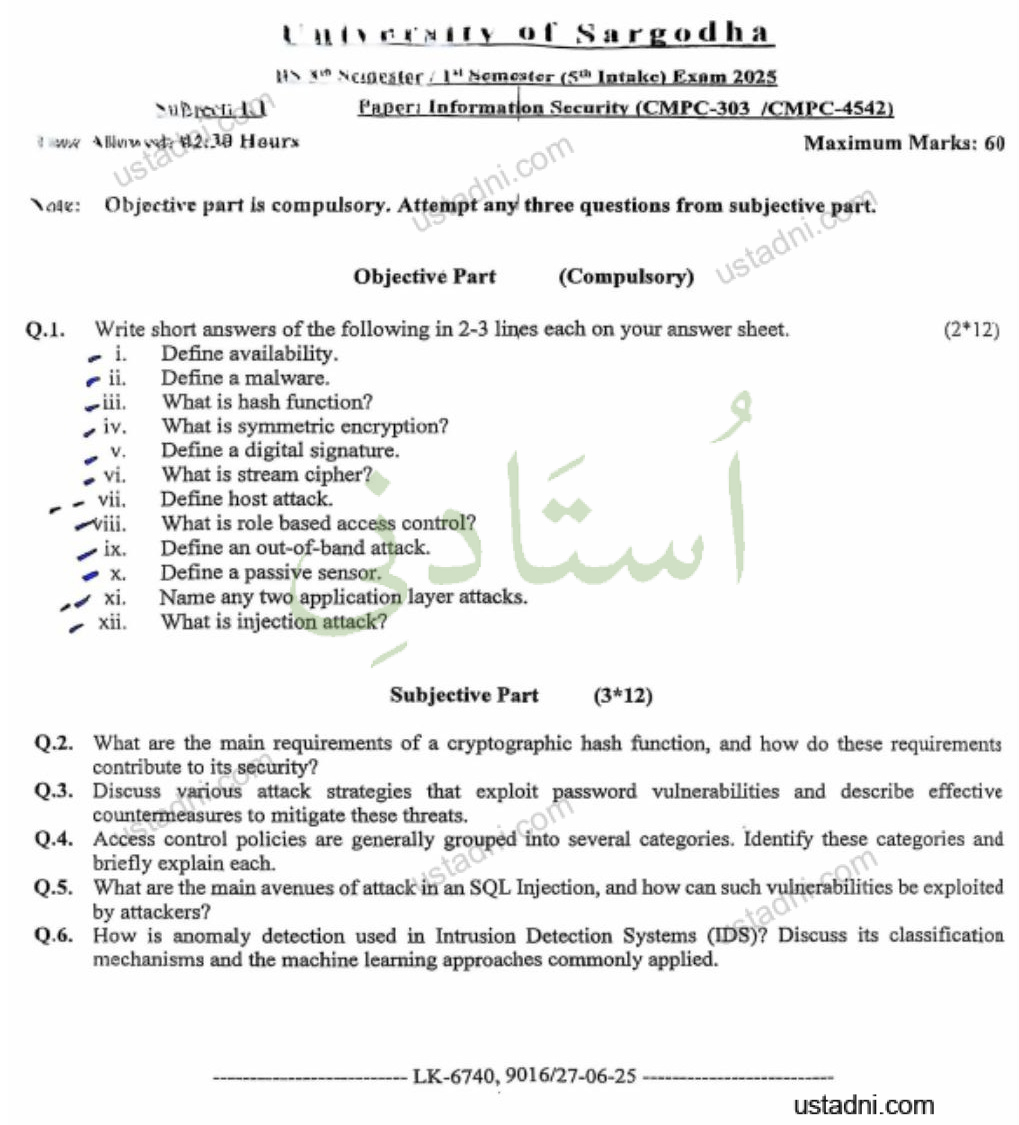
Lnitvernity of Sargodha
US Nagester AM ester (S™
Lowi Allow wd: 92:18 Hours Maximum Marks: 60
Nate: Objective part is compulsory. Attempt any three questions from subjective part.
Objective Part (Compulsory)
Q.1. Write short answers of the following in 2-3 lines each on your answer sheet. (2*12)
~
i. Define availability.
#
ii. Define a malware.
«iii. What is hash function?
»
iv. What is symmetric encryption?
» V- Define a digital signature.
» Vi. What is stream cipher?
, = Vii. Define host attack.
Lntveentty of Sargodha
WS Nagester 4M ester (S™
Supe dad n -4
Lowa ABNow ody 92:18 Hours Maximum Marks:
60)
Note: Objective part is compulsory. Attempt any three questions from subjective part.
Q.1. Write short answers of the following in 2-3 lines each on your answer sheet. (2%12)
~ 1v. What is symmetric encryption?
v. Define a digital signature.
-~ vii, Define host attack.
#Viii. What is role based access control?
»
ix. Define an out-of-band attack.
« X. Define a passive sensor.
,« Xi. Name any two application layer attacks.
»~ Xi. What is injection attack?
Subjective Part (3*12)
Q.2. What are the main requirements of a cryptographic hash function, and how do these requirements
contribute to its security?
Q.3. Discuss various attack strategies that exploit password vulnerabilities and describe effective
countermeasures to mitigate these threats.
Q.4. Access control policies are generally grouped into several categories. Identify these categories and
briefly explain each.
Q.5. What are the main avenues of attack in an SQL Injection, and how can such vulnerabilities be exploited
by attackers?
Q.6. How is anomaly detection used in Intrusion Detection Systems (IDS)? Discuss its classification
mechanisms and the machine learning approaches commonly applied.
LK-6740, 9016/27-06-25
ustadni.com