
Mobile Computing M.Sc. 4 Semester/Term UOS — University of Sargodha 2017
Discussion
Ask a question about this paper, or help someone else with theirs. Answers are emailed to whoever asked.
No questions yet — be the first to ask.
More Mobile Computing papers
See all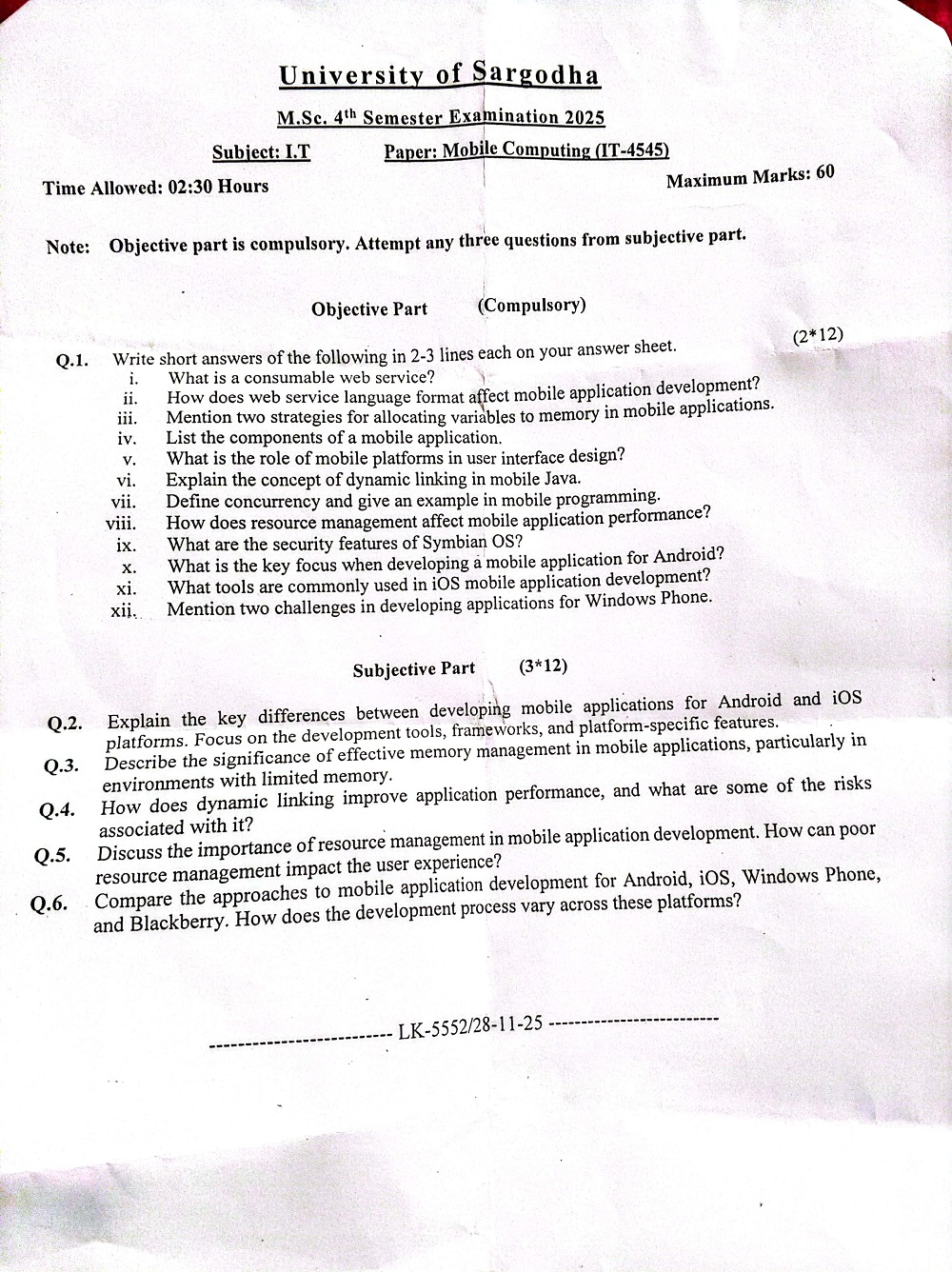 Mobile Computing Msc IT 4 Semester/Term University Of Sargodha (UOS) 2025
Uploaded 9 months ago
Download ↓
Mobile Computing Msc IT 4 Semester/Term University Of Sargodha (UOS) 2025
Uploaded 9 months ago
Download ↓
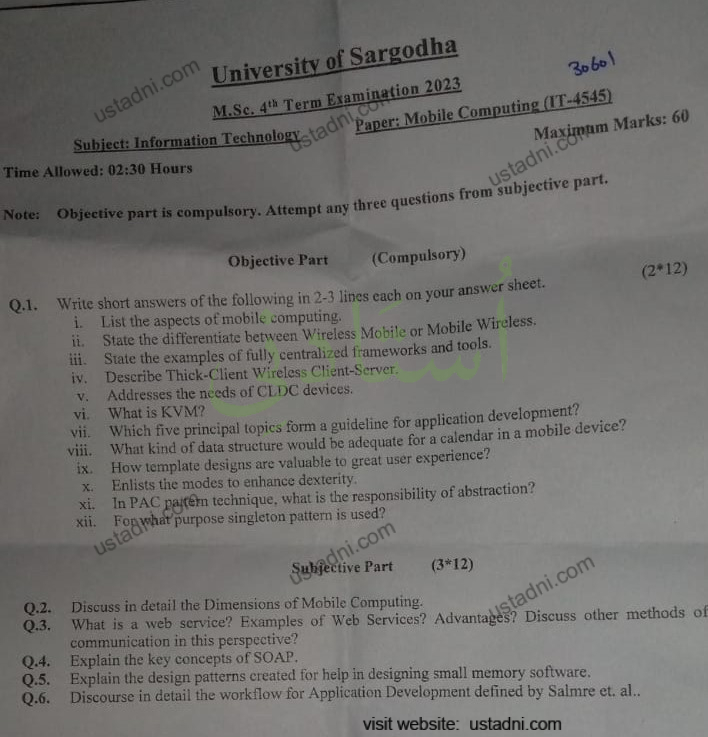 Mobile Computing Msc IT 4 Semester/Term University Of Sargodha (UOS) 2023
Uploaded 3 years ago
Download ↓
Mobile Computing Msc IT 4 Semester/Term University Of Sargodha (UOS) 2023
Uploaded 3 years ago
Download ↓
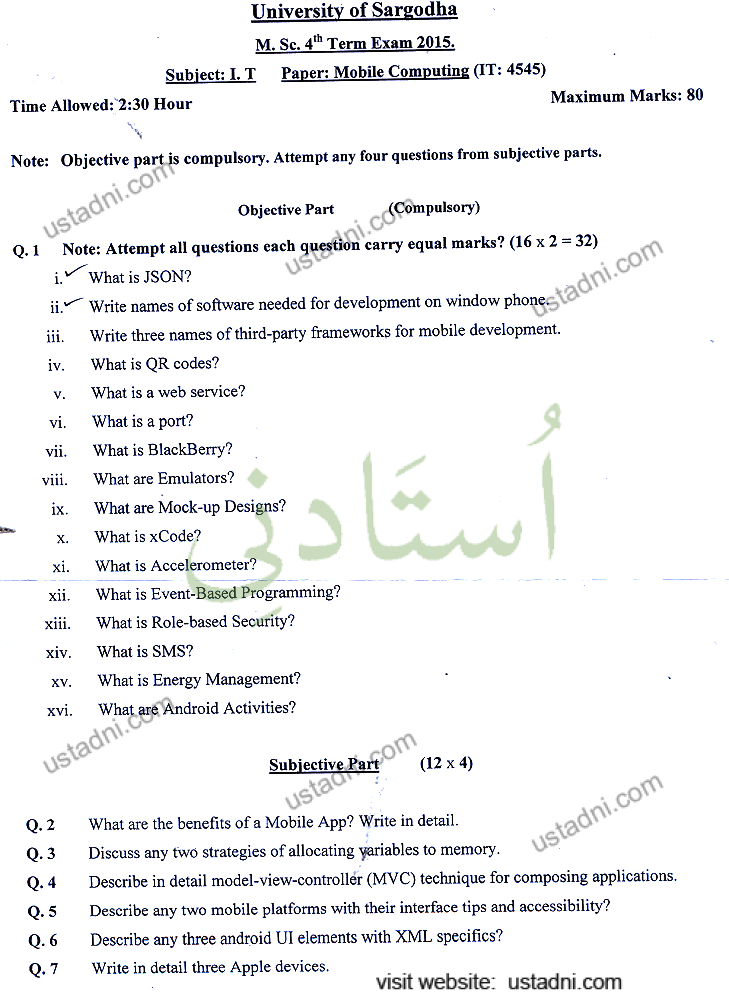 Mobile Computing MSC IT 2015 UOS
Uploaded 3 years ago
Download ↓
Mobile Computing MSC IT 2015 UOS
Uploaded 3 years ago
Download ↓
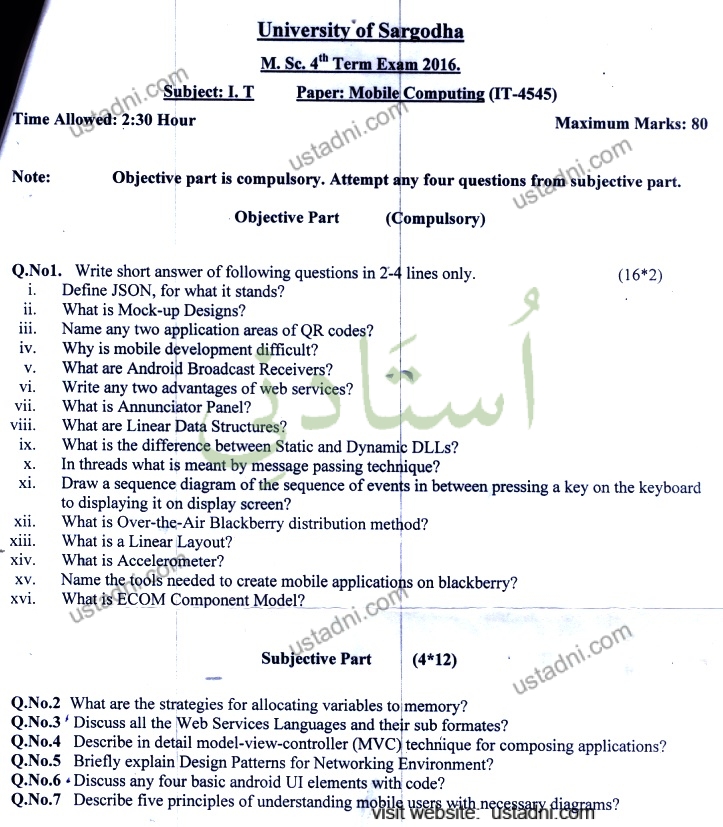 Mobile Computing MSC IT 2016 UOS
Uploaded 3 years ago
Download ↓
Mobile Computing MSC IT 2016 UOS
Uploaded 3 years ago
Download ↓
 Mobile Computing MSC IT 2021 UOS
Uploaded 3 years ago
Download ↓
Mobile Computing MSC IT 2021 UOS
Uploaded 3 years ago
Download ↓
Paper text
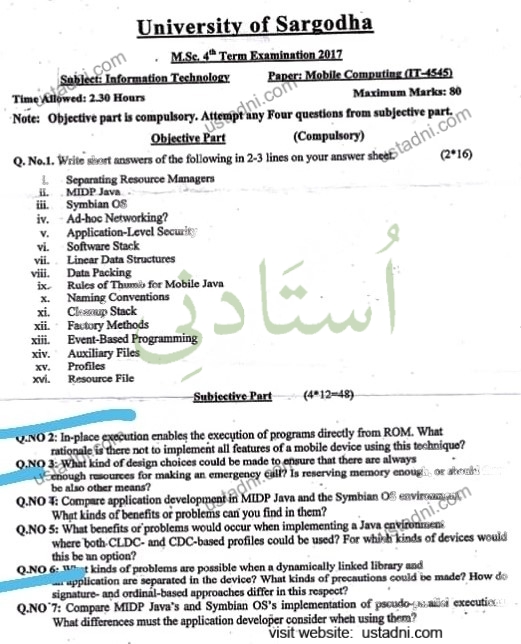
University of Sargodha
M.Sc. 4th Term Examination 2017
Subject: Information Technology
Paper: Mobile Computing (IT-4545)
Time Allowed: 2.30 Hours
Maximum Marks: 80
Note: Objective part is compulsory. Attempt any Four questions from subjective part.
Objective Part (Compulsory)
Q. No.1. Write short answers of the following in 2-3 lines on your answer sheet. (2*16)
i. Separating Resource Managers
ii. MIDP Java
iii. Symbian OS
iv. Ad-hoc Networking?
v. Application-Level Security
vi. Software Stack
vii. Linear Data Structures
viii. Data Packing
ix. Rules of Thumb for Mobile Java
x. Naming Conventions
xi. Cleanup Stack
xii. Factory Methods
xiii. Event-Based Programming
xiv. Auxiliary Files
xv. Profiles
xvi. Resource File
Subjective Part (4*12=48)
Q.NO 2: In-place execution enables the execution of programs directly from ROM. What rationale is there not to implement all features of a mobile device using this technique?
Q.NO 3: What kind of design choices could be made to ensure that there are always enough resources for making an emergency call? Is reserving memory enough, or should there be also other means?
Q.NO 4: Compare application development in MIDP Java and the Symbian OS environments. What kinds of benefits or problems can you find in them?
Q.NO 5: What benefits or problems would occur when implementing a Java environment where both CLDC- and CDC-based profiles could be used? For which kinds of devices would this be an option?
Q.NO 6: What kinds of problems are possible when a dynamically linked library and an application are separated in the device? What kinds of precautions could be made? How do signature- and ordinal-based approaches differ in this respect?
Q.NO 7: Compare MIDP Java's and Symbian OS's implementation of pseudo-parallel execution. What differences must the application developer consider when using them?