
Operating System MS Computer Science/MSc Computer Science/PhD Computer Science 3 Semester/Term Islamia University Bhawalpur (IUB) 2014
Discussion
Ask a question about this paper, or help someone else with theirs. Answers are emailed to whoever asked.
No questions yet — be the first to ask.
More Operating System papers
See all Operating System Msc IT 2 Semester/Term University Of Sargodha (UOS) 2019
Uploaded 3 years ago
Download ↓
Operating System Msc IT 2 Semester/Term University Of Sargodha (UOS) 2019
Uploaded 3 years ago
Download ↓
 Operating System Msc IT 2 Semester/Term University Of Sargodha (UOS) 2018
Uploaded 3 years ago
Download ↓
Operating System Msc IT 2 Semester/Term University Of Sargodha (UOS) 2018
Uploaded 3 years ago
Download ↓
 Operating System Msc IT University Of Sargodha (UOS) 2017
Uploaded 3 years ago
Download ↓
Operating System Msc IT University Of Sargodha (UOS) 2017
Uploaded 3 years ago
Download ↓
 Operating System MS Computer Science/MSc Computer Science/PhD Computer Science 1 Semester/Term Islamia University Bhawalpur (IUB) 2014
Uploaded 3 years ago
Download ↓
Operating System MS Computer Science/MSc Computer Science/PhD Computer Science 1 Semester/Term Islamia University Bhawalpur (IUB) 2014
Uploaded 3 years ago
Download ↓
 Operating System MSCS 2016 IUB
Uploaded 3 years ago
Download ↓
Operating System MSCS 2016 IUB
Uploaded 3 years ago
Download ↓
 Operating System MSCS 2016 Mid Term IUB
Uploaded 3 years ago
Download ↓
Operating System MSCS 2016 Mid Term IUB
Uploaded 3 years ago
Download ↓
Paper text
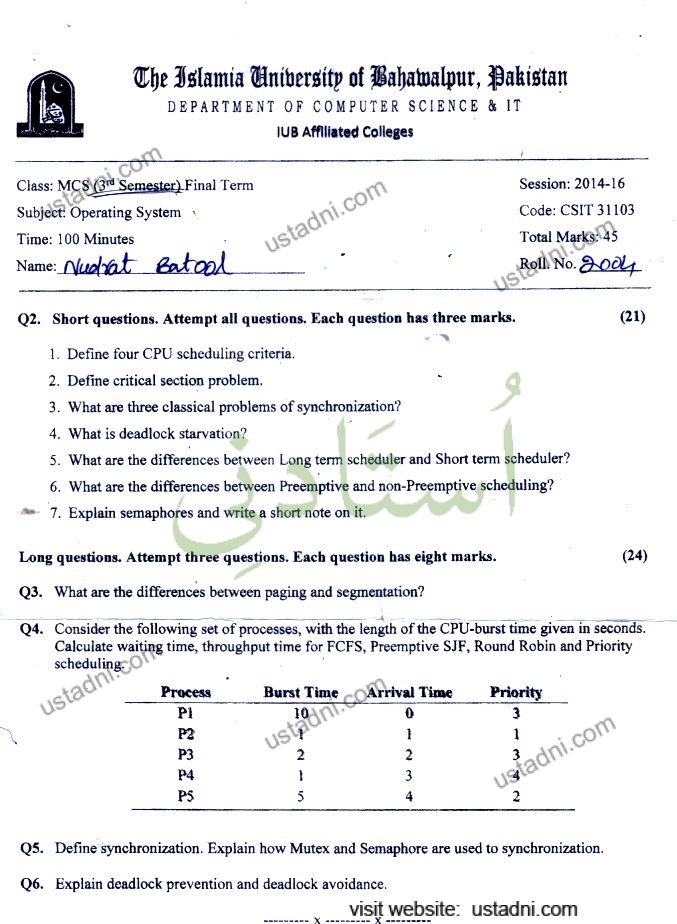
The Islamia Unibersity of ahabalpur, Pakistan
DEPARTMENT OF COMPUTER SCIENCE & IT
IUB Affiliated Colleges
Class: MCS (3 Semester) Final Term
Subject: Operating System
Time: 100 Minutes
Name: Nudvat Batool
ustadni.com
Session: 2014-16
Code: CSIT 31103
Total Marks: 45
Roll No. 2004
(21)
Q2. Short questions. Attempt all questions. Each question has three marks.
1. Define four CPU scheduling criteria.
2. Define critical section problem.
3. What are three classical problems of synchronization?
4. What is deadlock starvation?
5. What are the differences between Long term scheduler and Short term scheduler?
6. What are the differences between Preemptive and non-Preemptive scheduling?
7. Explain semaphores and write a short note on it.
Long questions. Attempt three questions. Each question has eight marks.
(24)
Q3. What are the differences between paging and segmentation?
Q4. Consider the following set of processes, with the length of the CPU-burst time given in seconds.
Calculate waiting time, throughput time for FCFS, Preemptive SJF, Round Robin and Priority
scheduling.
Process
PI
P2
P3
P4
PS
Burst Time
10.
Arrival Time
0
2
Priority
3
1
3
tadni.com
Q5. Define synchronization. Explain how Mutex and Semaphore are used to synchronization.
Q6. Explain deadlock prevention and deadlock avoidance.
visit website: ustadni.com