
Operating Systems BSSE 4 Semester/Term UOS — University of Sargodha 2015
Discussion
Ask a question about this paper, or help someone else with theirs. Answers are emailed to whoever asked.
No questions yet — be the first to ask.
Paper text
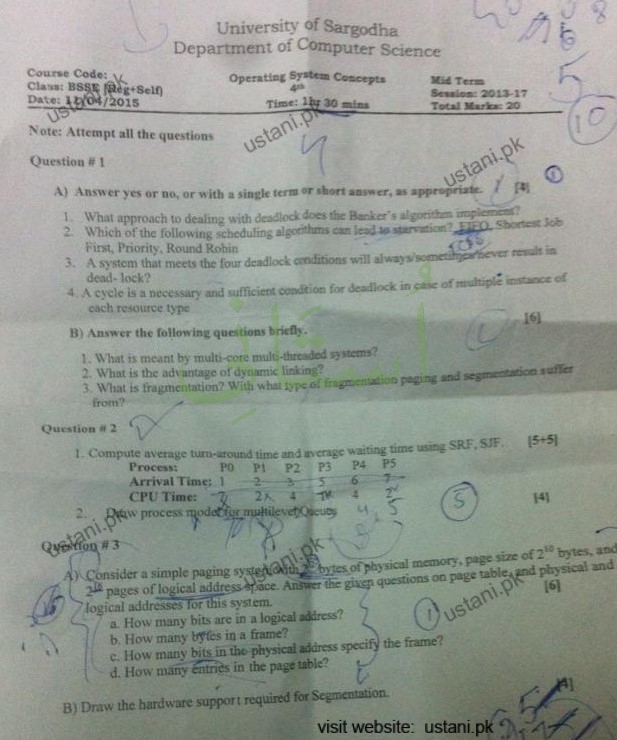
University of Sargodha
Department of Computer Science
Course Code:
Class: BSSE (Reg+Self)
Date: 12/04/2015
Operating System Concepts
4th
Time: 1hr 30 mins
Mid Term
Session: 2013-17
Total Marks: 20
Note: Attempt all the questions
Question # 1
A) Answer yes or no, or with a single term or short answer, as appropriate.
1. What approach to dealing with deadlock does the Banker's algorithm implement?
2. Which of the following scheduling algorithms can lead to starvation? FIFO, Shortest Job
First, Priority, Round Robin
3. A system that meets the four deadlock conditions will always/sometimes/never result in
dead-lock?
4. A cycle is a necessary and sufficient condition for deadlock in case of multiple instance of
each resource type
B) Answer the following questions briefly.
1. What is meant by multi-core multi-threaded systems?
2. What is the advantage of dynamic linking?
3. What is fragmentation? With what type of fragmentation paging and segmentation suffer
from?
Question # 2
1. Compute average turn-around time and average waiting time using SRF, SJF.
Process: P0 P1 P2 P3 P4 P5
Arrival Time: 1 2 3 5 6 7
CPU Time: 3 2 4 1 4 2
2. Draw process model for multilevel Queues
Question # 3
A) Consider a simple paging system with 2^16 bytes of physical memory, page size of 2^10 bytes, and
2^10 pages of logical address space. Answer the given questions on page table, and physical and
logical addresses for this system.
a. How many bits are in a logical address?
b. How many bytes in a frame?
c. How many bits in the physical address specify the frame?
d. How many entries in the page table?
B) Draw the hardware support required for Segmentation.