Waves & Oscillations ADP/BS Physics 1 Semester/Term UOS — University of Sargodha 2024
Discussion
Ask a question about this paper, or help someone else with theirs. Answers are emailed to whoever asked.
No questions yet — be the first to ask.
Paper text
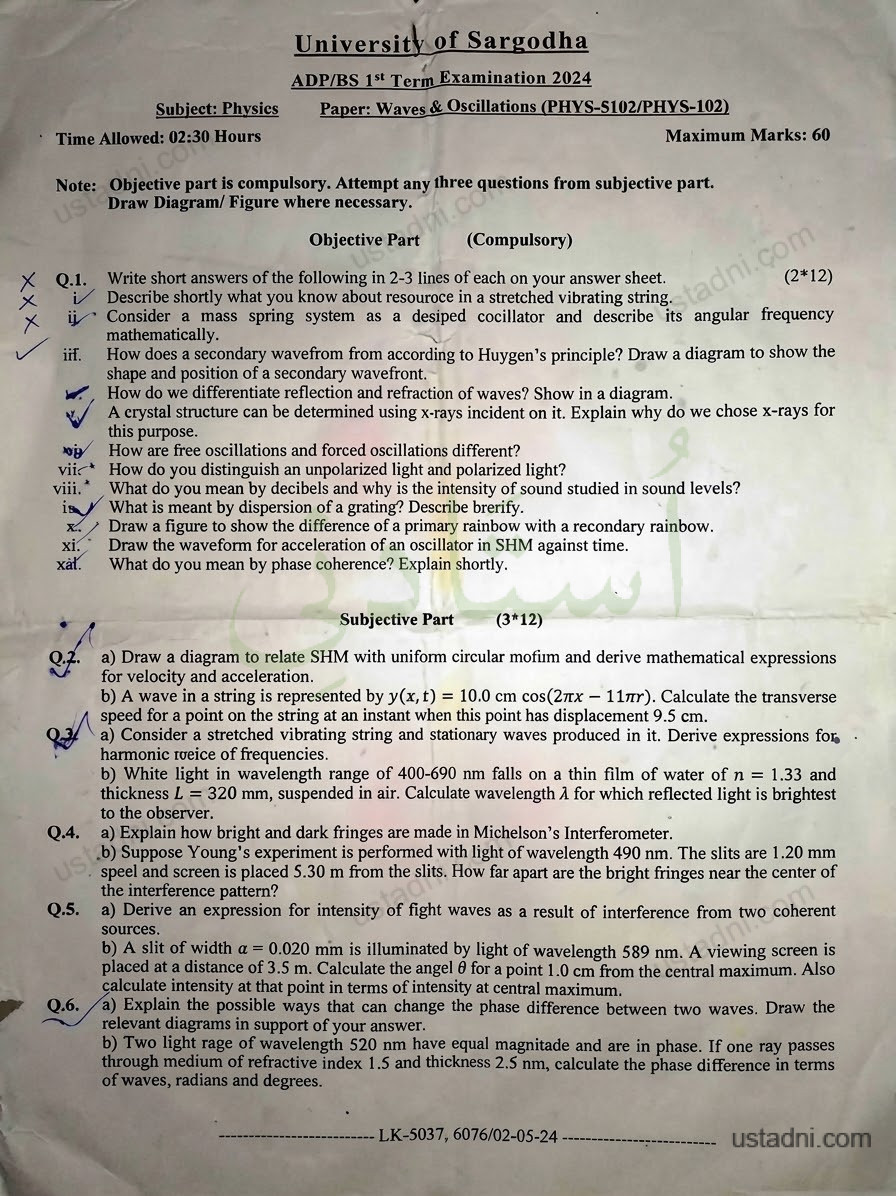
University of Sargodha
ADP/BS 1S Term Examination 2024
Paper: Waves & Oscillations (PHYS-S102/PHYS-102)
Subject: Physics
Time Allowed: 02:30 Hours
Maximum Marks: 60
Note: Objeetive part is compulsory. Attempt any three questions from subjective part.
Draw Diagram/ Figure where necessary.
irf.
Q.4.
Q.5.
Q.6
Objective Part
(Compulsory)
Write short answers of the following in 2-3 lines of each on your answer sheet.
(2*12)
Describe shortly what you know about resource in a stretched vibrating string.
Consider a mass spring system as a desiped cocillator and describe its angular frequency
mathematically.
How does a secondary wavefrom from according to Huygen's principle? Draw a diagram to show the
shape and position of a secondary wavefront.
How do we differentiate reflection and refraction of waves? Show in a diagram.
A crystal structure can be determined using x-rays incident on it. Explain why do we chose x-rays for
this purpose.
How are free oscillations and forced oscillations different?
How do you distinguish an unpolarized light and polarized light?
What do you mean by decibels and why is the intensity of sound studied in sound levels?
What is meant by dispersion of a grating? Describe brerify.
Draw a figure to show the difference of a primary rainbow with a recondary rainbow.
Draw the waveform for acceleration of an oscillator in SHM against time.
What do you mean by phase coherence? Explain shortly.
Subjective Part
(3*12)
a) Draw a diagram to relate SHM with uniform circular mofim and derive mathematical expressions
for velocity and acceleration.
b) A wave in a string is represented by y(x, t) = 10.0 cm cos (27x - 117). Calculate the transverse
speed for a point on the string at an instant when this point has displacement 9.5 cm.
a) Consider a stretched vibrating string and stationary waves produced in it. Derive expressions for
harmonic reice of frequencies.
b) White light in wavelength range of 400-690 nm falls on a thin film of water of n = 1.33 and
thickness L = 320 mm, suspended in air. Calculate wavelength 1 for which reflected light is brightest
to the observer.
a) Explain how bright and dark fringes are made in Michelson's Interferometer.
b) Suppose Young's experiment is performed with light of wavelength 490 nm. The slits are 1.20 mm
speel and screen is placed 5.30 m from the slits. How far apart are the bright fringes near the center of
the interference pattern?
a) Derive an expression for intensity of fight waves as a result of interference from two coherent
sources.
b) A slit of width a = 0.020 mm is illuminated by light of wavelength 589 nm. A viewing screen is
placed at a distance of 3.5 m. Calculate the angel 0 for a point 1.0 cm from the central maximum. Also
calculate intensity at that point in terms of intensity at central maximum.
a) Explain the possible ways that can change the phase difference between two waves. Draw the
relevant diagrams in support of your answer.
b) Two light rage of wavelength 520 nm have equal magnitade and are in phase. If one ray passes
through medium of refractive index 1.5 and thickness 2.5 nm, calculate the phase difference in terms
of waves, radians and degrees.
LK-5037, 6076/02-05-24