
BS(CS) Subject: BS(CS) University of Sargodha Ist Term final Exam 2015 Course:Basic Electronics (PHY-2210) Time Allowed: 2:30 Hours
Discussion
Ask a question about this paper, or help someone else with theirs. Answers are emailed to whoever asked.
No questions yet — be the first to ask.
More Basic Electronics papers
See all Basic Electronics ADP 1 Semester/Term University Of Sargodha (UOS) 2024
Uploaded 11 months ago
Download ↓
Basic Electronics ADP 1 Semester/Term University Of Sargodha (UOS) 2024
Uploaded 11 months ago
Download ↓
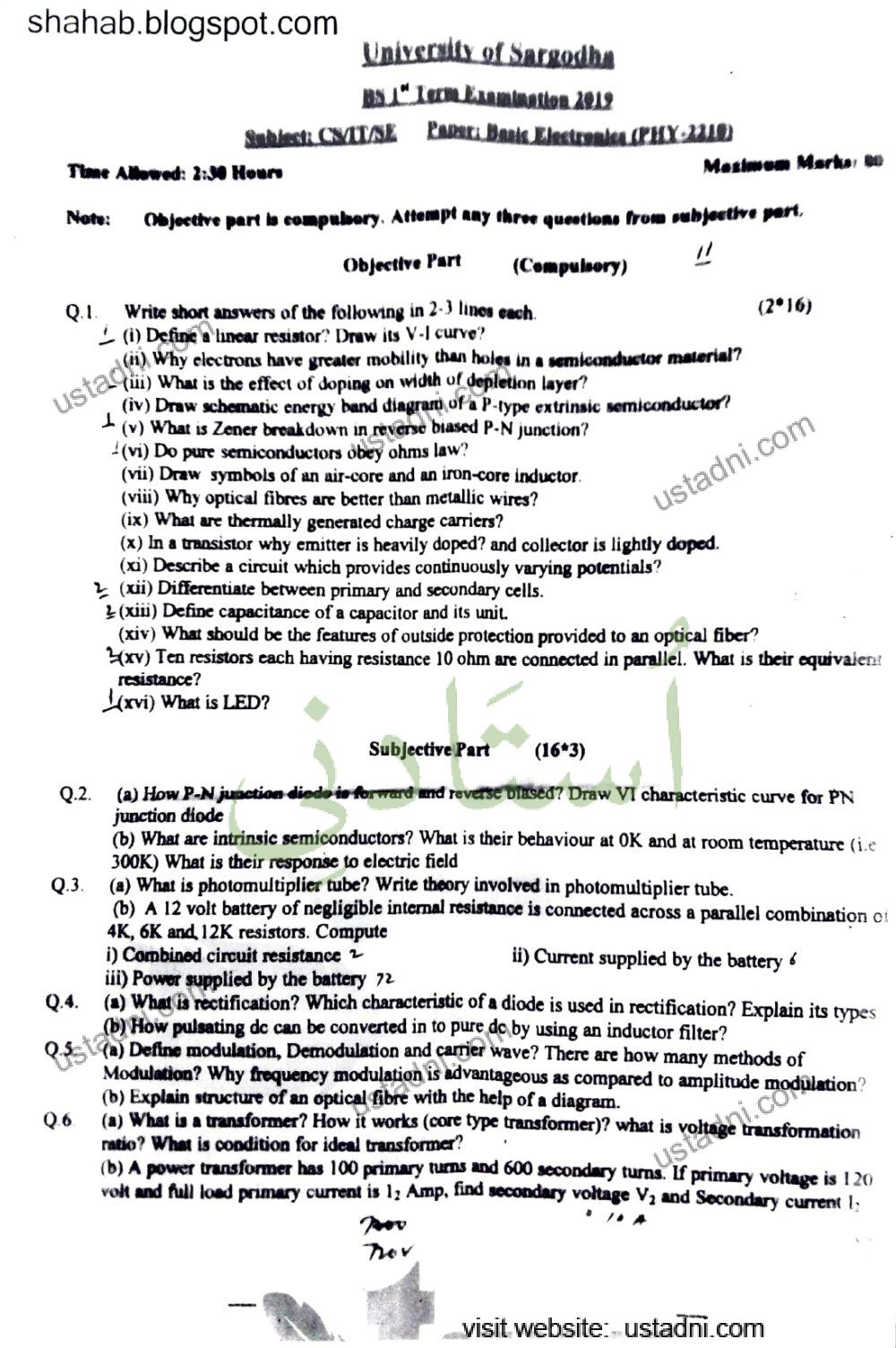 Basic Electronics BSSE/CS/IT UOS — University of Sargodha 2019
Uploaded 2 years ago
Download ↓
Basic Electronics BSSE/CS/IT UOS — University of Sargodha 2019
Uploaded 2 years ago
Download ↓
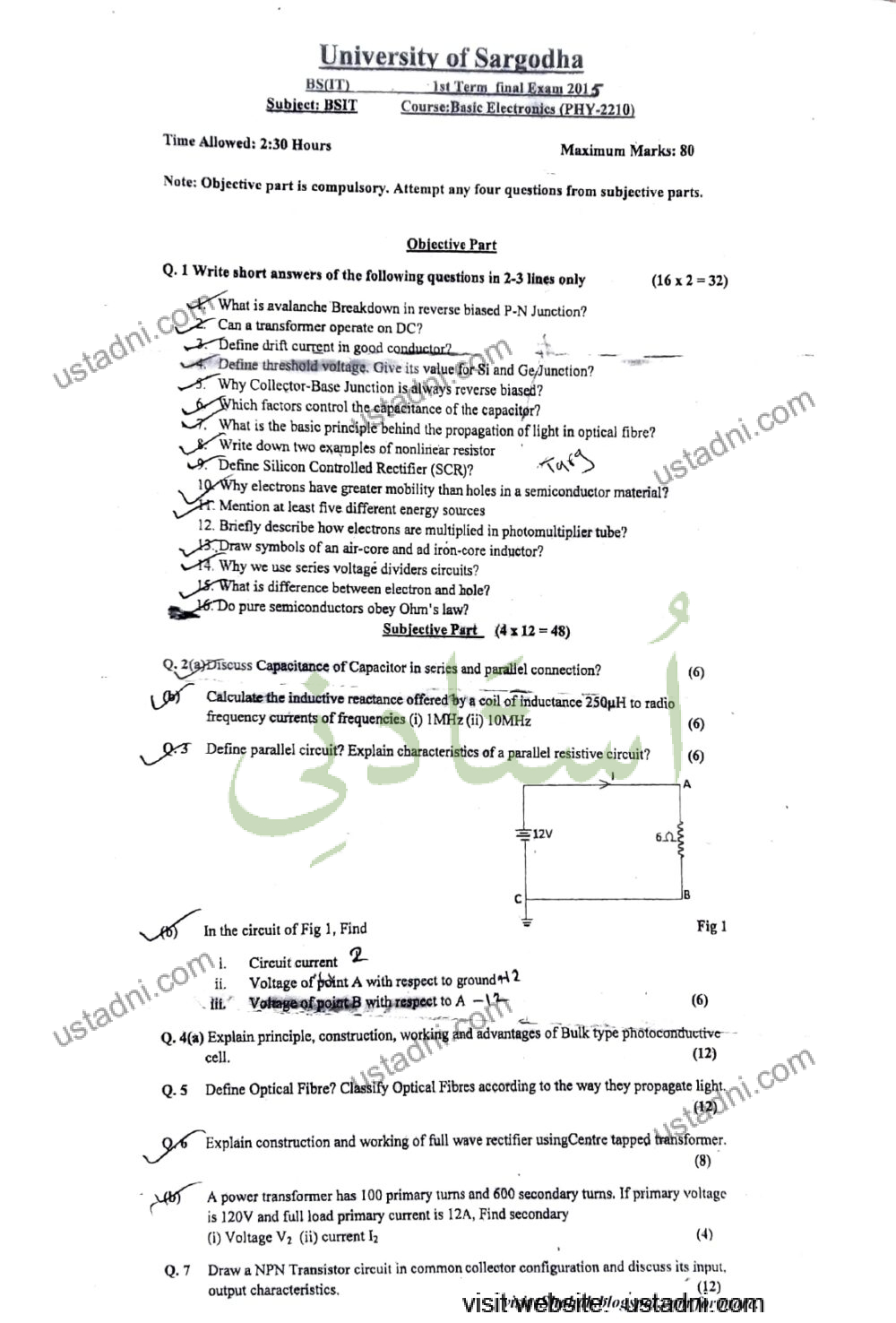 Basic Electronics AD/BS/BSIT University Of Sargodha (UOS) 2015
Uploaded 2 years ago
Download ↓
Basic Electronics AD/BS/BSIT University Of Sargodha (UOS) 2015
Uploaded 2 years ago
Download ↓
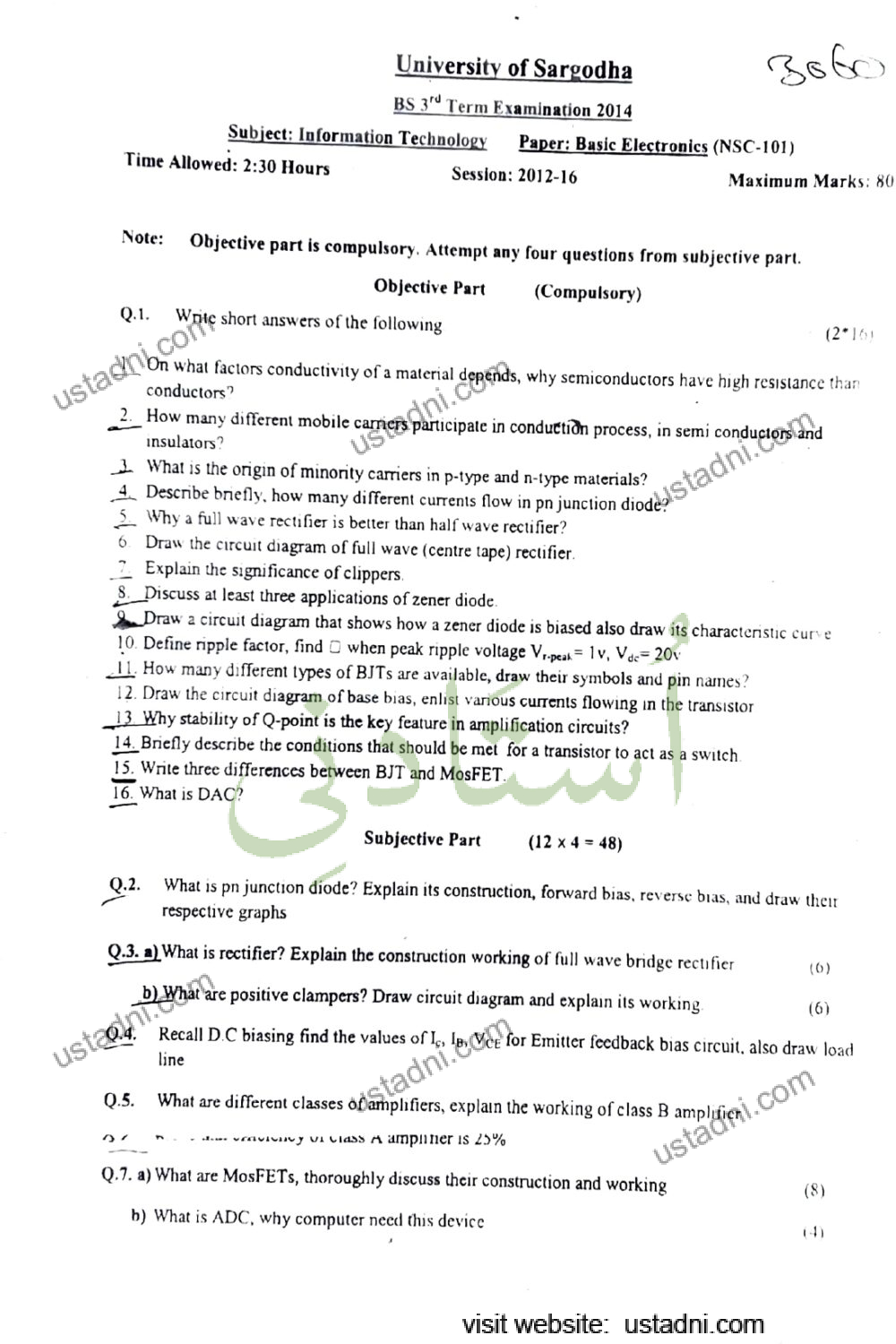 Basic Electronics ADC/BS/MPhil Information Technology 3 Semester/Term University Of Sargodha (UOS) 2014
Uploaded 2 years ago
Download ↓
Basic Electronics ADC/BS/MPhil Information Technology 3 Semester/Term University Of Sargodha (UOS) 2014
Uploaded 2 years ago
Download ↓
 Basic Electronics BS/MS Software Engineering/PhD Software Engineering 1 Semester/Term University Of Sargodha (UOS) 2017
Uploaded 2 years ago
Download ↓
Basic Electronics BS/MS Software Engineering/PhD Software Engineering 1 Semester/Term University Of Sargodha (UOS) 2017
Uploaded 2 years ago
Download ↓
 Basic Electronics BS 1 Semester/Term University Of Sargodha (UOS) 2016
Uploaded 2 years ago
Download ↓
Basic Electronics BS 1 Semester/Term University Of Sargodha (UOS) 2016
Uploaded 2 years ago
Download ↓
Paper text
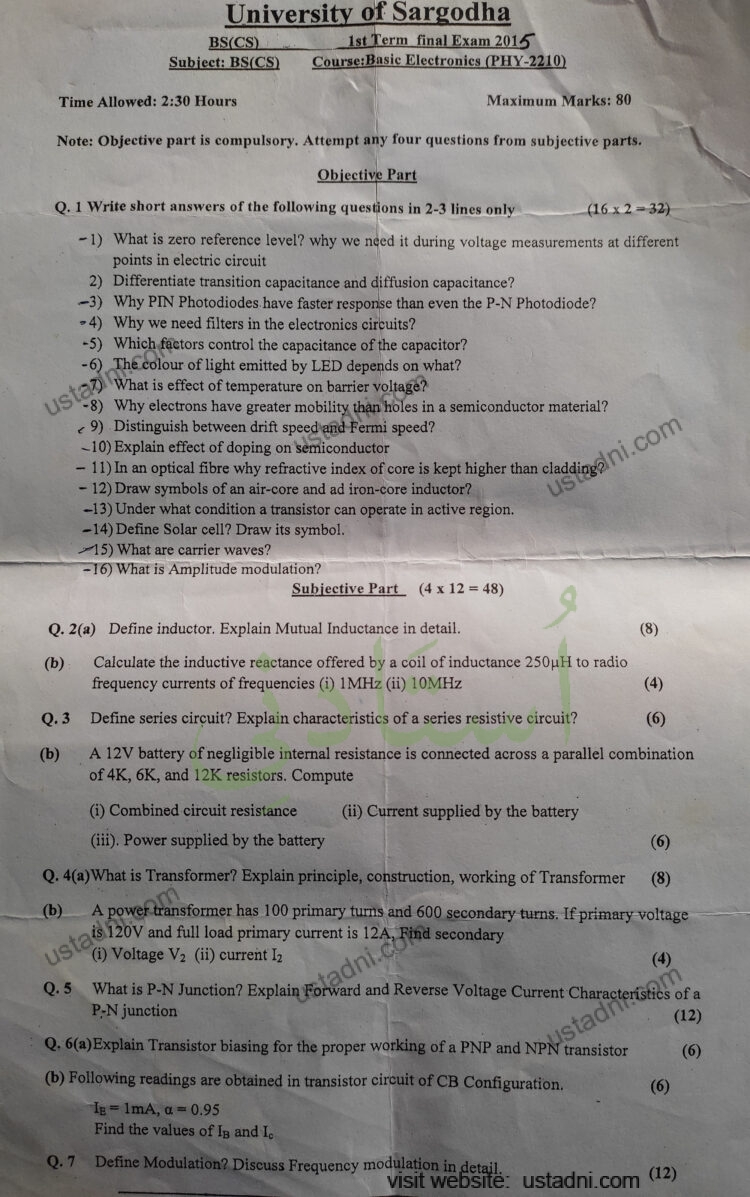
BS(CS)
Subject: BS(CS)
University of Sargodha
Ist Term final Exam 2015
Course:Basic Electronics (PHY-2210)
Time Allowed: 2:30 Hours
Maximum Marks: 80
Note: Objective part is compulsory. Attempt any four questions from subjective parts.
Objective Part
Q. 1 Write short answers of the following questions in 2-3 lines only
(16 x 2 =
32)
-
1) What is zero reference level? why we need it during voltage measurements at different
points in electric circuit
2) Differentiate transition capacitance and diffusion capacitance?
-3) Why PIN Photodiodes have faster response than even the P-N Photodiode?
-
4) Why we need filters in the electronics circuits?
-5) Which factors control the capacitance of the capacitor?
-6) The colour of light emitted by LED depends on what?
127)
What is effect of temperature on barrier voltage?
Why electrons have greater mobility than holes in a semiconductor material?
‹
9) Distinguish between drift speed and Fermi speed?
-
11) In an optical fibre why refractive index of core is kept higher than cladding? ni.Com
-10) Explain effect of doping on semiconductor
-
12) Draw symbols of an air-core and ad iron-core inductor?
-13) Under what condition a transistor can operate in active region.
-14) Define Solar cell? Draw its symbol.
15) What are carrier waves?
-16) What is Amplitude modulation?
Subjective Part (4x12 =
48)
Q. 2(a) Define inductor. Explain Mutual Inductance in detail.
(b) Calculate the inductive reactance offered by a coil of inductance 250uH to radio
frequency currents of frequencies
(i) 1MHz
(ii) 10MHz
Q. 3 Define series circuit? Explain characteristics of a series resistive circuit?
(8)
(4)
(6)
(b)
A 12V battery of negligible internal resistance is connected across a parallel combination
of 4K, 6K, and 12K resistors. Compute
(i) Combined circuit resistance
(ii) Current supplied by the battery
(ill). Power supplied by the battery
Q. 4(a) What is Transformer? Explain principle, construction, working of Transformer
(8)
(b)
A power transformer has 100 primary turns and 600 secondary turns. If primary voltage
is 120V and full load primary current is 12A, Find secondary
(i) Voltage V2
(ii) current Iz
Q.5
What is P-N Junction? Explain Forward and Reverse Voltage Current Characteristics of a
P-N junction
Q. 6(a) Explain Transistor biasing for the proper working of a PNP and NPN transistor
(4)
(12)
(6)
(b) Following readings are obtained in transistor circuit of CB Configuration.
(б)
Ig = 1mA, a = 0.95
Find the values of Ig and lo
Q. 7 Define Modulation? Discuss Frequency modulation in detail
visit website: ustadni.com )