
Subject: I.T/CS/SE Time Allowed: 02:30 Hours University of Sargodha ADP/BS 1º Semester Examination 2025
Discussion
Ask a question about this paper, or help someone else with theirs. Answers are emailed to whoever asked.
No questions yet — be the first to ask.
More Programming Fundamentals papers
See all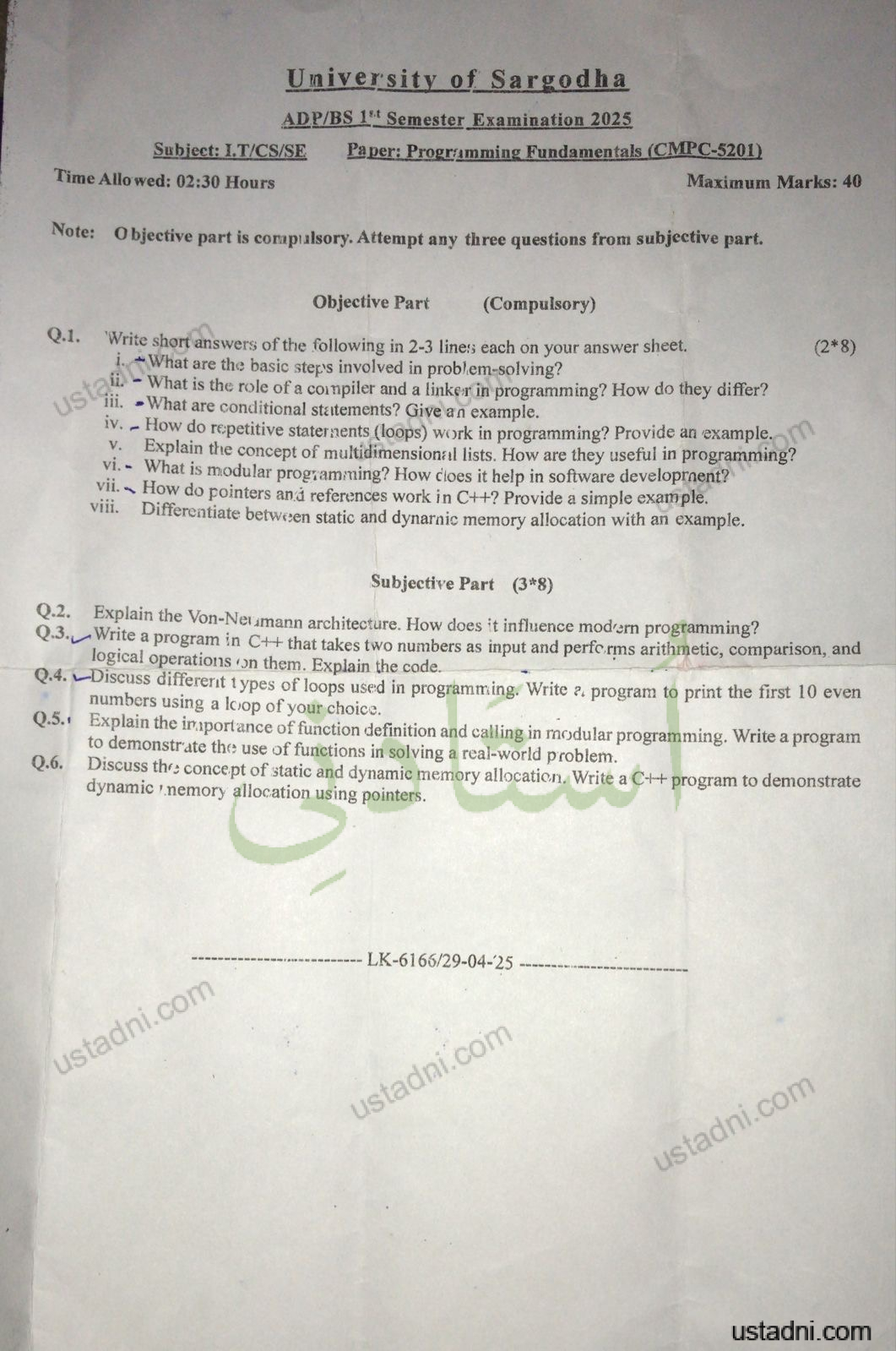 Programming Fundamentals (CMPC-5201) I.T/CS/SE University of Sargodha - ADP/BS 1' Semester Examination 2025
Uploaded 8 months ago
Download ↓
Programming Fundamentals (CMPC-5201) I.T/CS/SE University of Sargodha - ADP/BS 1' Semester Examination 2025
Uploaded 8 months ago
Download ↓
 Programming Fundamental (CMPC-102) UOS ADP-IT 2024 Paper 2nd Semester
Uploaded 1 year ago
Download ↓
Programming Fundamental (CMPC-102) UOS ADP-IT 2024 Paper 2nd Semester
Uploaded 1 year ago
Download ↓
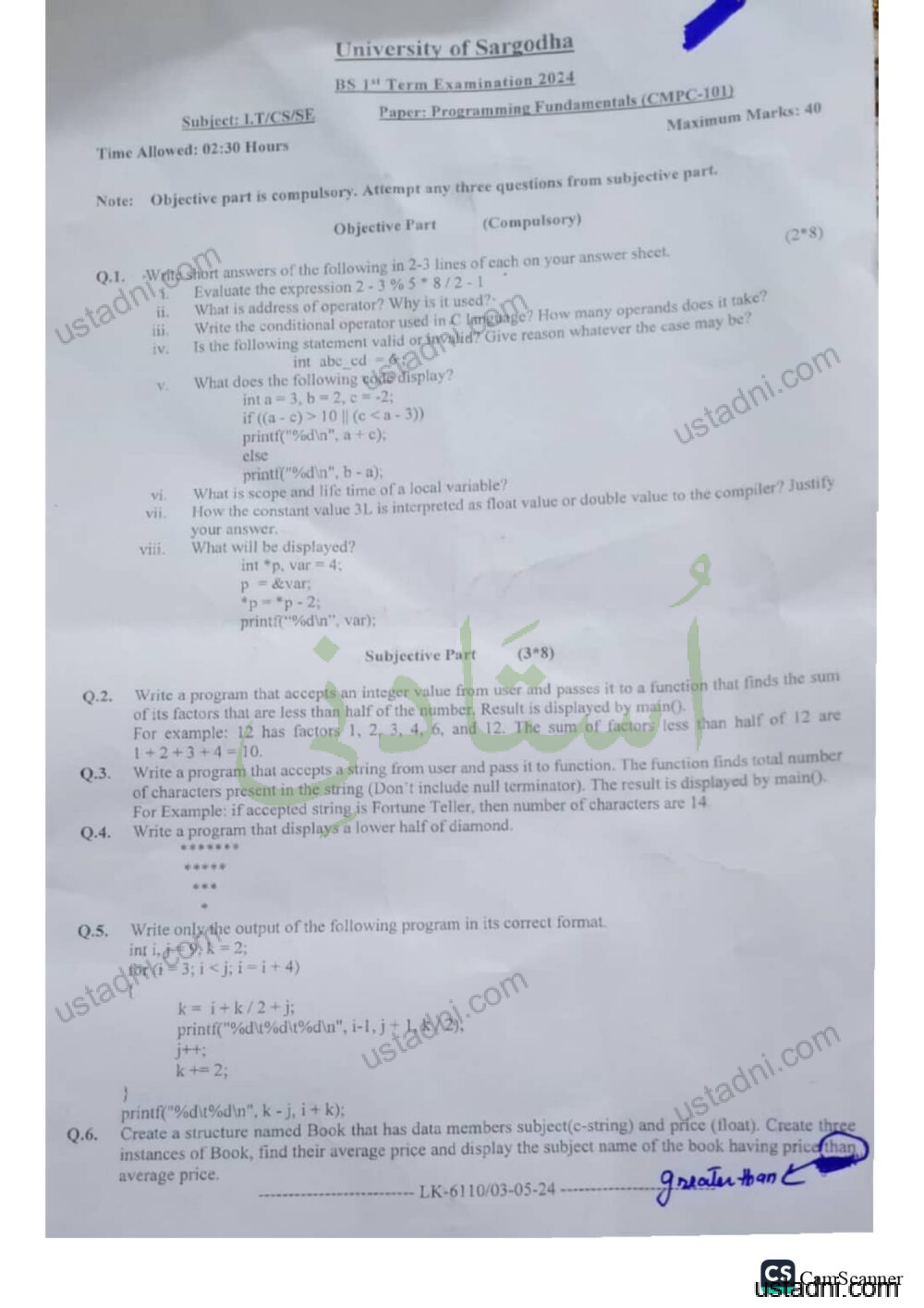 Bs-IT-Cs-SE-Programming-Fundamentals University Of Sargodha -2024.
Uploaded 1 year ago
Download ↓
Bs-IT-Cs-SE-Programming-Fundamentals University Of Sargodha -2024.
Uploaded 1 year ago
Download ↓
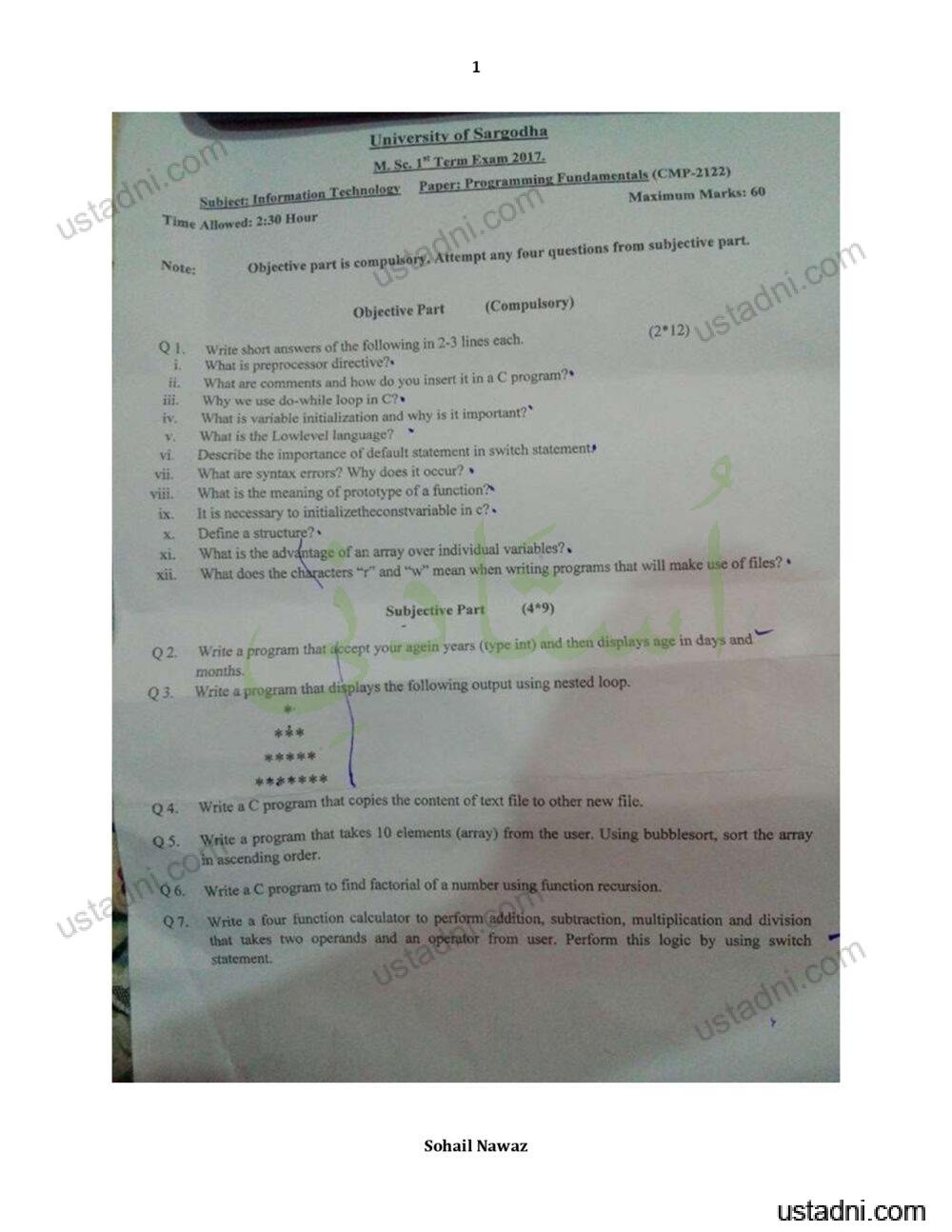 Programming-Fundamentals-Msc-IT UOS 2017.
Uploaded 1 year ago
Download ↓
Programming-Fundamentals-Msc-IT UOS 2017.
Uploaded 1 year ago
Download ↓
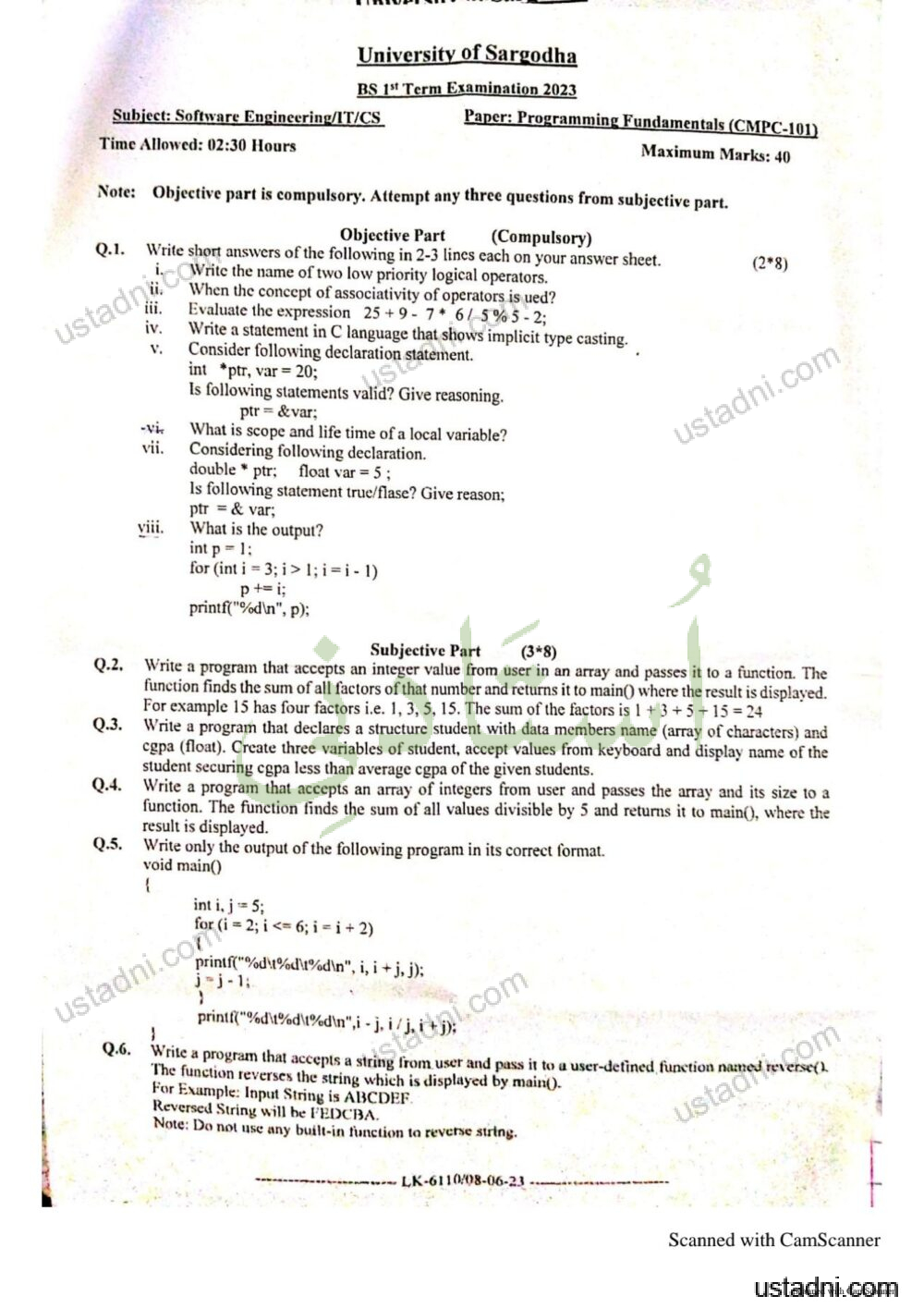 BS-IT-CS-SE-Programming-Fundamentals UOS ( University Of Sargodha) -2023
Uploaded 1 year ago
Download ↓
BS-IT-CS-SE-Programming-Fundamentals UOS ( University Of Sargodha) -2023
Uploaded 1 year ago
Download ↓
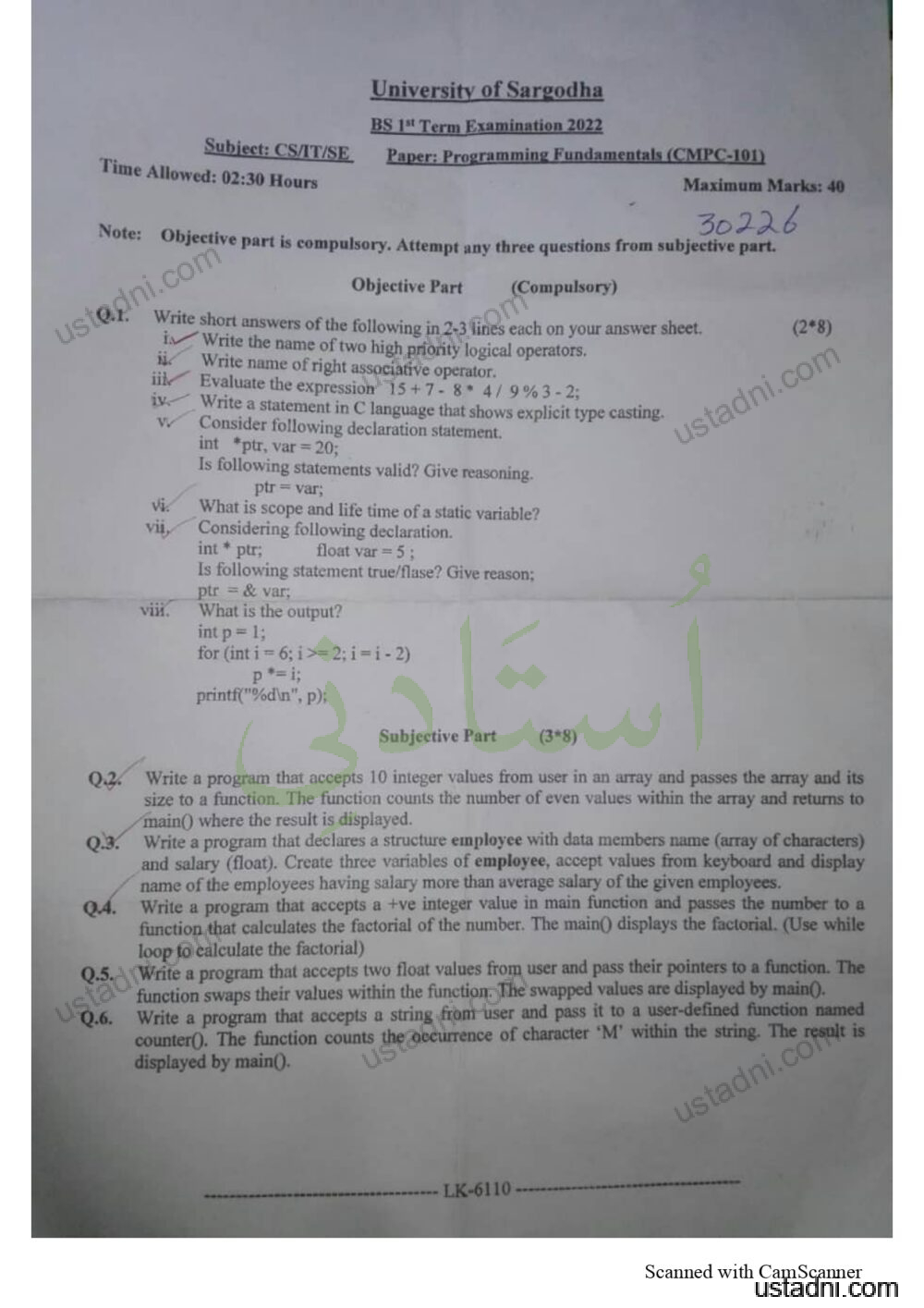 Bs-CS-SE-IT-Programming-Fundamentals University of Sargodha -2022.
Uploaded 1 year ago
Download ↓
Bs-CS-SE-IT-Programming-Fundamentals University of Sargodha -2022.
Uploaded 1 year ago
Download ↓
Paper text
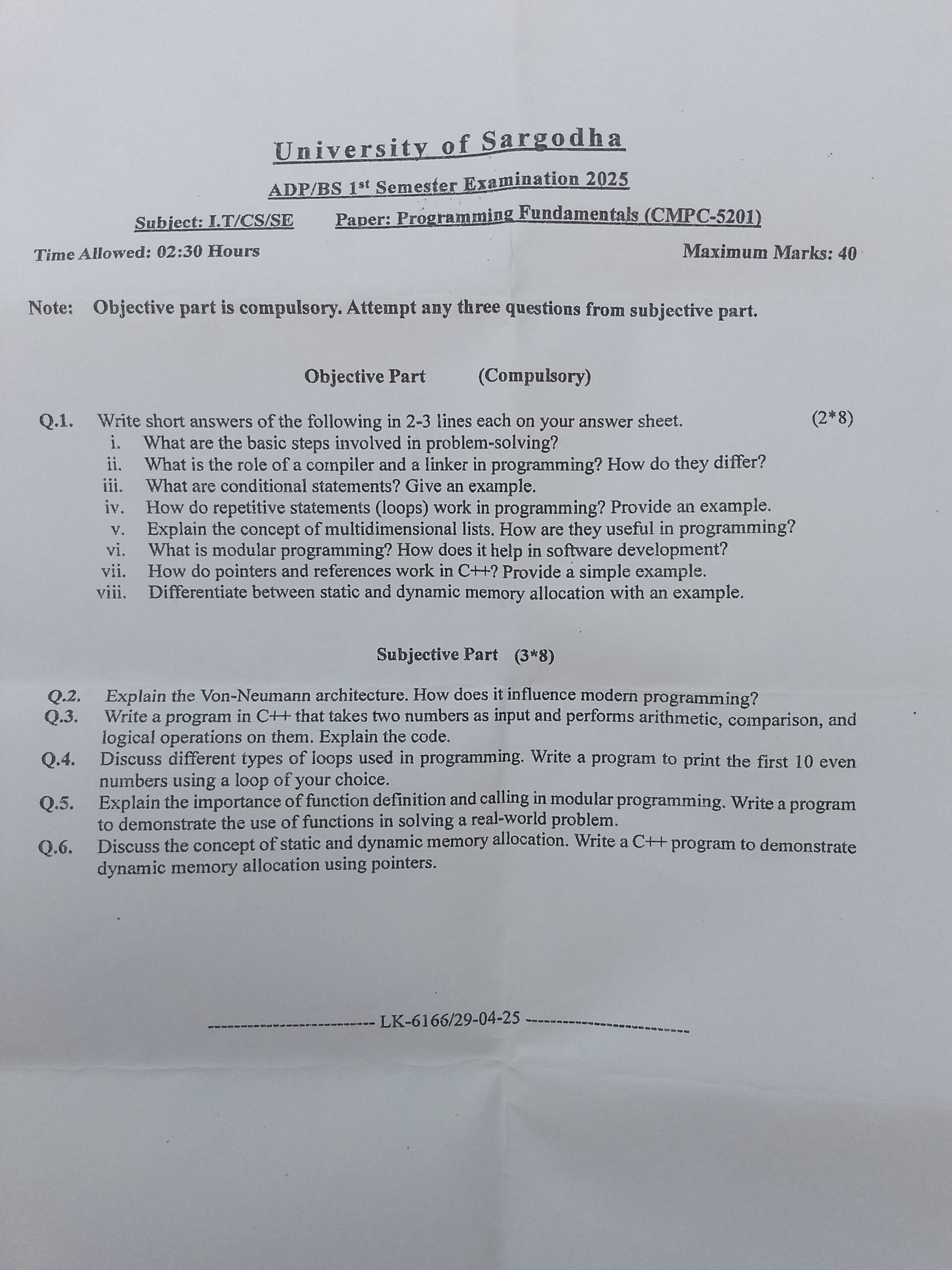
Subject: I.T/CS/SE
Time Allowed: 02:30 Hours
University of Sargodha
ADP/BS 1º Semester Examination 2025
Paper: Programming Fundamentals (CMPC-5201)
Maximum Marks: 40
Note: Objective part is compulsory. Attempt any three questions from subjective part.
Objective Part (Compulsory)
Q.1. Write short answers of the following in 2-3 lines each on your answer sheet.
i. What are the basic steps involved in problem-solving?
il. What is the role of a compiler and a linker in programming? How do they differ?
iii.
What are conditional statements? Give an example.
iv. How do repetitive statements (loops) work in programming? Provide an example.
V.
Explain the concept of multidimensional lists. How are they useful in programming?
vi.
What is modular programming? How does it help in software development?
vii. How do pointers and references work in C++? Provide a simple example.
vili. Differentiate between static and dynamic memory allocation with an example.
2*8)
Subjective Part (3*8)
Q.2.
Explain the Von-Neumann architecture. How does it influence modern programming?
0.3.
Write a program in Ct that takes two numbers as input and performs arithmetic, comparison, and
logical operations on them. Explain the code.
Q.4.
Discuss different types of loops used in programming. Write a program to print the first 10 even
numbers using a loop of your choice.
Q.5.
Explain the importance of function definition and calling in modular programming. Write a program
to demonstrate the use of functions in solving a real-world problem.
Q.6.
Discuss the concept of static and dynamic memory allocation. Write a Ct + program to demonstrate
dynamic memory allocation using pointers.
LK-6166/29-04-25