
University of Sargedha BS 5* Term Examination 2018 Subicct: Computer Science Paper: Numerical Computing (CS: 3941) Time Allowed: 2:30 Hour

Discussion
Ask a question about this paper, or help someone else with theirs. Answers are emailed to whoever asked.
No questions yet — be the first to ask.
More Numerical Computing papers
See all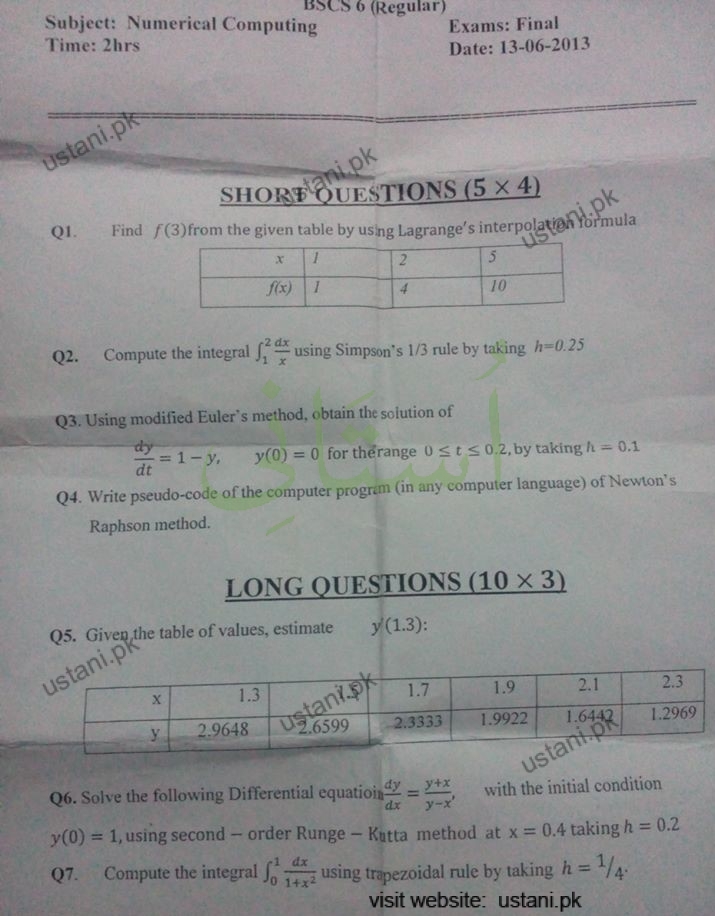 Numerical Computing BSCS 2013 UOS
Uploaded 3 years ago
Download ↓
Numerical Computing BSCS 2013 UOS
Uploaded 3 years ago
Download ↓
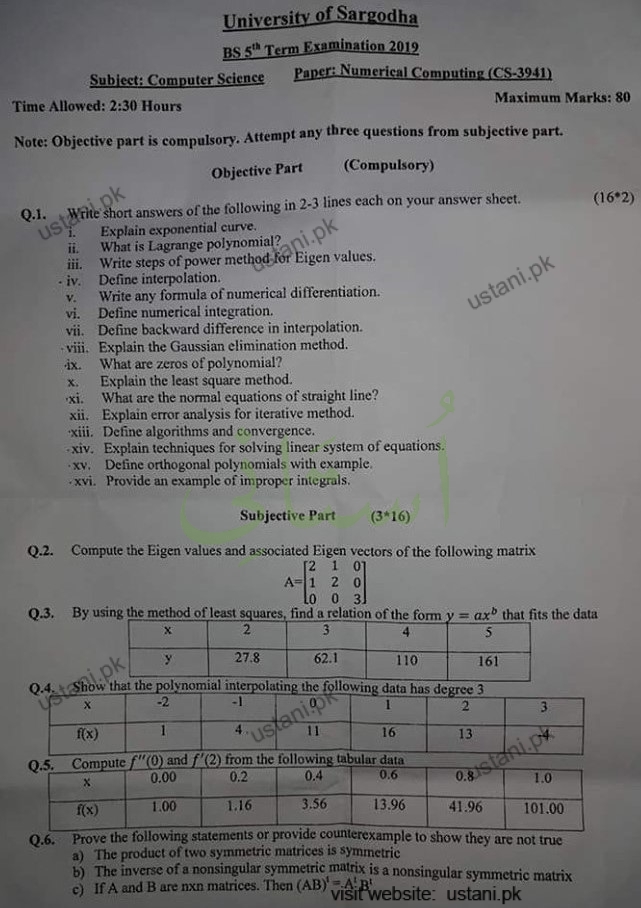 Numerical Computing BSCS 2019 UOS
Uploaded 3 years ago
Download ↓
Numerical Computing BSCS 2019 UOS
Uploaded 3 years ago
Download ↓
 Numerical Computing BSCS 2022 UOS
Uploaded 3 years ago
Download ↓
Numerical Computing BSCS 2022 UOS
Uploaded 3 years ago
Download ↓
 Numerical Computing BSCS 2020 UOS
Uploaded 3 years ago
Download ↓
Numerical Computing BSCS 2020 UOS
Uploaded 3 years ago
Download ↓
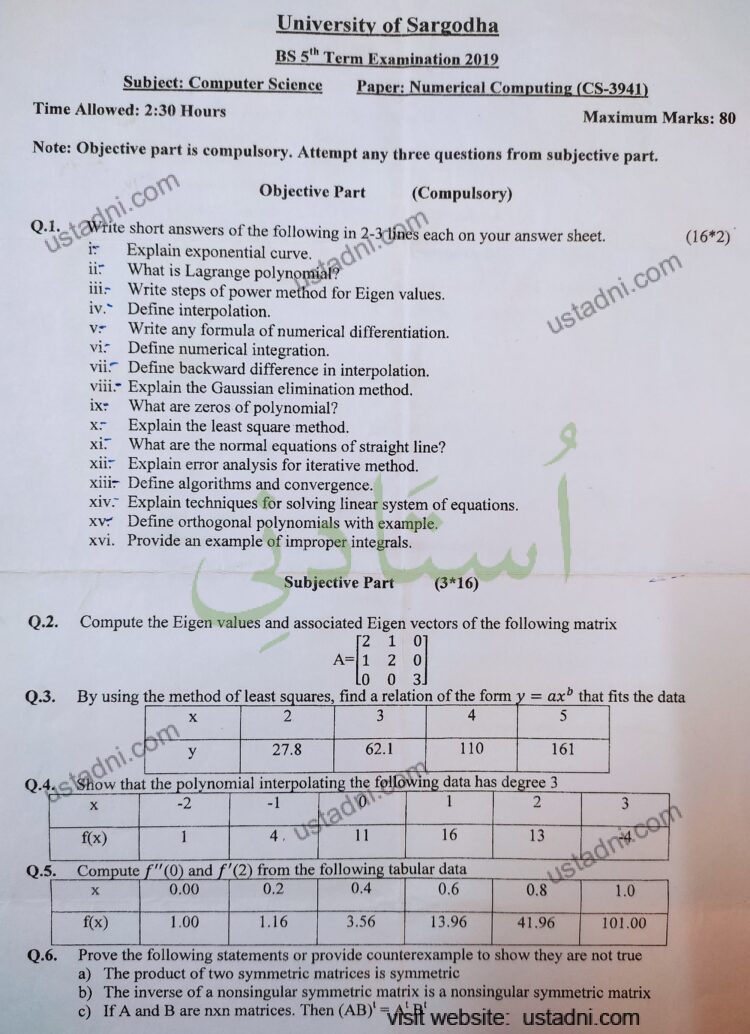 Numerical Computing BSCS 2019 UOS
Uploaded 3 years ago
Download ↓
Numerical Computing BSCS 2019 UOS
Uploaded 3 years ago
Download ↓
 Numerical Computing BSCS 2018 UOS
Uploaded 3 years ago
Download ↓
Numerical Computing BSCS 2018 UOS
Uploaded 3 years ago
Download ↓
Paper text
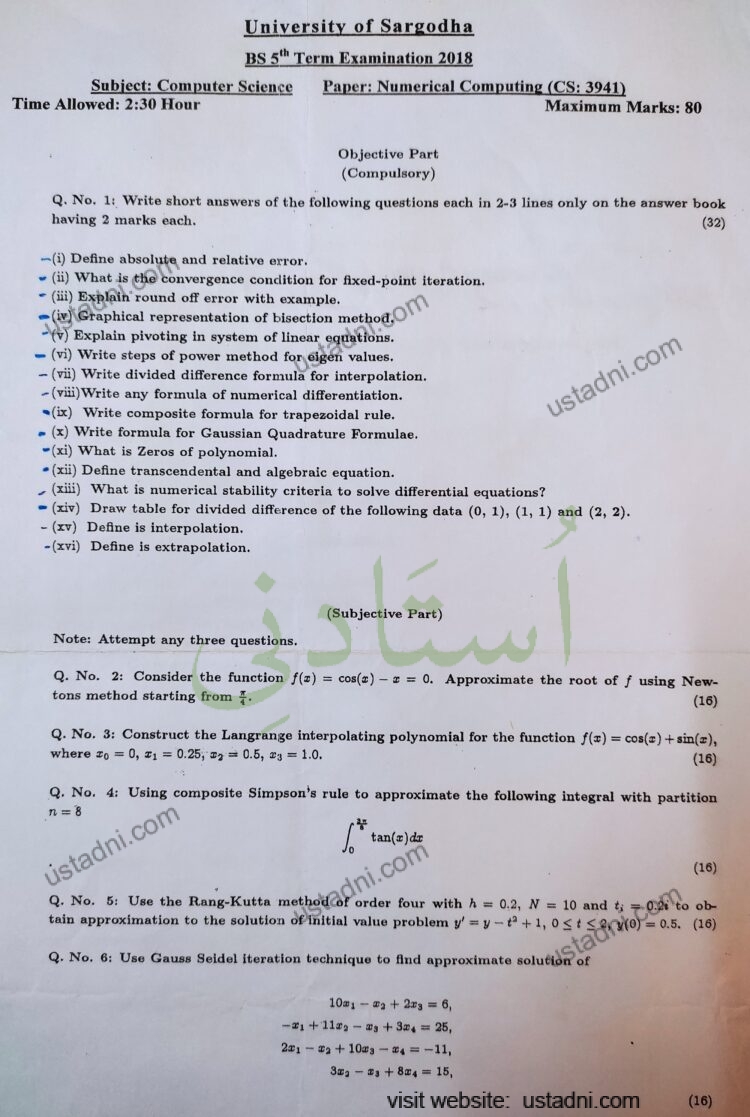
University of Sargedha
BS 5* Term Examination 2018
Subicct: Computer Science Paper: Numerical Computing (CS: 3941)
Time Allowed: 2:30 Hour
Maximum Marks: 80
Objective Part
(Compulsory)
Q. No. I Strite short answers of the following quertione each in 2-3 lines only on the anewer book
having 2 marks each.
(32)
-(i) Define absolute and relative error.
-
(a) What in the convergence condistes for fixed-point Iteration.
- (1) Explain round off error with example.
-(iv) Graphical representation of bisection method.
- (v) Explain pivoting In system of linear equations.
-
(vi) Write steps of power method for eigen values.
ustadni.com
- (vil) Write divided difference formula for interpolation.
-(vill) Write any formula of numerical differentiation.
•(ix) Write composite formula for trapezoidal rule.
- (x) Write formula for Gaussian Quadrature Formulne.
-(xi) What is Zeros of polynomial.
• (xil) Define transcendental and algebraic equation.
- (xili) What is numerical stability criteria to solve differential equations?
-
(xiv) Draw table for divided difference of the following data (0, 1), (1,
1) and (2, 2).
- (x) Define is interpolation.
-(xvi) Define is extrapolation.
(Subjective Part)
Note: Attempt any three questions.
Q. No. 2: Consider the function f(=) = cos(s) - z =
0. Approximate the root of / using New-
tons method starting from
(16)
Q. No. 3: Construct the Langrange interpolating polynomial for the function f(=) = cos(2) + sin(2),
where to = 0, =, = 0.25, =z = 0.5, =g = 1.0.
(16)
Q. No.
4C Using composite Simpson's rule to approximate the following integral with partition
tan(z) dz
com
(16)
Q. No. 5: Use the Rang-Kutta method of order four with ^ = 0.2, N = 10 and i, = 0.2i to ob-
tain approximation to the solution of initial value problem y'= y-p+ 4,051 ≤ 2, (0) = 0.5. (16)
Q. No. 6: Use Gauss Seidel Iteration technique to find approximate solution of
102g - =a + 2zg = 6,
-=, + +11z, - 3y + 32, = 25,
2=1 - 52 + 10zy -24=-11,
3=, - wistewebsite: ustadni.com