
University of Sargodha ADP/BS 2"d Semester (F-24) Examination 2025 Subiest: SAT/S Paper: Database System (CMPC-5203) Time Allowed: 02:30 Hours

Discussion
Ask a question about this paper, or help someone else with theirs. Answers are emailed to whoever asked.
No questions yet — be the first to ask.
More Database System papers
See all Database System BS 4 Semester/Term UOS — University of Sargodha 2024
Uploaded 8 days ago
Download ↓
Database System BS 4 Semester/Term UOS — University of Sargodha 2024
Uploaded 8 days ago
Download ↓
 Database System M.Sc. 3 Semester/Term UOS — University of Sargodha 2015
Uploaded 8 days ago
Download ↓
Database System M.Sc. 3 Semester/Term UOS — University of Sargodha 2015
Uploaded 8 days ago
Download ↓
 Database System MS Computer Science/MSc Computer Science/PhD Computer Science
Uploaded 26 days ago
Download ↓
Database System MS Computer Science/MSc Computer Science/PhD Computer Science
Uploaded 26 days ago
Download ↓
 Database System ADP/BS 2 Semester/Term University Of Sargodha (UOS) 2025
Uploaded 1 month ago · by Jaweria Gull
Download ↓
Database System ADP/BS 2 Semester/Term University Of Sargodha (UOS) 2025
Uploaded 1 month ago · by Jaweria Gull
Download ↓
 Database System AD/ADP/BS 2 Semester/Term University Of Sargodha (UOS) 2025
Uploaded 3 months ago
Download ↓
Database System AD/ADP/BS 2 Semester/Term University Of Sargodha (UOS) 2025
Uploaded 3 months ago
Download ↓
 Database System ADP/BS 2 Semester/Term University Of Sargodha (UOS) 2025
Uploaded 10 months ago
Download ↓
Database System ADP/BS 2 Semester/Term University Of Sargodha (UOS) 2025
Uploaded 10 months ago
Download ↓
Paper text
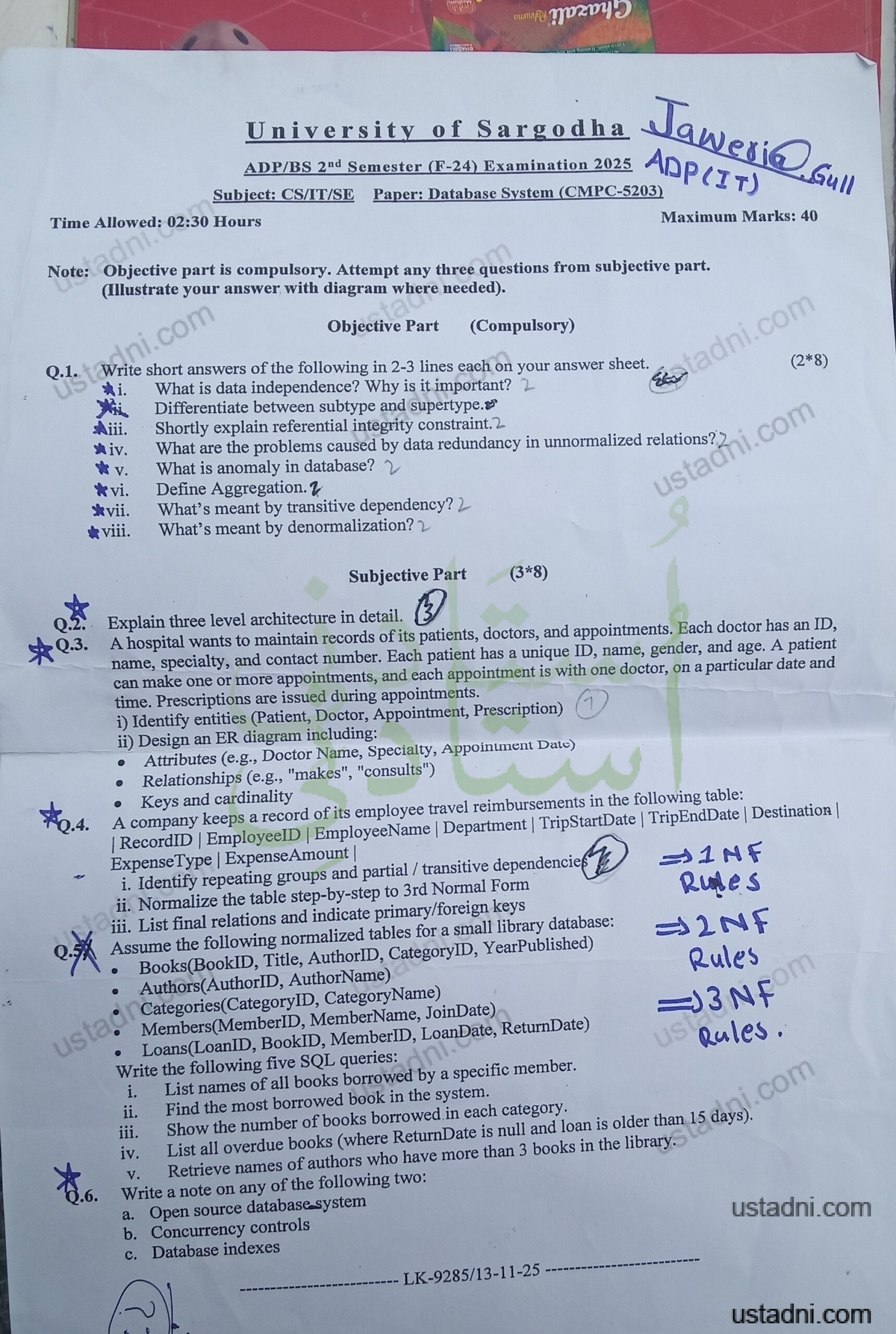
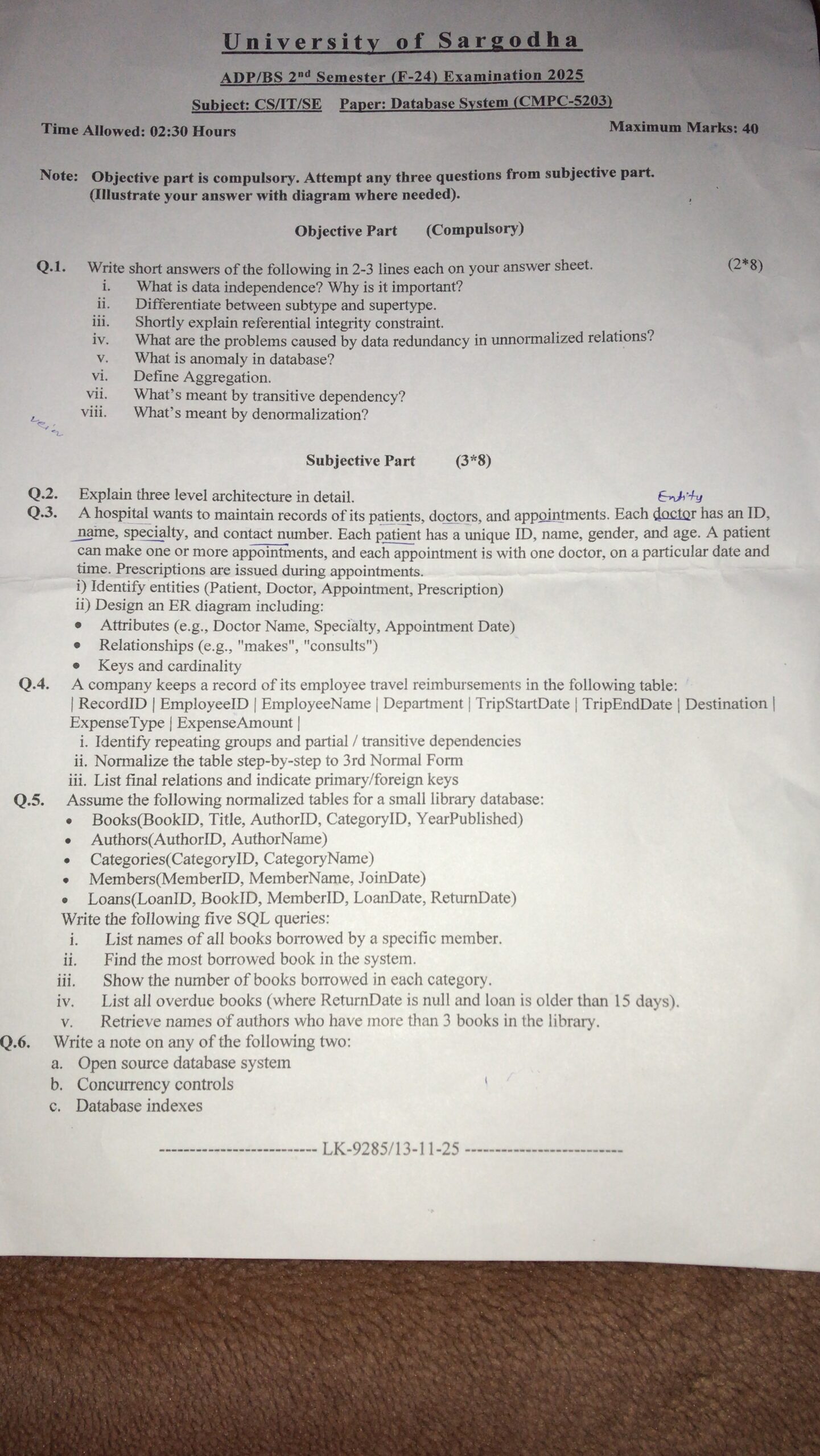
University of Sargodha
ADP/BS 2"d Semester (F-24) Examination 2025
Subiest: SAT/S Paper: Database System (CMPC-5203)
Time Allowed: 02:30 Hours
Note:
Objective part is compulsory. Attempt any three questions from subjeetive part.
(Illustrate your answer with dingram where needed).
Objective Part (Compulsory)
Q.1.
Write short answers of the following in 2-3 lines cach on your answer sheet.
1.
ii.
ili.
iv.
V.
vi.
Vil.
vili.
What is data independence? Why is it important?
Differentiate between subtype and supertype.
Shortly explain referential integrity constraint.
What are the problems caused by data redundancy in unnormalized relations?
What is anomaly in database?
Define Aggregation.
What's meant by transitive dependency?
What's meant by denormalization?
Maximum Marks: 40
(2*8)
Subjective Part
(3*8)
Q.2.
Q.3.
Explain three level architecture in detail.
A hospital wants to maintain records of its patients, doctors, and appointments. Each doctor has an IP,
name, specialty, and contact number. Each patient has a unique ID, name, gender, and age. A patient
can make one or more appointments, and each appointment is with one doctor, on a particular date and
time. Prescriptions are issued during appointments.
i) Identify entities (Patient, Doctor, Appointment, Prescription)
ii) Design an ER diagram including:
• Attributes (e.g., Doctor Name, Specialty, Appointment Date)
• Relationships (e.g., "makes", "consults")
•
Keys and cardinality
Q.4.
A company keeps a record of its employee travel reimbursements in the following table:
| RecordID | EmployeeID | EmployeeName | Department | TripStartDate | TripEndDate | Destination |
ExpenseType | ExpenseAmount |
i. Identify repeating groups and partial / transitive dependencies
ii. Normalize the table step-by-step to 3rd Normal Form
ili. List final relations and indicate primary/foreign keys
Q.5. Assume the following normalized tables for a small library database:
• Books(BookID, Title, AuthorID, CategoryID, YearPublished)
• Authors(AuthorID, AuthorName)
• Categories(CategoryID, CategoryName)
• Members(MemberID, MemberName, JoinDate)
• Loans(LoanID, BookID, MemberID, LoanDate, ReturnDate)
Write the following five SQL queries:
List names of all books borrowed by a specific member.
it Find the most borrowed book ta the system.
iii. Show the number of books borrowed in each category.
iv.
List all overdue books (where ReturnDate is null and loan is older than 15 days).
V.
Retrieve names of authors who have more than 3 books in the library.
Q.6.
Write a note on any of the following two:
a. Open source database system
b. Concurrency controls
c. Database indexes
-- LK-9285/13-11-25 -