
University of Sargodha BS 3m Semester (5* Intake) Exam 2025 Subject: Information Technology Paper: Artificial Intelligence (ITEC-3810)
Discussion
Ask a question about this paper, or help someone else with theirs. Answers are emailed to whoever asked.
No questions yet — be the first to ask.
Paper text
University of Sargodha
BS 3m Semester (5* Intake) Exam 2025
Subject: Information Technology
Paper: Artificial Intelligence (ITEC-3810)
Time Allowed: 2:30 Hours
Maximum Marks: 60
Note: Objective part is compulsory. Attempt any three questions from subjective part.
Objective Part
(Compulsory)
Q.1.
Write short answers of the following in 2-3 lines of each on your answer sheet.
(2*12)
Define a neighborhood.
Will stochastic hill-climbing search always find a valid sentence?
Does depth first search find an optimal path with respect to the cost of the path?
Can breadth first search find an optimal path with respect to the number of steps in the path?
Using constraint propagation as part of DFS with backtracking increases the time complexity of the
search. Why?
Do you think that Best-first search can be thought of as a special case of A*?
Is a heuristic that always evaluates to hs) = 1 for non-goal search nodes s, always admissible?
How does the k-Nearest Neighbors approach scales to high dimensional spaces?
In which form, knowledge is contained in the agents?
Can propositional logic handle propositions that are completely unknown?
How a possible world, or model, for first-order logic is defined?
What is spatial reasoning?
Q.2.
Q.3.
Q.4.
Subjective Part
(3*
12)
For each of the following algorithms, state whether it is guaranteed to converge to the global
maximum. Assume that the state space is finite. Justify your answer briefly (2 to 3 sentences) for
the following algorithms.
a) Hil-climbing from a randomly chosen initial condition.
b) Simulated annealing
c) Genetic algorithms
Let A and B be two binary random variables independent events with probabilities P(A =
1) = 0.1
and P(B =
1) = 0.4. Let C denote the event that at least one of the events A and B is on, i.e., C=A
OR B, and let D be the event that exactly one of the events A and B occurs, i.e., D = A XOR B.
a) Compute P(C = 1).
b) Compute P(D = 1).
c) Compute P(D(A).
d) Prove that A and D are not independent.
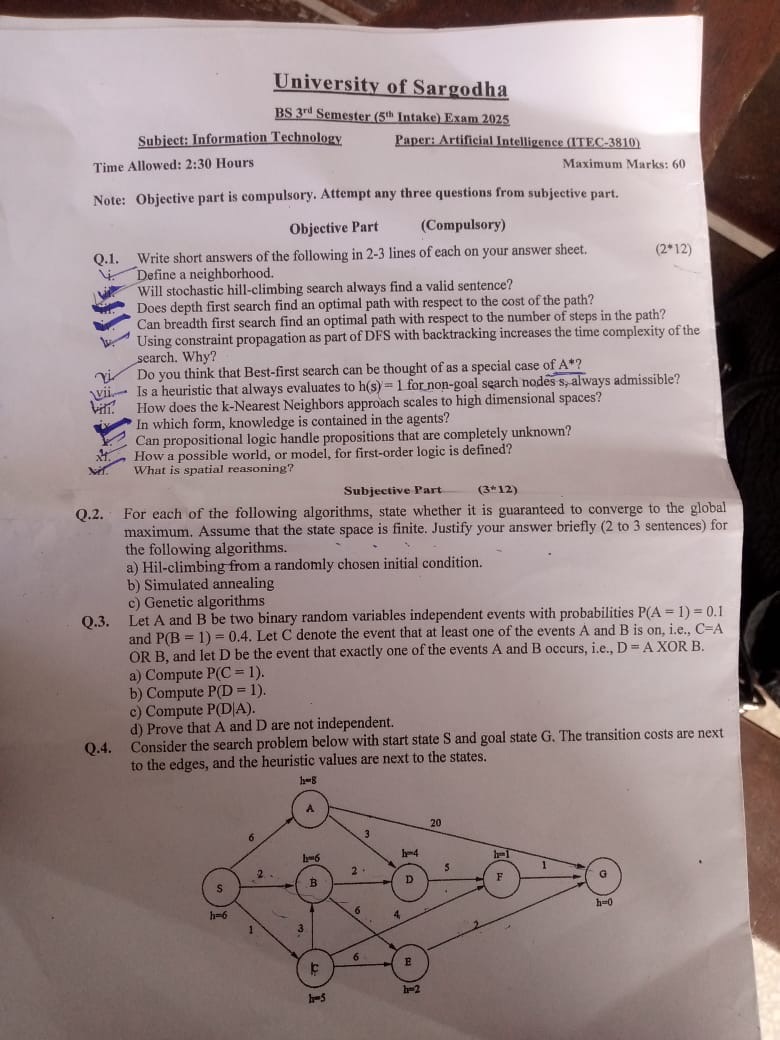
Consider the search problem below with start state S and goal state G. The transition costs are next
to the edges, and the heuristic values are next to the states.
hw8
20