
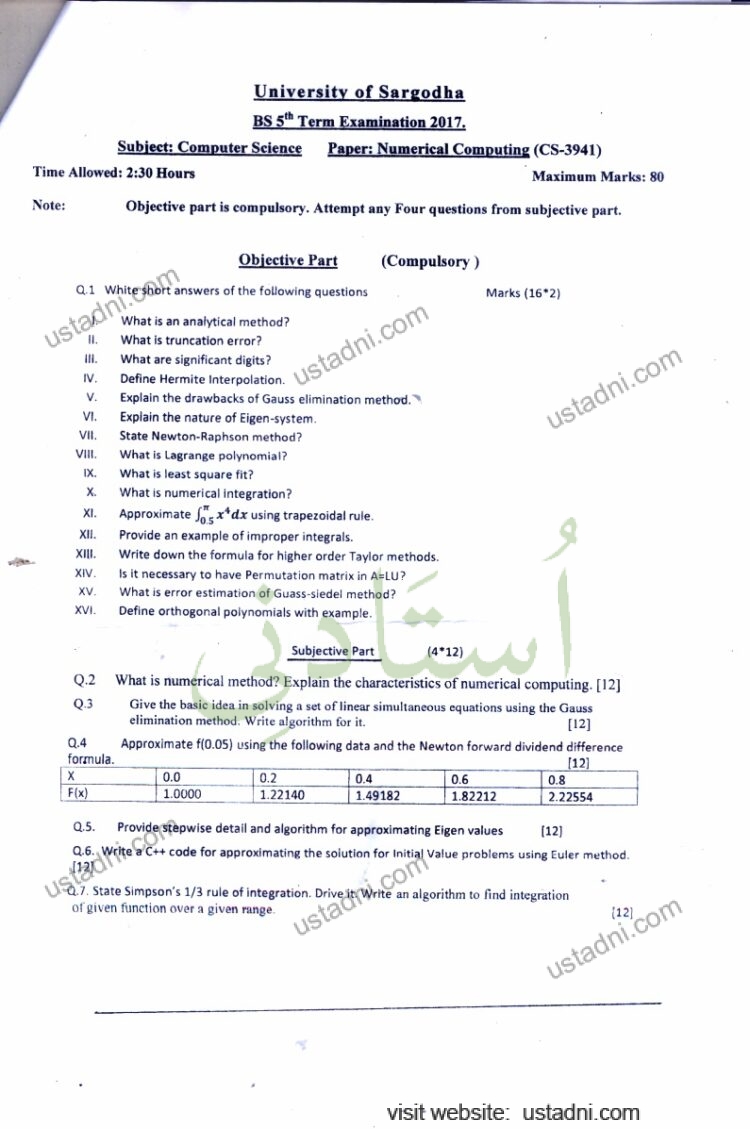
University of Sargodha BS st Term Examination 2017. Subject: Computer Science Paper: Numerical Computing (CS-3941) Time Allowed: 2:30 Hours
Discussion
Ask a question about this paper, or help someone else with theirs. Answers are emailed to whoever asked.
No questions yet — be the first to ask.
More Numerical Computing papers
See all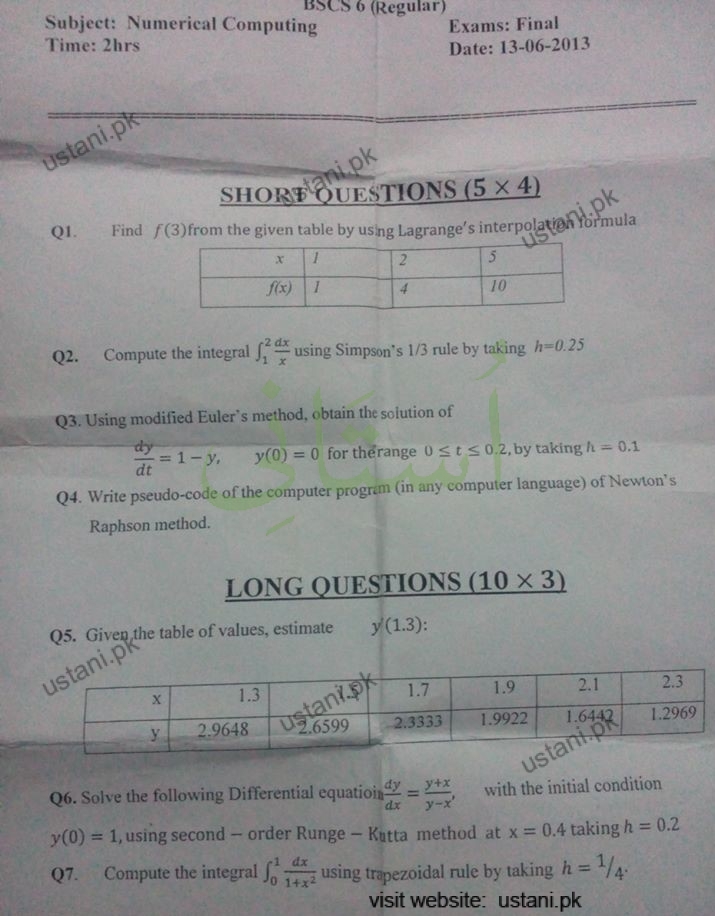 Numerical Computing BSCS 2013 UOS
Uploaded 3 years ago
Download ↓
Numerical Computing BSCS 2013 UOS
Uploaded 3 years ago
Download ↓
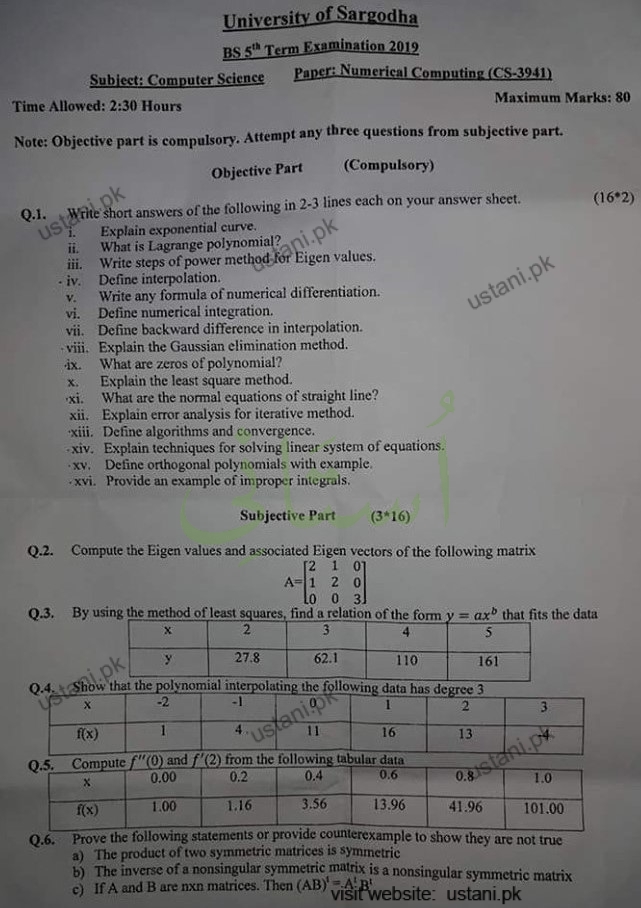 Numerical Computing BSCS 2019 UOS
Uploaded 3 years ago
Download ↓
Numerical Computing BSCS 2019 UOS
Uploaded 3 years ago
Download ↓
 Numerical Computing BSCS 2022 UOS
Uploaded 3 years ago
Download ↓
Numerical Computing BSCS 2022 UOS
Uploaded 3 years ago
Download ↓
 Numerical Computing BSCS 2020 UOS
Uploaded 3 years ago
Download ↓
Numerical Computing BSCS 2020 UOS
Uploaded 3 years ago
Download ↓
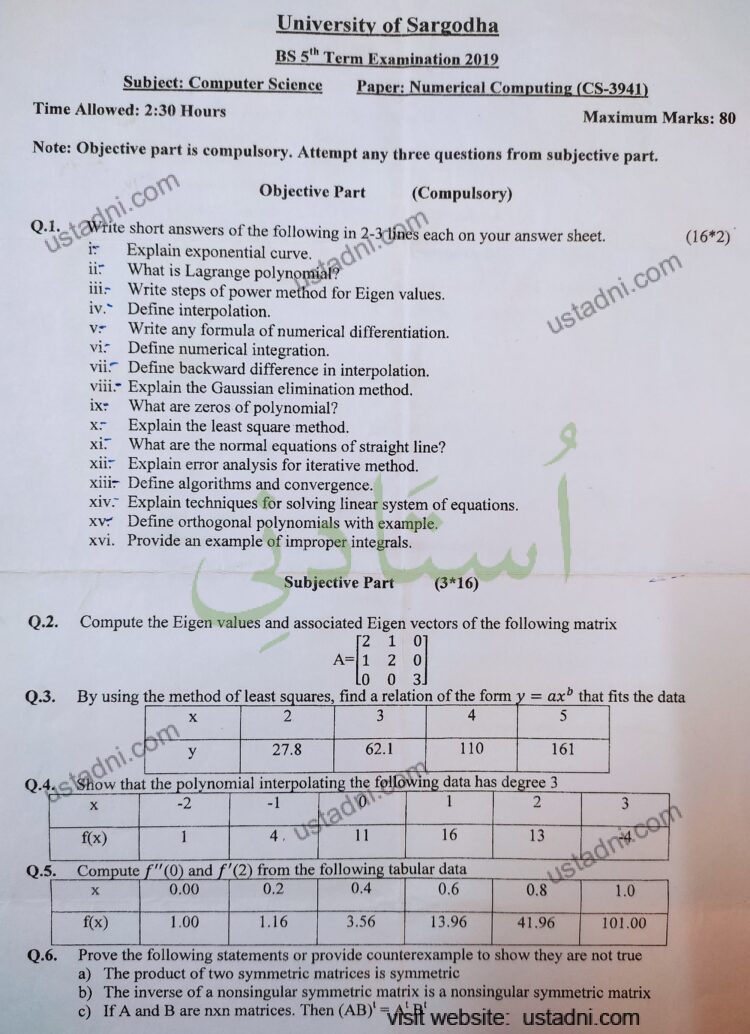 Numerical Computing BSCS 2019 UOS
Uploaded 3 years ago
Download ↓
Numerical Computing BSCS 2019 UOS
Uploaded 3 years ago
Download ↓
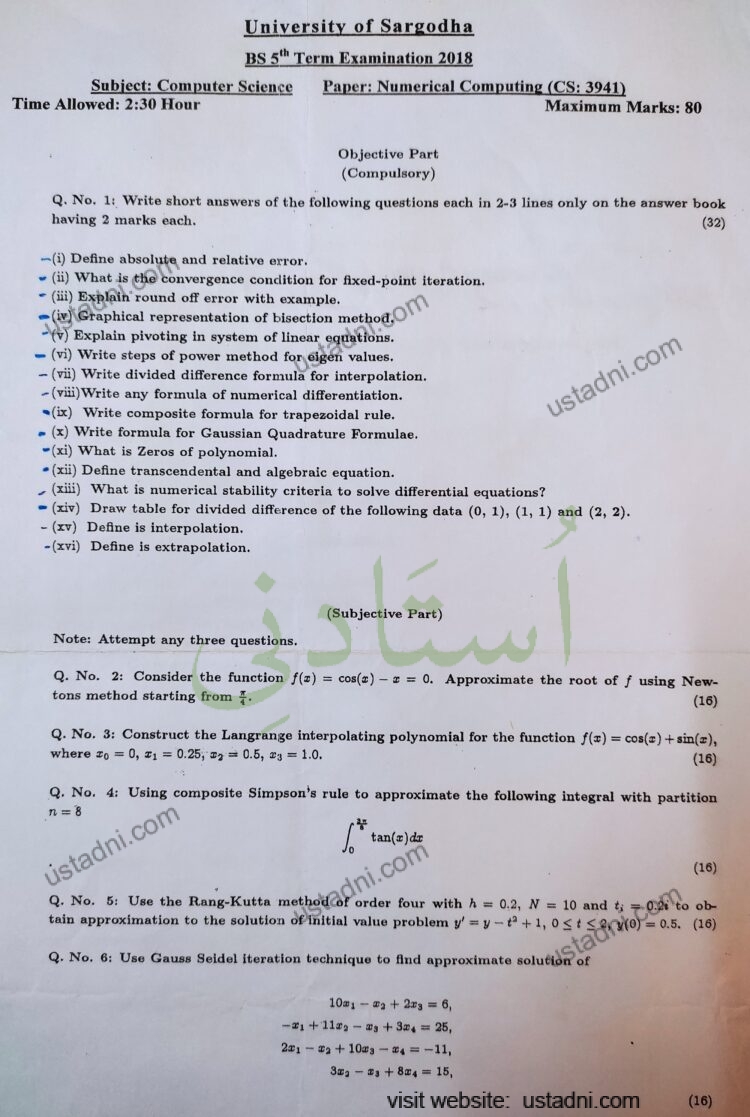 Numerical Computing BSCS 2018 UOS
Uploaded 3 years ago
Download ↓
Numerical Computing BSCS 2018 UOS
Uploaded 3 years ago
Download ↓
Paper text
University of Sargodha
BS st Term Examination 2017.
Subject: Computer Science Paper: Numerical Computing (CS-3941)
Time Allowed: 2:30 Hours
Maximum Marks: 80
Note:
Objective part is compulsory. Attempt any Four questions from subjective part.
Objective Part
Q.1 White short answers of the following questions
(Compulsory )
ustadn
What is an analytical method?
Il.
What is truncation error?
Ill.
What are significant digits?
IV.
Marks (16*2)
ustadni.com
VI.
VIl.
VIlI.
IX.
XI.
XII.
XIII.
XIV.
XV.
XVI.
Explain the drawbacks of Gauss elimination method. "
Explain the nature of Eigen-system.
State Newton-Raphson method?
What is Lagrange polynomial?
What is least square fit?
What is numerical integration?
Approximate Jos **dx using trapezoidal rule.
Provide an example of improper integrals.
Write down the formula for higher order Taylor methods.
Is it necessary to have Permutation matrix in AsLU?
What is error estimation of Guass-siedel method?
Define orthogonal polynomials with example.
Subjective Part
(4*12)
Q.2
What is numerical method? Explain the characteristics of numerical computing. [12]
Q.3
Give the basic idea in solving a set of linear simultancous equations using the Gauss
elimination method. Write algorithm for it.
[12]
Q.4
formula.
Approximate f(0.05) using the following data and the Newton forward dividend difference
F(x)
0.0
1.0000 (
0.2
1.22140
0.4
1.49182
0.6
1.82212
0.8
2.22554
Provide stepwise detail and algorithm for approximating Eigen values
Q.6. Write a C++ code for approximating the solution for Initial Value problems using Euler method
Q.7. State Simpson's 1/3 rule of integration. Drive it Write an algorithm to find integration
of given function over a given range.
ustadni.com
visit website: ustadni.com