
Computer Architecture BSCS 4 Semester/Term UOS — University of Sargodha 2016
Discussion
Ask a question about this paper, or help someone else with theirs. Answers are emailed to whoever asked.
No questions yet — be the first to ask.
More Computer Architecture papers
See all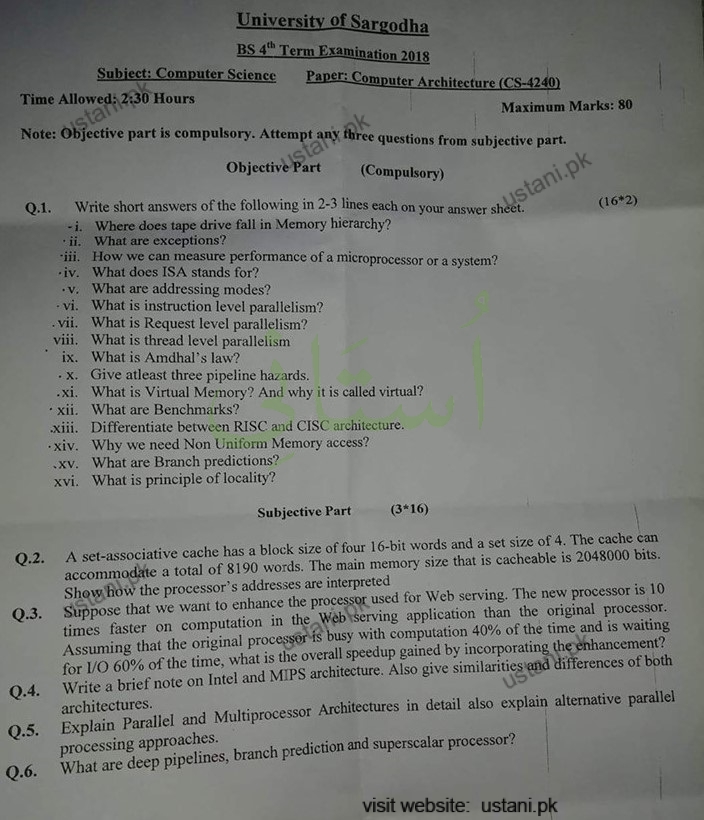 Computer Architecture BSCS 2018 UOS
Uploaded 3 years ago
Download ↓
Computer Architecture BSCS 2018 UOS
Uploaded 3 years ago
Download ↓
 Computer Architecture BSCS 2016 UOS
Uploaded 3 years ago
Download ↓
Computer Architecture BSCS 2016 UOS
Uploaded 3 years ago
Download ↓
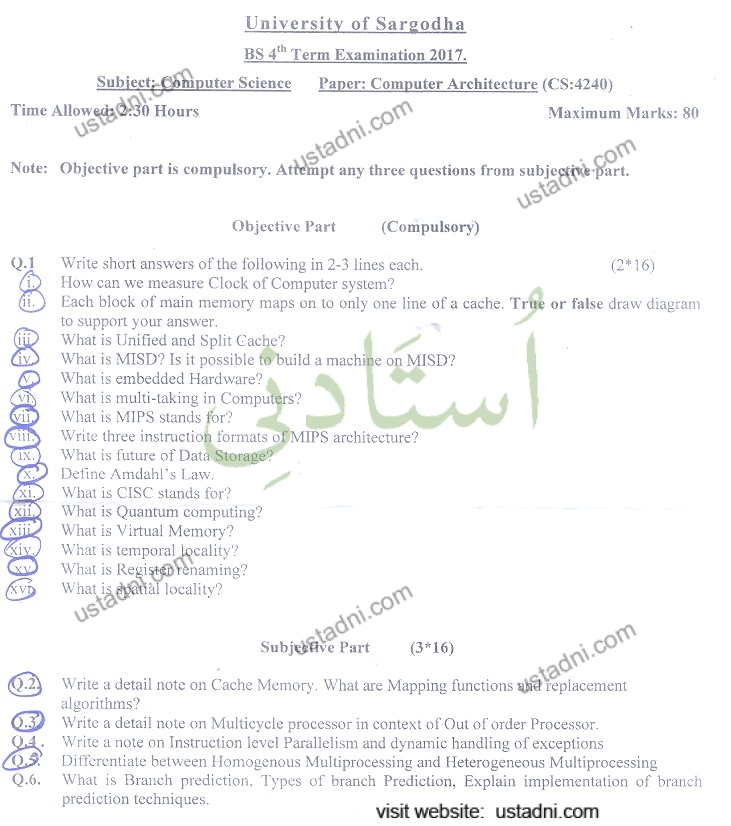 University of Sargodha BS 4** Term Examination 2017. Subject: Computer Science Paper: Computer Architecture (CS:4240) Time Alloweds 2:30 Hours Maximum Marks: 80 (VID
Uploaded 3 years ago
Download ↓
University of Sargodha BS 4** Term Examination 2017. Subject: Computer Science Paper: Computer Architecture (CS:4240) Time Alloweds 2:30 Hours Maximum Marks: 80 (VID
Uploaded 3 years ago
Download ↓
 University of Sargodha BS 4* Term Examination 2017. Subjects Computer Science Paper: Computer Architecture (CS:4240) Time Allowed: 2:30 Hours Maximum Marks: 80 Objective Part
Uploaded 3 years ago
Download ↓
University of Sargodha BS 4* Term Examination 2017. Subjects Computer Science Paper: Computer Architecture (CS:4240) Time Allowed: 2:30 Hours Maximum Marks: 80 Objective Part
Uploaded 3 years ago
Download ↓
 University of Sargodha BS 6t* Term Examination 2015 Subject: Computer Science Paper: Computer Architecture (CS-420) Time Allowed: 2:30 Hours Maximum Marks: 80 0.1
Uploaded 3 years ago
Download ↓
University of Sargodha BS 6t* Term Examination 2015 Subject: Computer Science Paper: Computer Architecture (CS-420) Time Allowed: 2:30 Hours Maximum Marks: 80 0.1
Uploaded 3 years ago
Download ↓
 University of Sargodha BS 4** Term Examination 2015 Subject: Computer Science Paper: Computer Architecture (CS-4240) Time Allowed: 2:30 Hours istadni.co Maximum Marks: 80
Uploaded 3 years ago
Download ↓
University of Sargodha BS 4** Term Examination 2015 Subject: Computer Science Paper: Computer Architecture (CS-4240) Time Allowed: 2:30 Hours istadni.co Maximum Marks: 80
Uploaded 3 years ago
Download ↓
Paper text
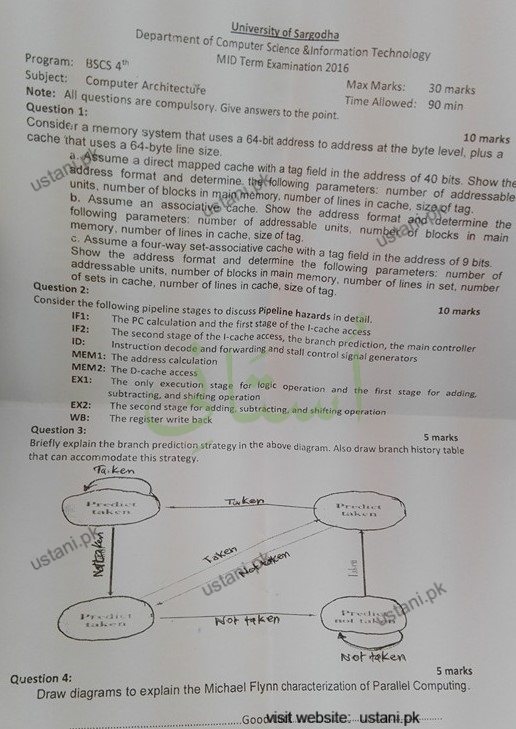
University of Sargodha
Department of Computer Science & Information Technology
MID Term Examination 2016
Program: BSCS 4th
Subject: Computer Architecture
Max Marks: 30 marks
Time Allowed: 90 min
Note: All questions are compulsory. Give answers to the point.
Question 1: 10 marks
Consider a memory system that uses a 64-bit address to address at the byte level, plus a
cache that uses a 64-byte line size.
a. Assume a direct mapped cache with a tag field in the address of 40 bits. Show the
address format and determine the following parameters: number of addressable
units, number of blocks in main memory, number of lines in cache, size of tag.
b. Assume an associative cache. Show the address format and determine the
following parameters: number of addressable units, number of blocks in main
memory, number of lines in cache, size of tag.
c. Assume a four-way set-associative cache with a tag field in the address of 9 bits.
Show the address format and determine the following parameters: number of
addressable units, number of blocks in main memory, number of lines in set, number
of sets in cache, number of lines in cache, size of tag.
Question 2: 10 marks
Consider the following pipeline stages to discuss Pipeline hazards in detail.
IF1: The PC calculation and the first stage of the I-cache access
IF2: The second stage of the I-cache access, the branch prediction, the main controller
ID: Instruction decode and forwarding and stall control signal generators
MEM1: The address calculation
MEM2: The D-cache access
EX1: The only execution stage for logic operation and the first stage for adding,
subtracting, and shifting operation
EX2: The second stage for adding, subtracting, and shifting operation
WB: The register write back
Question 3: 5 marks
Briefly explain the branch prediction strategy in the above diagram. Also draw branch history table
that can accommodate this strategy.
[Diagram of branch prediction state machine]
Question 4: 5 marks
Draw diagrams to explain the Michael Flynn characterization of Parallel Computing.