
Computer Communication and Network BS/MPhil Computer Science/MS Computer Science 3 Semester/Term University Of Sargodha (UOS) 2015
Discussion
Ask a question about this paper, or help someone else with theirs. Answers are emailed to whoever asked.
No questions yet — be the first to ask.
More Computer Communication and Network papers
See all Computer Communication and Network BS 5 Semester/Term University Of Sargodha (UOS) 2015
Uploaded 1 year ago
Download ↓
Computer Communication and Network BS 5 Semester/Term University Of Sargodha (UOS) 2015
Uploaded 1 year ago
Download ↓
 Computer Communication and Network BS/MPhil Computer Science/MS Computer Science 3 Semester/Term University Of Sargodha (UOS) 2023
Uploaded 1 year ago
Download ↓
Computer Communication and Network BS/MPhil Computer Science/MS Computer Science 3 Semester/Term University Of Sargodha (UOS) 2023
Uploaded 1 year ago
Download ↓
 Computer Communication and Network Msc IT University Of Sargodha (UOS) 2019
Uploaded 3 years ago
Download ↓
Computer Communication and Network Msc IT University Of Sargodha (UOS) 2019
Uploaded 3 years ago
Download ↓
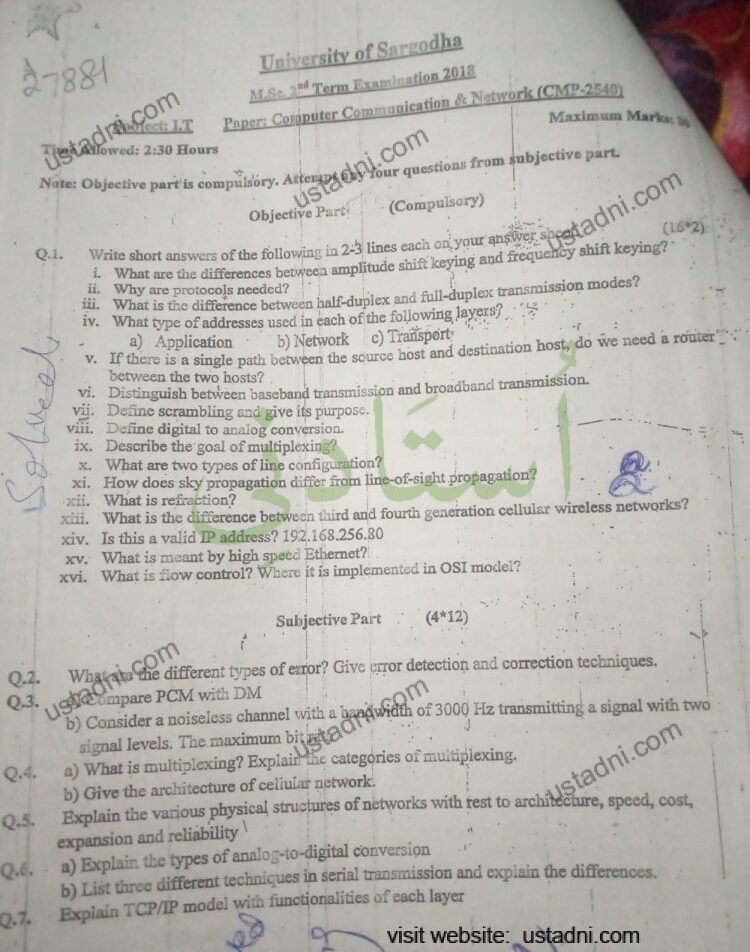 Computer Communication and Network Msc IT University Of Sargodha (UOS) 2018
Uploaded 3 years ago
Download ↓
Computer Communication and Network Msc IT University Of Sargodha (UOS) 2018
Uploaded 3 years ago
Download ↓
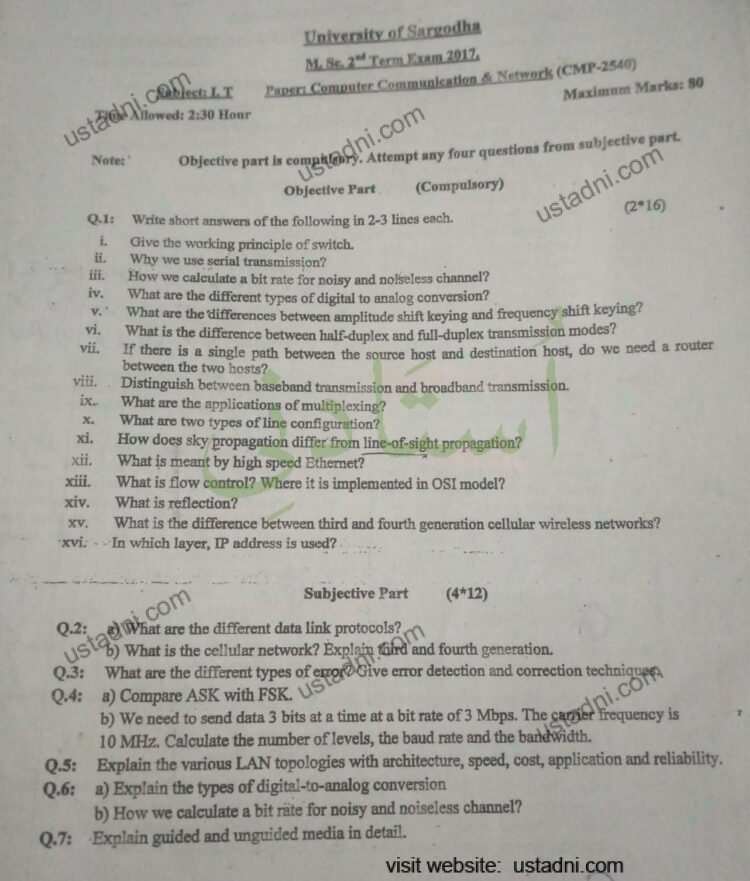 Computer Communication and Network Msc IT 2 Semester/Term University Of Sargodha (UOS) 2017
Uploaded 3 years ago
Download ↓
Computer Communication and Network Msc IT 2 Semester/Term University Of Sargodha (UOS) 2017
Uploaded 3 years ago
Download ↓
Paper text
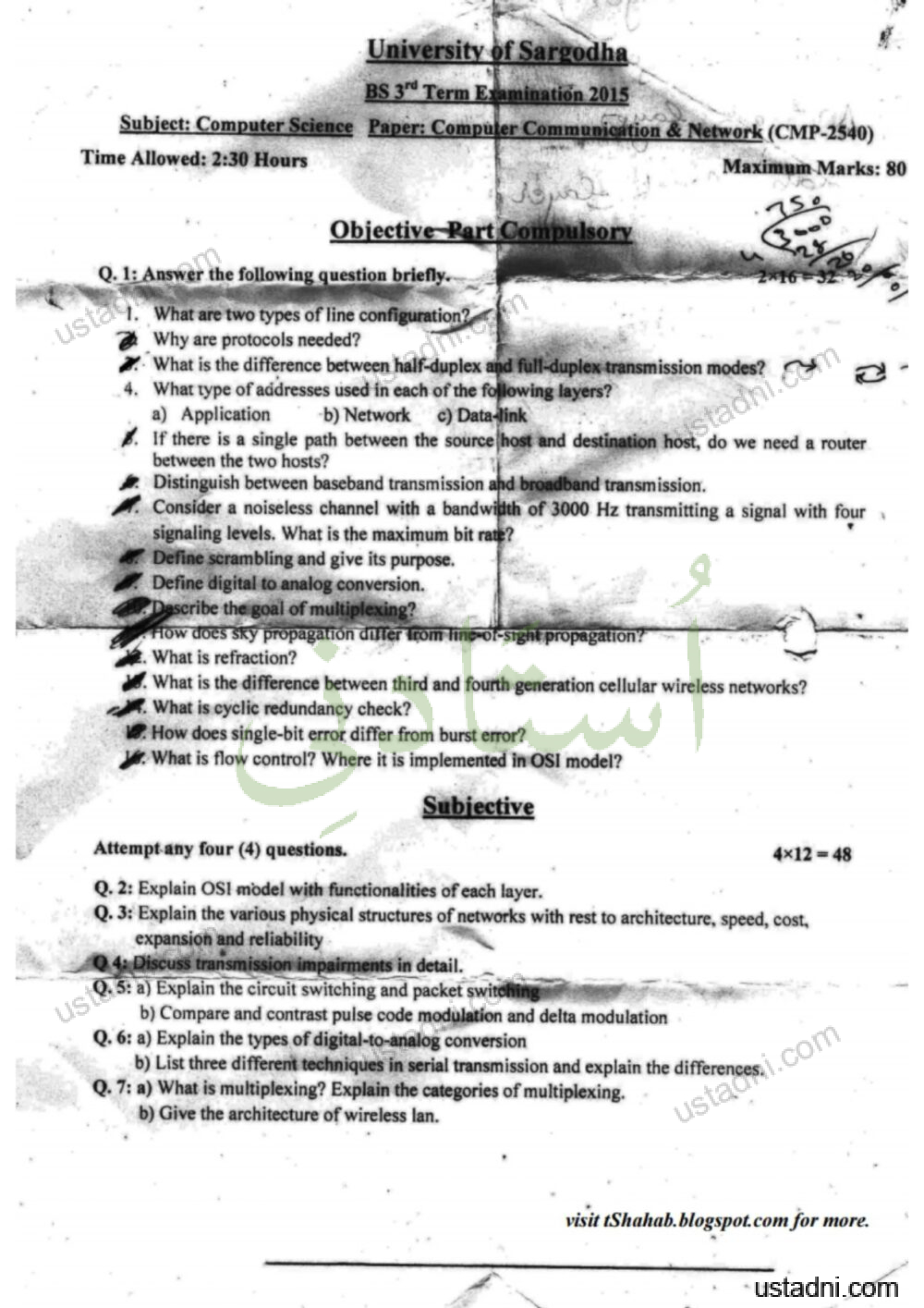
University of Sargodha
BS 3"° Term Es
nation 2015
Subject: Computer Science
Paper: Computer Communication & Network (CMP-2540)
Time Allowed: 2:30 Hours
Maximum Marks: 80
Objective Part Compulsory
Q. 1: Answer the following question briefly.-
2416-321/6,
1. What are two types of line configuration?
Why are protocols needed?
• What is the difference between half-duplex and full-duplex transmission modes?
4. What type of addresses used in each of the following layers?
a) Application
b) Network
c) Data-link
6. If there is a single path between the source host and destination host, do we need a router
between the two hosts?
J. Distinguish between baseband transmission and broadband transmission.
Consider a noiseless channel with a bandwith of 3000 Hz transmitting a signal with four .
signaling levels. What is the maximum bit rate?
Define scrambling and give its purpose.
Define digital to analog conversion.
escribe the goal of multiplexing?
How does sky propagation differ from line ol-sight propagation?
What is refraction?
. What is the difference between third and fourth generation cellular wireless networks?
. What is cyclic redundancy check?
V. How does single-bit error differ from burst error?
Jr. What is flow control? Where it is implemented in OS model?
Subjective
Attempt any four (4) questions.
4×12 = 48
Q. 2: Explain OSI model with functionalities of each layer.
Q. 3: Explain the various physical structures of networks with rest to architecture, speed, cost.
expansion and reliability
• 4: Discuss transmission impairments in detail.
Q.5:
a) Explain the circuit switching and packet switching
b) Compare and contrast pulse code modulation and delta modulation
Q. 6:
a) Explain the types of digital-to-analog conversion
com
b) List three different techniques in serial transmission and explain the differences.
Q. 7:
a) What is multiplexing? Explain the categories of multiplexing.
b) Give the architecture of wireless lan.
visit tShahab.blogspot.com for more.
• ustadni.com