
University of Sargodha BS 3* Term Examination 2016 Subject: 1. I Paper: Computer Communication & Network (CMP-2540) Time Allowed: 2:30 Hours
Discussion
Ask a question about this paper, or help someone else with theirs. Answers are emailed to whoever asked.
No questions yet — be the first to ask.
More Computer Communication and Network papers
See all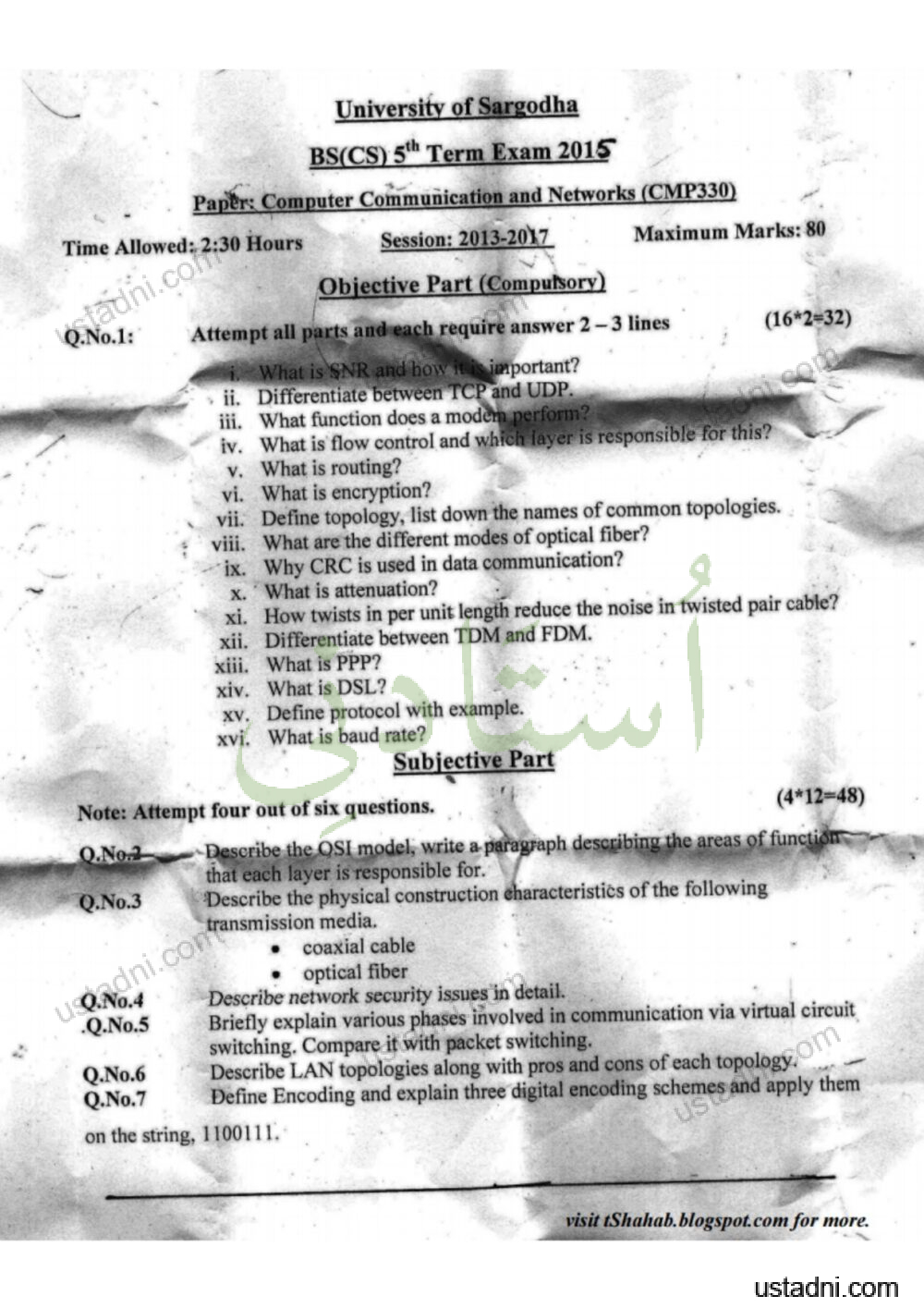 Computer Communication and Network BS 5 Semester/Term University Of Sargodha (UOS) 2015
Uploaded 1 year ago
Download ↓
Computer Communication and Network BS 5 Semester/Term University Of Sargodha (UOS) 2015
Uploaded 1 year ago
Download ↓
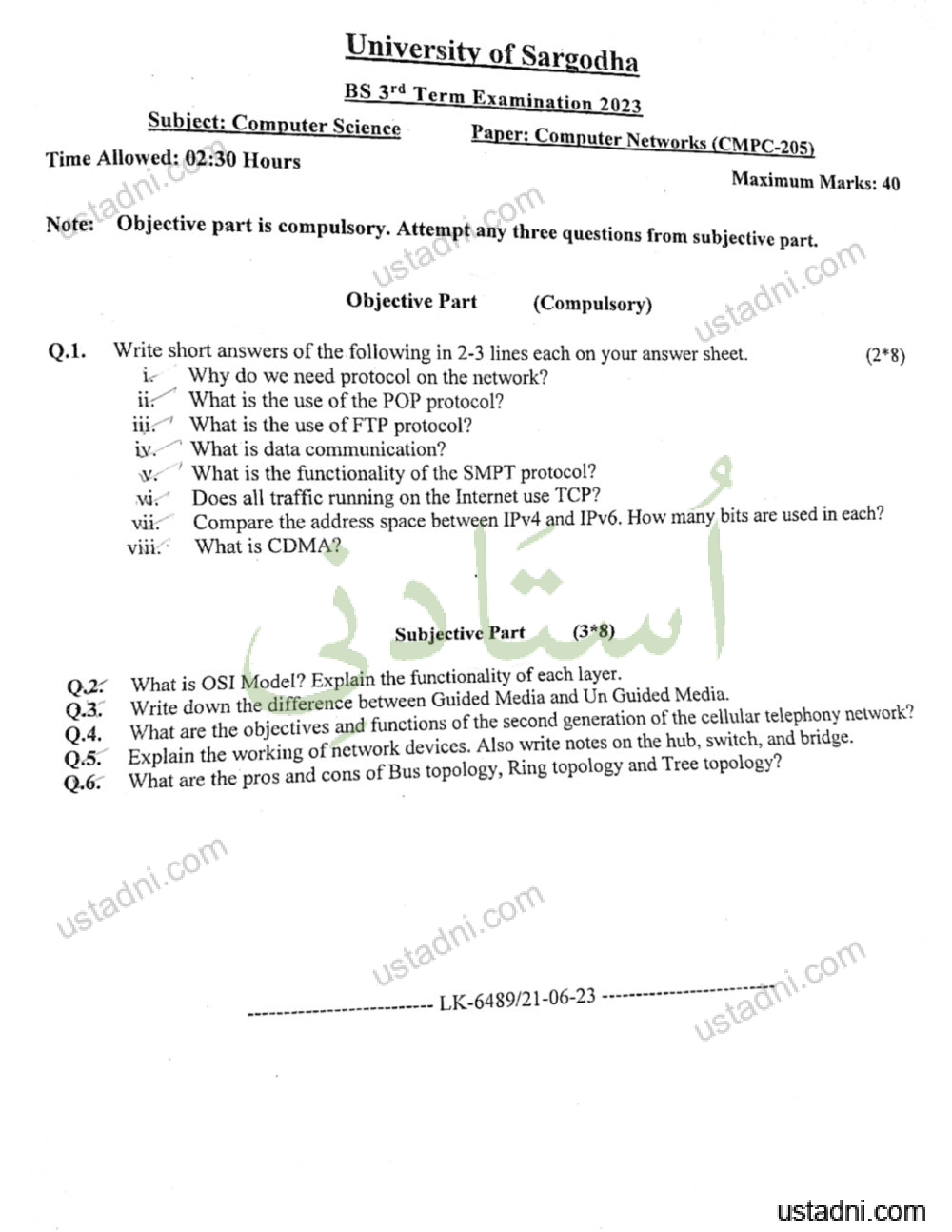 Computer Communication and Network BS/MPhil Computer Science/MS Computer Science 3 Semester/Term University Of Sargodha (UOS) 2023
Uploaded 1 year ago
Download ↓
Computer Communication and Network BS/MPhil Computer Science/MS Computer Science 3 Semester/Term University Of Sargodha (UOS) 2023
Uploaded 1 year ago
Download ↓
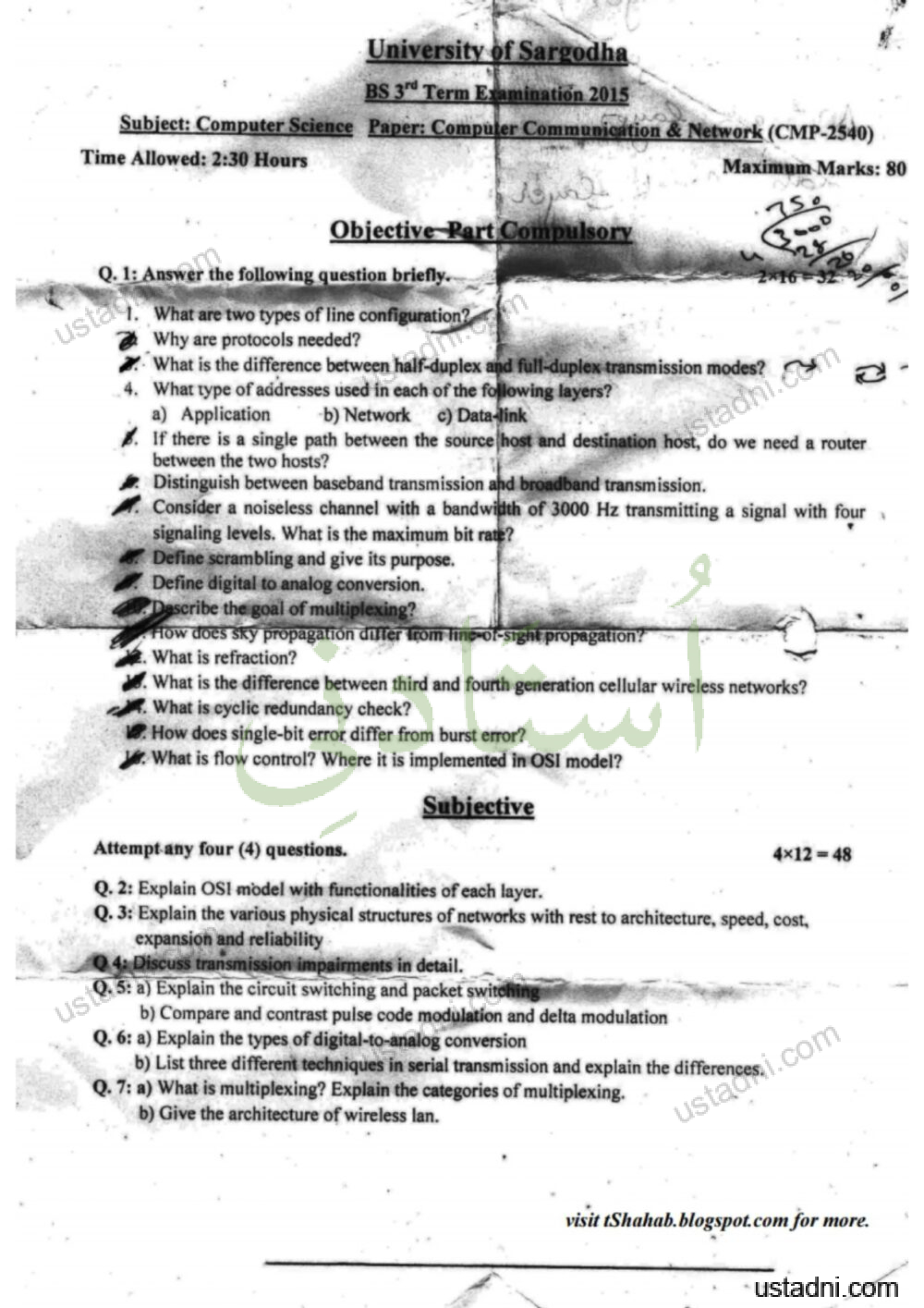 Computer Communication and Network BS/MPhil Computer Science/MS Computer Science 3 Semester/Term University Of Sargodha (UOS) 2015
Uploaded 1 year ago
Download ↓
Computer Communication and Network BS/MPhil Computer Science/MS Computer Science 3 Semester/Term University Of Sargodha (UOS) 2015
Uploaded 1 year ago
Download ↓
 Computer Communication and Network Msc IT University Of Sargodha (UOS) 2019
Uploaded 3 years ago
Download ↓
Computer Communication and Network Msc IT University Of Sargodha (UOS) 2019
Uploaded 3 years ago
Download ↓
 Computer Communication and Network Msc IT University Of Sargodha (UOS) 2018
Uploaded 3 years ago
Download ↓
Computer Communication and Network Msc IT University Of Sargodha (UOS) 2018
Uploaded 3 years ago
Download ↓
Paper text
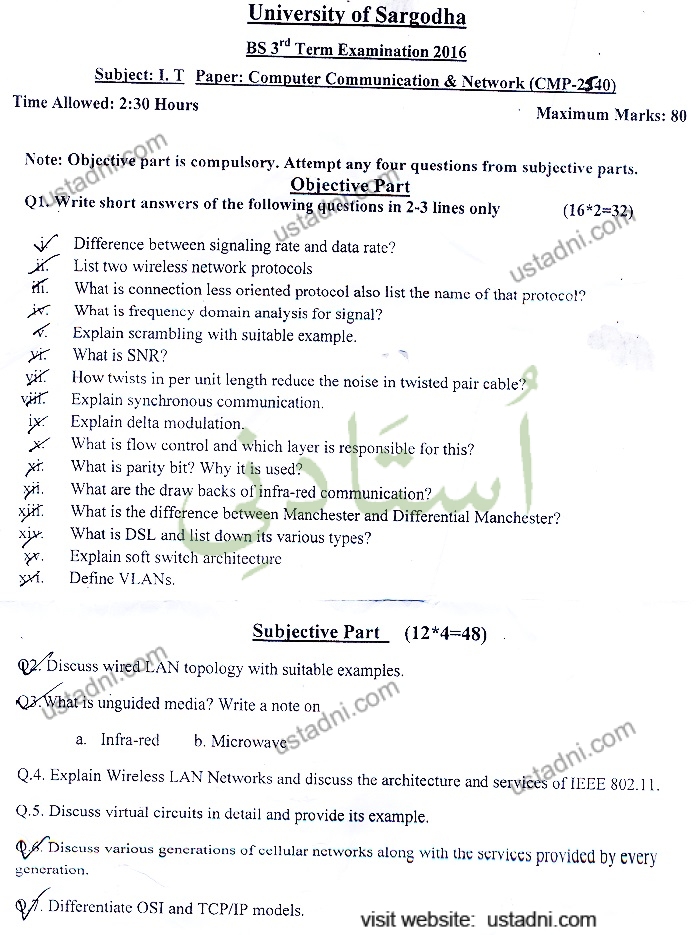
University of Sargodha
BS 3* Term Examination 2016
Subject:
1. I Paper: Computer Communication & Network (CMP-2540)
Time Allowed: 2:30 Hours
Maximum Marks: 80
Note: Objective part is compulsory. Attempt any four questions from subjective parts.
Objective Part
QI. Write short answers of the following questions in 2-3 lines only
(16*2=32)
stadni
Hi.
ух.
viit.
**
yi.
xit.
xiN.
**.
ун1.
Difference between signaling rate and data ratc?
List two wireless network protocols
What is connection less oriented protocol also list the name of that protoce!?
What is frequency domain analysis for signal?
Explain scrambling with suitable example.
What is SNR?
How twists in per unit length reduce the noise in twisted pair cable?
Explain synchronous communication.
Explain delta modulation.
What is flow control and which layer is responsible for this?
What is parity bit? Why it is used?
What are the draw backs of infra-red communication?
What is the difference between Manchester and Differential Manchester?
What is DSL and list down its various types?
Explain soft switch architecture
Define VLANs.
Subjective Part_ (12*4=48)
Q2. Discuss wired LAN topology with suitable examples.
Q3. What is unguided media? Write a note on
dni.com
a. Infra-red b. Microwaves to
dni.com
Q.4. Explain Wireless LAN Networks and discuss the architecture and services of IBEE 802.11.
Q.5. Discuss virtual circuits in detail and provide its example.
Q. Discuss various generations of cellular networks along with the services provided by every
generation.
O. Differentiate OST and TCP/P models.
visit website: ustadni.com