
Advance Operating System/Operating System/Operating Systems AD/BS 1/5 Semester/Term University Of Sargodha (UOS) 2026
Discussion
Ask a question about this paper, or help someone else with theirs. Answers are emailed to whoever asked.
No questions yet — be the first to ask.
More Advance Operating System papers
See all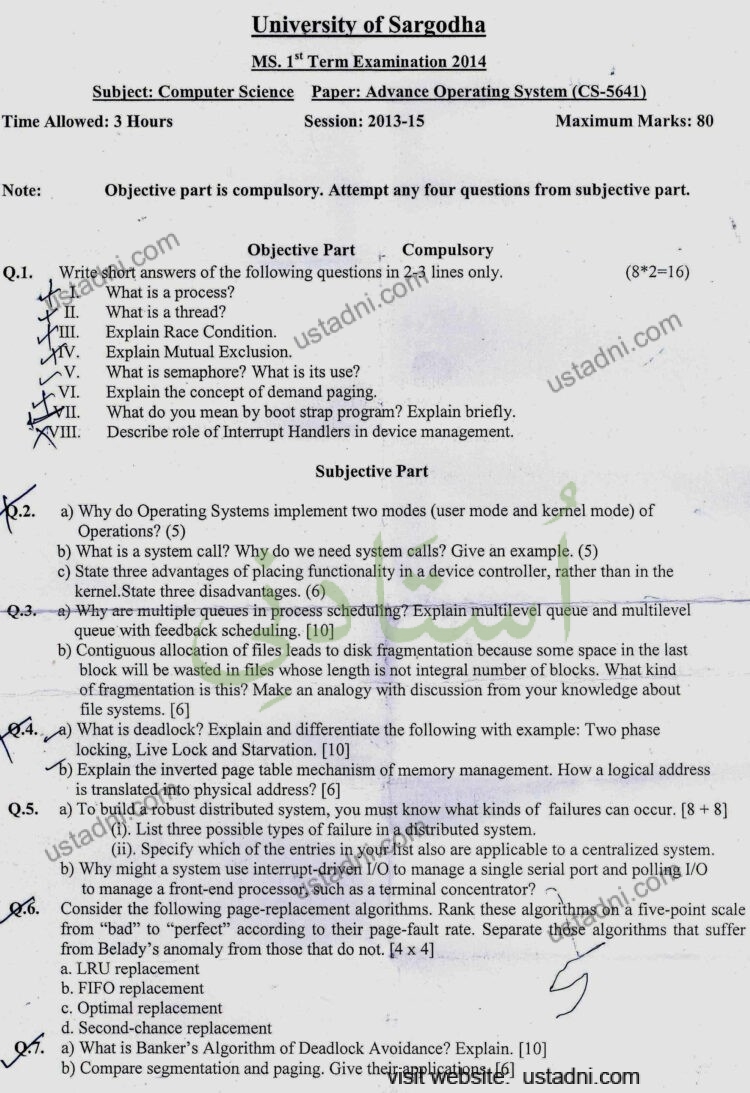 University of Sargodha MS. 1" Term Examination 2014 Subject: Computer Science Paper: Advance Operating System (CS-5641) Time Allowed: 3 Hours
Uploaded 3 years ago
Download ↓
University of Sargodha MS. 1" Term Examination 2014 Subject: Computer Science Paper: Advance Operating System (CS-5641) Time Allowed: 3 Hours
Uploaded 3 years ago
Download ↓
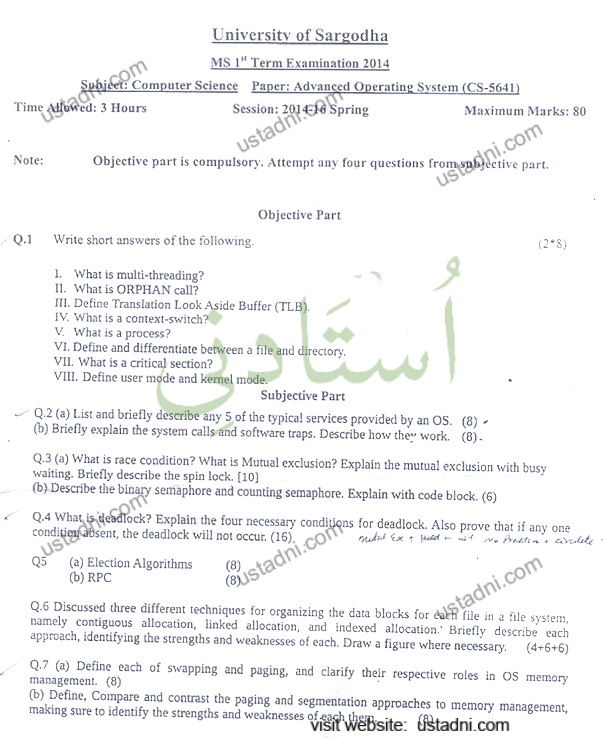 University of Sargodha MS I" Term Examination 2014 Subside: Computer Science Paper: Advanced Operating System (CS-5611) Time Altered: 3 Hours
Uploaded 3 years ago
Download ↓
University of Sargodha MS I" Term Examination 2014 Subside: Computer Science Paper: Advanced Operating System (CS-5611) Time Altered: 3 Hours
Uploaded 3 years ago
Download ↓
Paper text
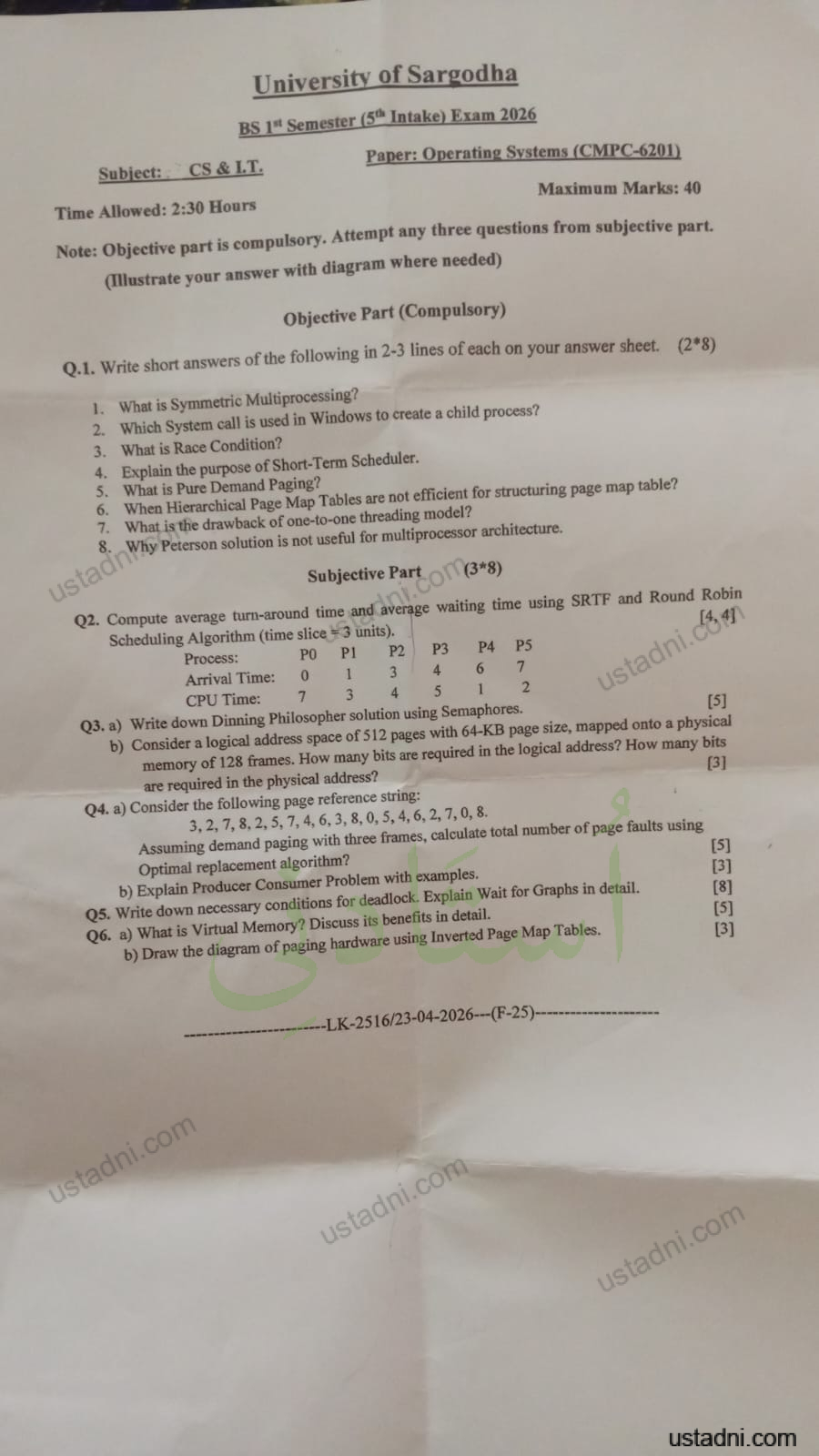
University of Sargodha
BS 1* Semester (5™ Intake) Exam 2026
Subject: CS<. Paper: Operating Systems (CMPC-6201)
Time Allowed: 2:30 Hours Maximum Marks: 40
Note: Objective part is compulsory. Attempt any three questions from subjective part.
(Mlustrate your answer with diagram where needed)
Objective Part (Compulsory)
Q.1. Write short answers of the following in 2-3 lines of each on your answer sheet. (2*8)
1. What is Symmetric Multiprocessing?
2. Which System call is used in Windows to create a child process?
3. What is Race Condition?
4. Explain the purpose of Short-Term Scheduler.
S. What is Pure Demand Paging?
6. When Hierarchical Page Map Tables are not efficient for structuring page map table?
7. What is the drawback of one-to-one threading model?
8. _ Why Peterson solution is not useful for multiprocessor architecture.
Raa Subjective Part (38)
pies
Q2. Compute average turn-around time and average waiting time using SRTF and Round Robin
Scheduling Algorithm (time slice =3 units). | [4,41
Process: PO PI P2' P3 P4 PS AQ Ae
a a 2 » - re
BS 1* Semester (5 Intake) Exam 2026
Subject: CS<. Paper: Operating Svstems (CMPC-6201)
What is Symmetric Multiprocessing?
Which System call is used in Windows to create a child process?
What is Race Condition?
Explain the purpose of Short-Term Scheduler.
What is Pure Demand Paging?
When Hierarchical Page Map Tables are not efficient for structuring page map table?
What is the drawback of one-to-one threading model?
Why Peterson solution is not useful for multiprocessor architecture.
Subjective Part (3*8)
eA
Q2. Compute average turn-around time and waiting time using SRTF and Round Robin
¥ adr ad ot ol ol i 2
Scheduling Algorithm (time slice =3 units), [4,4]
Process: PO PI P2 P3 P4 PS wo
Amival Time: 0 1 3 4 6 7 2x0"
CPUTme: 7 3 4 5 1 2 wot
Q3.
a) Write down Dinning Philosopher solution using Semaphores. (5]
b) Consider a logical address space of 512 pages with 64-KB page size, mapped onto a physical
memory of 128 frames. How many bits are required in the logical address? How many bits
are required in the physical address? 3]
Q4.
a) Consider the following page reference string: :
3,2,7,8,2,5,7,4,6,3,8,0,5,4,6,2,7,0,
8.
Assuming demand paging with three frames, calculate total number of page faults using
Optimal replacement algorithm? [51
b) Explain Producer Consumer Problem with examples. 3]
QS. Write down necessary conditions for deadlock. Explain Wait for Graphs in detail. (8)
Q6.
a) What is Virtual Memory? Discuss its benefits in detail. (5)
b) Draw the diagram of paging hardware using Inverted Page Map Tables. 13]
LK-2516/23-04-2026--(F-25) emma ___
io
11etadni rere