
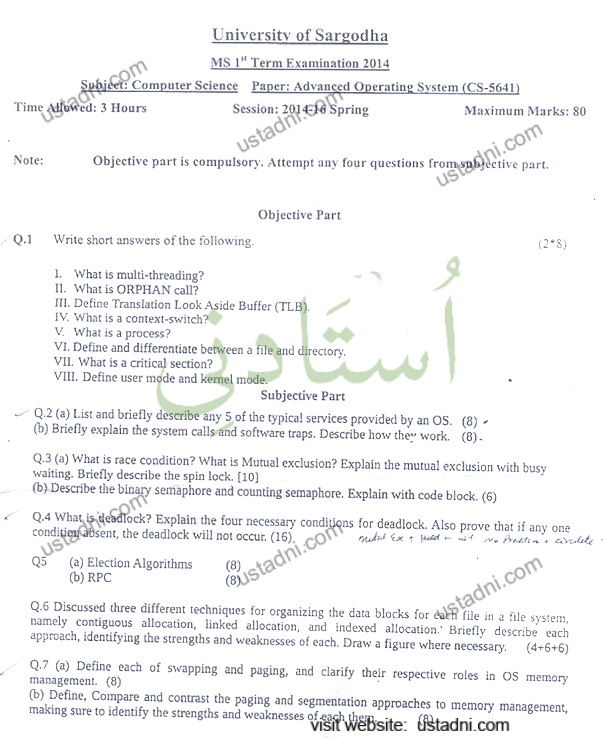
University of Sargodha MS I" Term Examination 2014 Subside: Computer Science Paper: Advanced Operating System (CS-5611) Time Altered: 3 Hours
Discussion
Ask a question about this paper, or help someone else with theirs. Answers are emailed to whoever asked.
No questions yet — be the first to ask.
More Advance Operating System papers
See all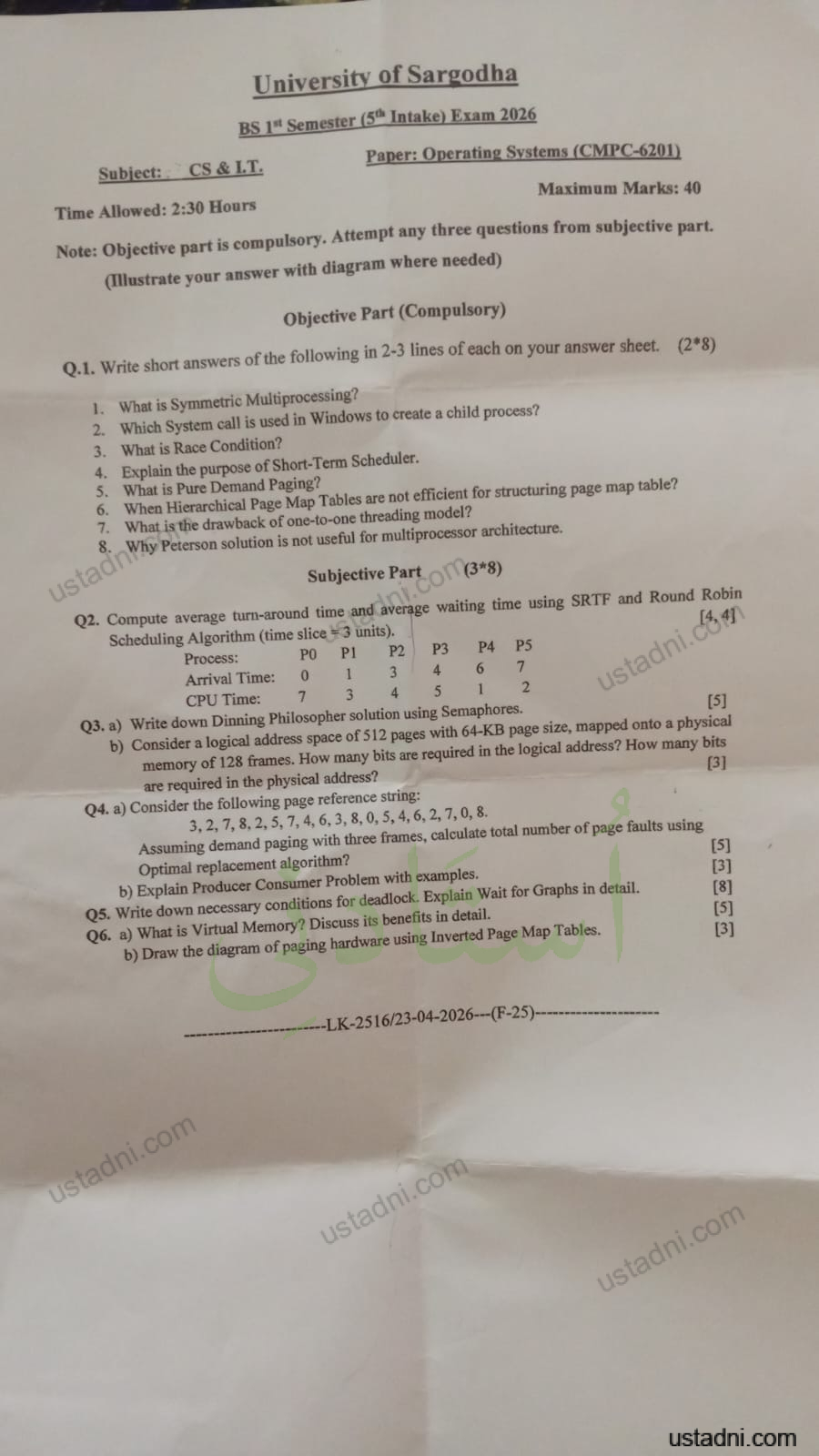 Advance Operating System/Operating System/Operating Systems AD/BS 1/5 Semester/Term University Of Sargodha (UOS) 2026
Uploaded 3 months ago
Download ↓
Advance Operating System/Operating System/Operating Systems AD/BS 1/5 Semester/Term University Of Sargodha (UOS) 2026
Uploaded 3 months ago
Download ↓
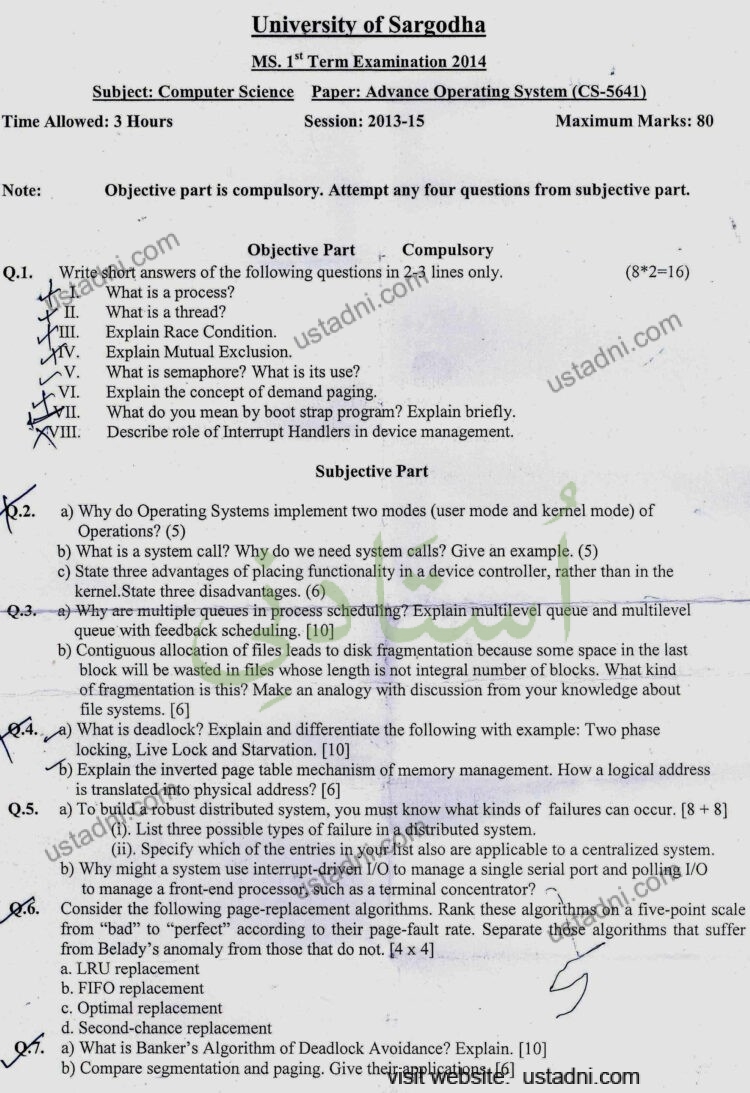 University of Sargodha MS. 1" Term Examination 2014 Subject: Computer Science Paper: Advance Operating System (CS-5641) Time Allowed: 3 Hours
Uploaded 3 years ago
Download ↓
University of Sargodha MS. 1" Term Examination 2014 Subject: Computer Science Paper: Advance Operating System (CS-5641) Time Allowed: 3 Hours
Uploaded 3 years ago
Download ↓
Paper text
University of Sargodha
MS I" Term Examination 2014
Subside: Computer Science Paper: Advanced Operating System (CS-5611)
Time Altered: 3 Hours
Session: 2014616 Spring
ustadni.
Maximum Marks: 80
Note:
Objective part is compulsory, Attempt any four questions fromsubjective part.
Objective Part
Q.1 Write short answers of the following.
1. What is multi-threading?
Il. What is ORPHAN call?
I!!. Define Translation Look Aside Buffer (TLB). /
IV. What is a context-switch?
V. What is a process?
VI. Define and differentiate between a file and directory.
VIl. What is a critical section?
VIII. Define user mode and kemel mode.
Subjective Part
Q.2
(a) List and briefly describe any 5 of the typical services provided by an OS. (8) -
(b) Briefly explain the system calls and software traps. Describe how the work. (8) -
Q.3
(a) What is race condition? What is Mutual exclusion? Explain the mutual exclusion with busy
waiting. Briefly describe the spin lock. (10]
(b) Describe the binary semaphore and counting semaphore. Explain with code block. (6)
(2*8)
(a) Election Algorithms
namely contiguous allocation, linked allocation, and indexed allocation. Briefly describe each
approach, identifying the strengths and weaknesses of each. Draw a figure where necessary. (4+6+6)
Q.7
(a) Define each of swapping and paging, and clarify their respective roles in OS memory
management. (8)
(b) Define, Compare and contrast the paging and segmentation approaches to memory management,
making sure to identify the strengths and weaknesses of iSit Website: stadni.com