
University of Sargodha MS. 1" Term Examination 2014 Subject: Computer Science Paper: Advance Operating System (CS-5641) Time Allowed: 3 Hours
Discussion
Ask a question about this paper, or help someone else with theirs. Answers are emailed to whoever asked.
No questions yet — be the first to ask.
More Advance Operating System papers
See all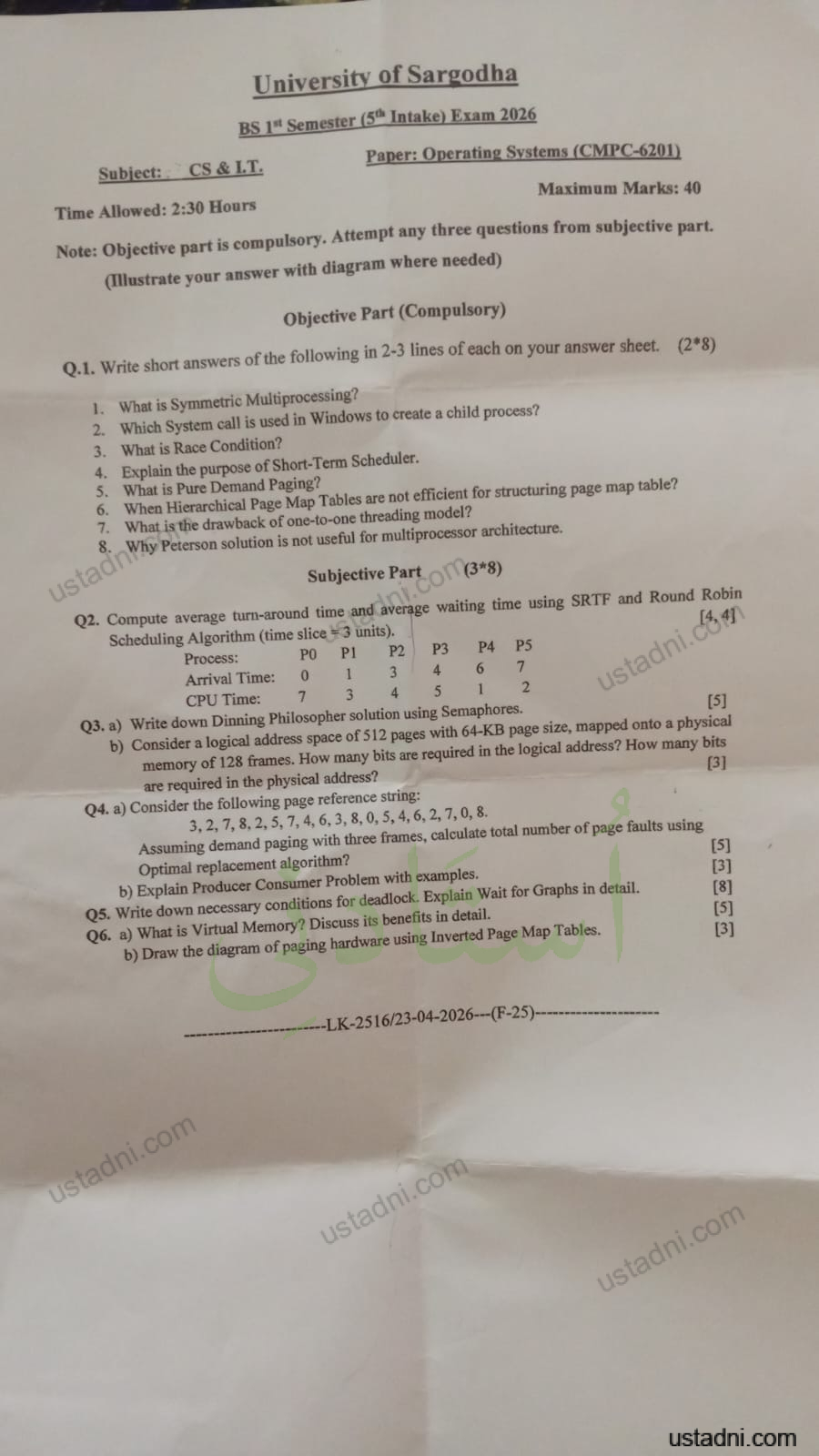 Advance Operating System/Operating System/Operating Systems AD/BS 1/5 Semester/Term University Of Sargodha (UOS) 2026
Uploaded 3 months ago
Download ↓
Advance Operating System/Operating System/Operating Systems AD/BS 1/5 Semester/Term University Of Sargodha (UOS) 2026
Uploaded 3 months ago
Download ↓
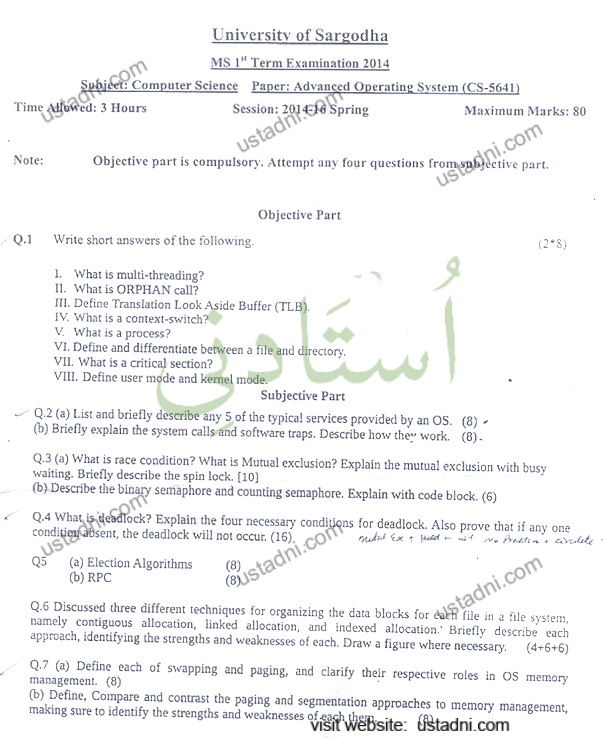 University of Sargodha MS I" Term Examination 2014 Subside: Computer Science Paper: Advanced Operating System (CS-5611) Time Altered: 3 Hours
Uploaded 3 years ago
Download ↓
University of Sargodha MS I" Term Examination 2014 Subside: Computer Science Paper: Advanced Operating System (CS-5611) Time Altered: 3 Hours
Uploaded 3 years ago
Download ↓
Paper text
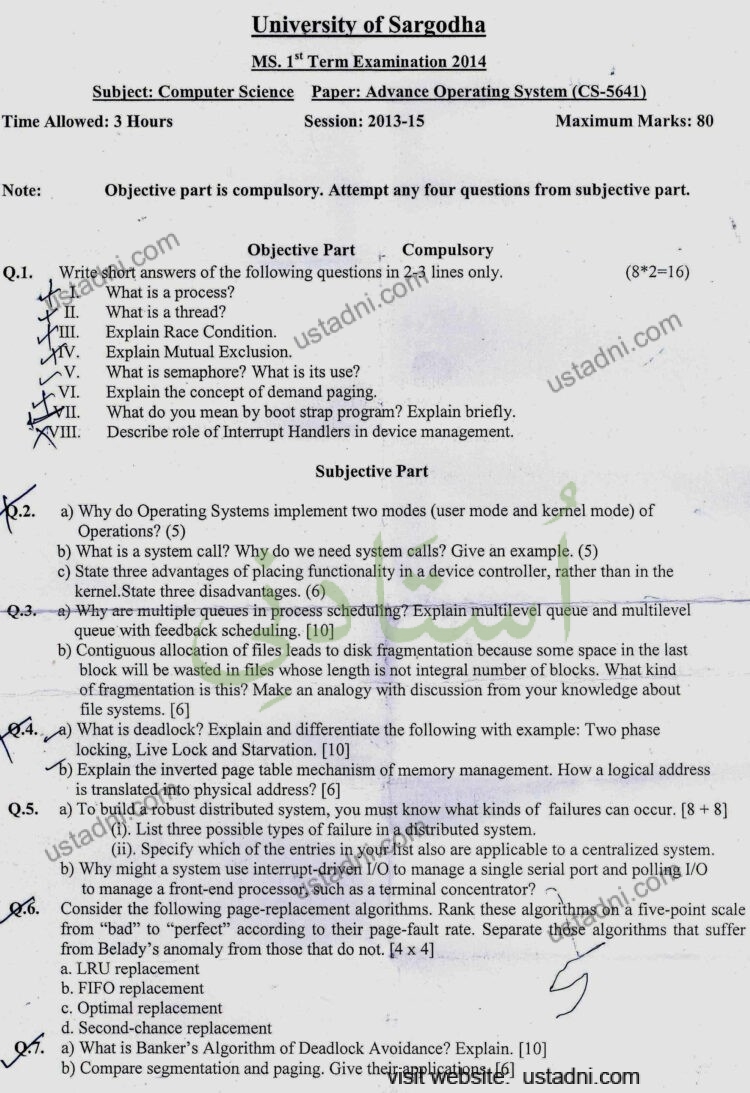
University of Sargodha
MS. 1" Term Examination 2014
Subject: Computer Science Paper: Advance Operating System (CS-5641)
Time Allowed: 3 Hours
Session: 2013-15
Maximum Marks: 80
Note:
Objective part is compulsory. Attempt any four questions from subjective part.
Q.1.
Objective Part
- Compulsory
Write short answers of the following questions in 2-3 lines only.
What is a process?
II.
What is a thread?
Explain Race Condition.
Explain Mutual Exclusion.
ustadni.col
What is semaphore? What is its use?
VI.
II.
HI.
Explain the concept of demand paging.
What do you mean by boot strap program? Explain briefly.
Describe role of Interrupt Handlers in device management.
(8*2=16)
ustadni.com
Subjective Part
a) Why do Operating Systems implement two modes (user mode and kernel mode) of
Operations? (5)
b) What is a system call? Why do we need system calls? Give an example. (5)
c) State three advantages of placing functionality in a device controller, rather than in the
Q.3.
kernel. State three disadvantages. (6)
a) Why are multiple queues in process scheduling? Explain multilevel queue and multilevel
queue with feedback scheduling. [10]
b) Contiguous allocation of files leads to disk fragmentation because some space in the last
block will be wasted in files whose length is not integral number of blocks. What kind
of fragmentation is this? Make an analogy with discussion from your knowledge about
file systems. [6]
1) What is deadlock? Explain and differentiate the following with example: Two phase
locking, Live Lock and Starvation. [10]
b) Explain the inverted page table mechanism of memory management. How a logical address
is translated into physical address? [6]
0.5.
a) To build a robust distributed system, you must know what kinds of failures can occur. [8 + 8]
UStaO
(i). List three possible types of failure in a distributed system.
(it). Specify which of the entries in your list also are applicable to a centralized system.
b) Why might a system use interrupt-drien I/O to manage a single serial port and polling 1/0
д.6.
to manage a front-end processor, such as a terminal concentrator? -
Consider the following page-replacement algorithms. Rank these algorithms on a five-point scale
from "bad" to "perfect" according to their page-fault rate. Separate those algorithms that suffer
from Belady's anomaly from those that do not. [4 x 4]
a. LRU replacement
b. FIFO replacement
c. Optimal replacement
d. Second-chance replacement
a) What is Banker's Algorithm of Deadlock Avoidance? Explain. [10]
b) Compare segmentation and paging. Give theish? feissite ustadni.com